
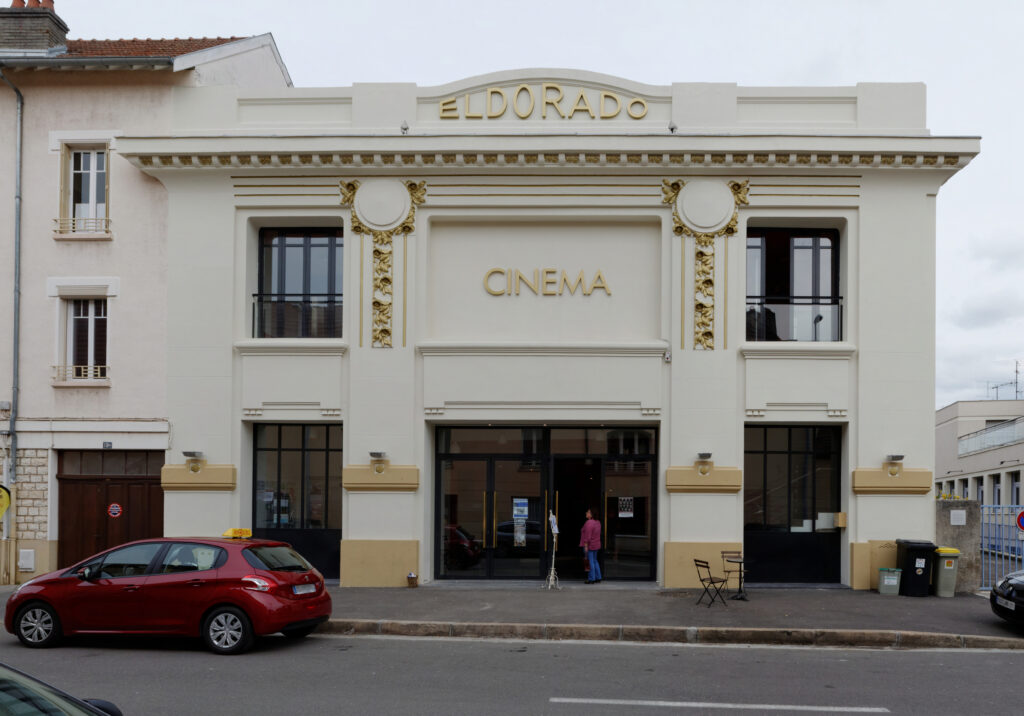

Built on the ruins of a workers’ dance hall in 1919, it has been showing films for over a century, and the state protects the front of it.
At a glance
The Eldorado stands on rue Alfred-de-Musset in the Faubourg Saint-Martin quarter of Dijon. The building permit was granted on 17 October 1919 and the cinema opened in July 1920, on the site of a ruined dance hall that had served the workers of the district. Its Art Deco front borrows from classical architecture — the projecting tables with drop ornaments are the detail usually cited — and it was inscribed on the French register of historic monuments by decree of 20 August 1986. It is still an independent art-house cinema, with three screens and 408 seats, and reopened after restoration in 2012.
Key facts
- Building permit: 17 October 1919
- Opened: July 1920
- Site: the ruins of a former dance hall used by workers of the quarter
- Style: Art Deco facade with classical borrowings
- Protected: facade inscribed as a monument historique, decree of 20 August 1986 (PA00112260)
- Capacity: three screens, 408 seats — 230, 130 and 48
- Restored and reopened: 2012
- GPS: 47.314428, 5.049048 — View on Google Maps
History
The permit was granted in October 1919, eleven months after the armistice, and the cinema opened the following July. That timing is the whole story of the building type: French towns built picture houses in the first years after the First World War at a rate they had never managed before, because the audience and the technology had both arrived at once.
The site had held a dance hall, frequented by people working nearby, and by 1919 it was in ruins. Building the cinema on it kept the same clientele and the same function — a large room in a working district where people went in the evening — and changed only what happened at the front of it.
The facade was inscribed on the register of historic monuments in August 1986, which protects the front while leaving the interior free to change, as cinema interiors must. Alain Cramier ran the house until January 2008, when Matthias Chouquer took over; a restoration was completed and the cinema reopened in 2012. It remains an independent art et essai house.
What you see
A flat, upright Art Deco front, symmetrical, with the strong vertical emphasis that interwar cinemas used to make a doorway look like an occasion. The classical borrowings are the part worth pausing over: the projecting tables with their drop ornaments belong to an older grammar, applied to a building type that had existed for barely twenty years. In 1919 nobody had yet decided what a cinema should look like, and this facade is one of the answers.
Inside, the main auditorium retains its balcony. The three-screen arrangement is a later adaptation, as it is almost everywhere; the protection covers the front, which is the part that had to survive for the building to remain legible from the street.
Practical information
- A working art-house cinema — the way to see it is to buy a ticket
- The facade is visible from the street at any hour and is the listed part
- Programme and times on the cinema’s own site; it takes part in the French heritage open days in September
Getting there
Rue Alfred-de-Musset is in the Faubourg Saint-Martin, about fifteen minutes on foot east of Dijon’s historic centre and twenty from Dijon-Ville station. Trams and buses serve the quarter.
Nearby
- Bouillon Chartier — in Paris, the same decades’ architecture of everyday life
- Petit Palais — the Belle Époque public building, for comparison
Sources
- Wikipedia (French), « Cinéma Eldorado » — the permit of 17 October 1919, the opening in July 1920, the former dance hall, the Art Deco facade and its classical borrowings, the inscription of 20 August 1986, the capacity and the change of management in 2008
- Monumentum and the French heritage database, notice PA00112260 — protected status of the facade
- CNC (Centre national du cinéma), article on the Eldorado — from dance hall to art-house cinema
- OpenStreetMap Nominatim — coordinates verified against rue Alfred-de-Musset 21
Find it on the map
See this place and what’s around it →📷 Become a Cultural Heritage Online photographer
Share your photos of places: they stay published under your name as the author. The more they're seen, the more you get noticed — and soon a contest will reward the most appreciated photos.
Log in or sign up free to add a photoIs this page about you?
This page is read by travellers and heritage enthusiasts who find it on Google. Tell us how you are connected to this place and we will take it from there.