
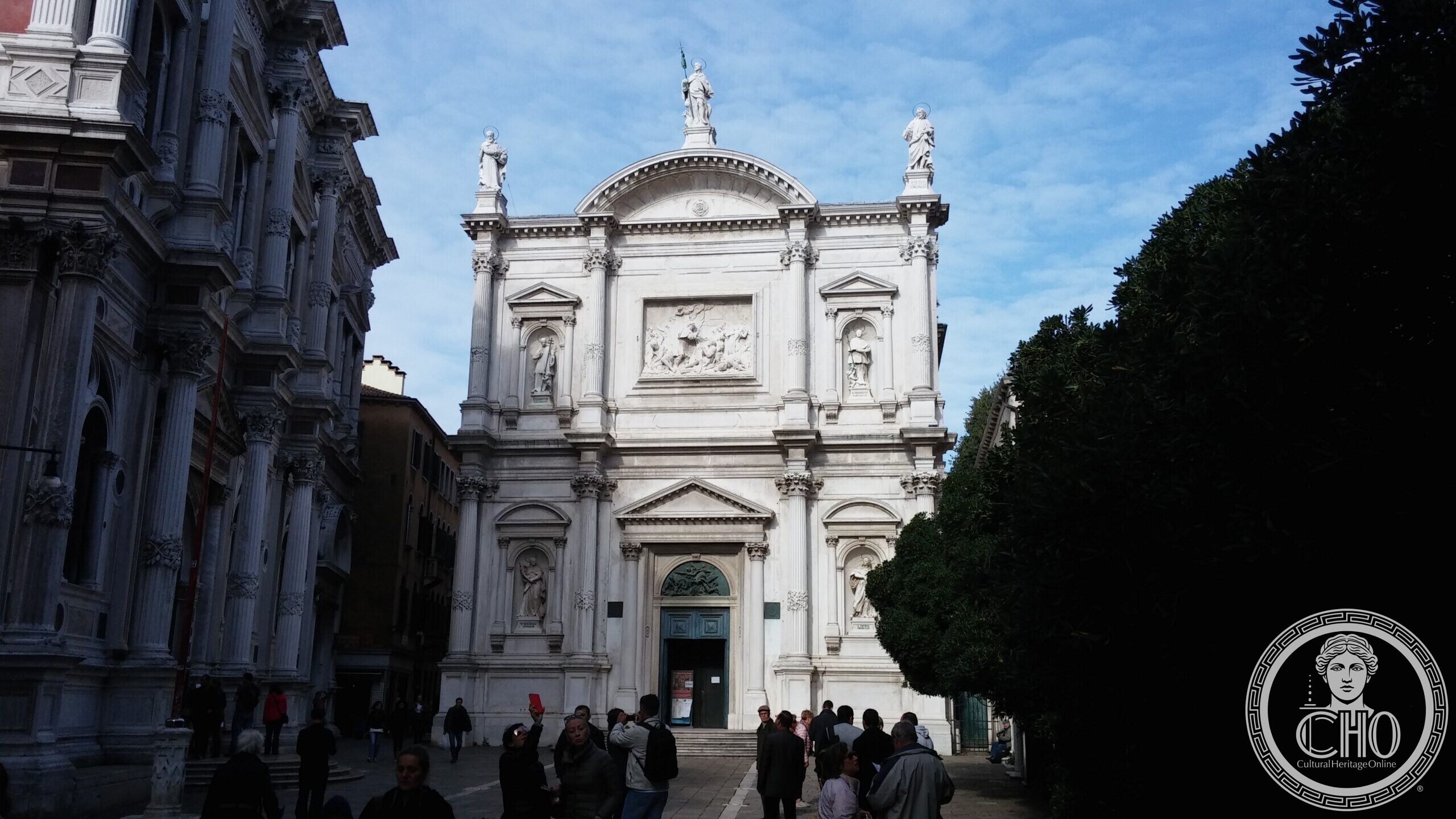
A church put up in five years by the confraternity next door to hold the body of a plague saint, rebuilt inside in the eighteenth century, and given a front designed to be read alongside the Scuola’s.
At a glance
Almost everyone who comes to this campo comes for the Scuola Grande di San Rocco and its Tintorettos, and walks past the church without going in. The church came first. The confraternity decided to build it in 1489 and opened it in 1494 — five years, which for Venice is a sprint — because it needed somewhere to keep the relics of Saint Roch, the saint invoked against plague. Inside are four large Tintorettos of the saint. The front you see is two and a half centuries younger than the building behind it.
Key facts
- Decided: 1489, by the Scuola Grande di San Rocco
- Opened: 1494; the dome completed in 1507
- Interior rebuilding: 1726–1732, by Giovanni Scalfarotto, who replaced the flat ceiling with a vault cut by large thermal windows
- Facade: Bernardino Maccaruzzi, 1765–1769, after a competition, in two levels echoing the Scuola Grande alongside
- Relics: the body of Saint Roch, in a reliquary-sarcophagus in the main chapel
- Tintoretto: four canvases of the saint — healing plague victims, comforted by an angel in prison, healing animals, and struck by plague
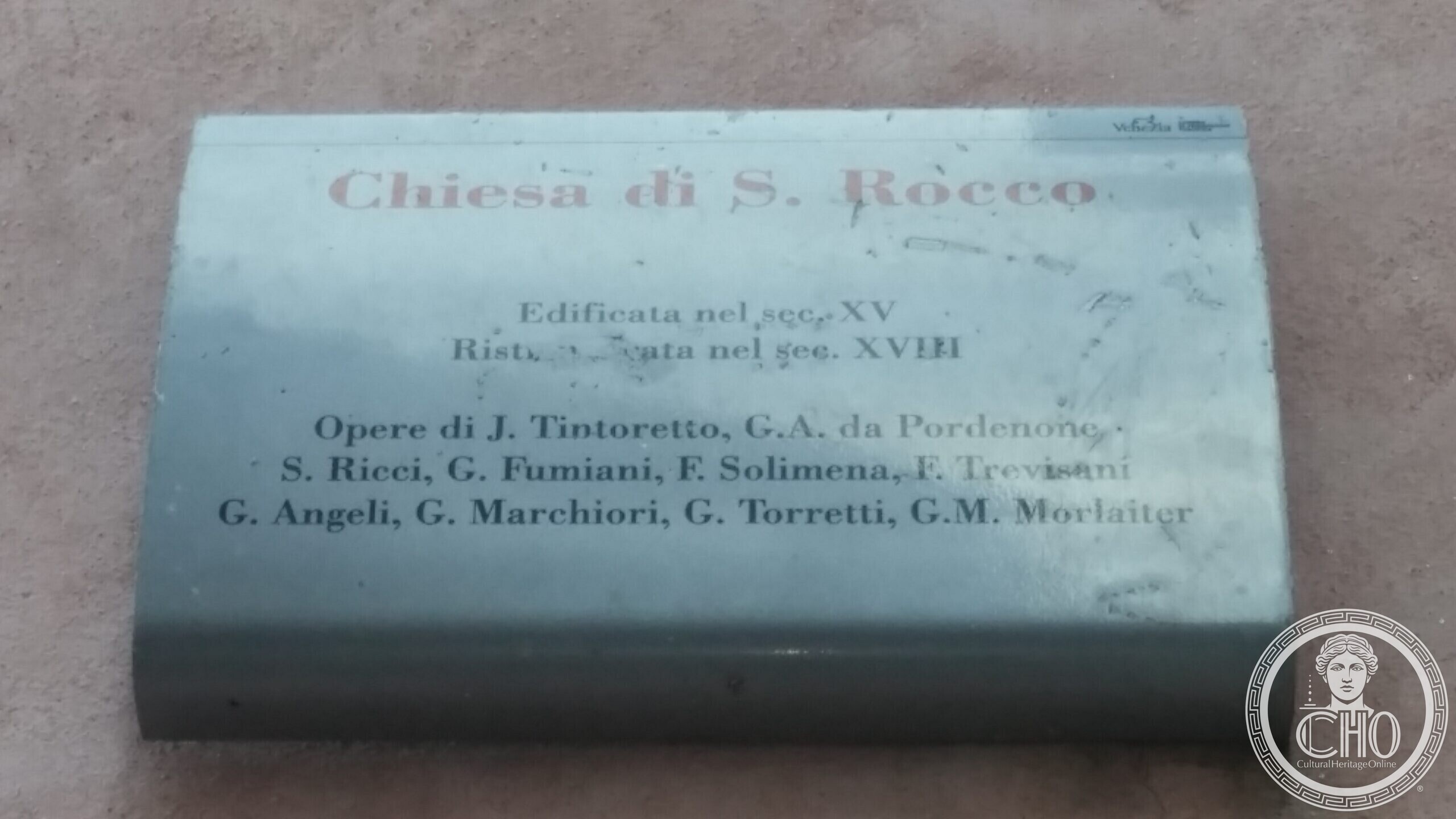
- Other artists, per the city plaque: Pordenone, Sebastiano Ricci, Fumiani, Solimena, Trevisani, Angeli, Marchiori, Torretti, Morlaiter
- GPS: 45.43693, 12.32534 · Open in Google Maps
History
Saint Roch was the saint Venice turned to when plague came, and a confraternity founded in his name became, within a few decades, one of the richest institutions in the city. In 1489 the Scuola Grande di San Rocco resolved to build a church beside its own hall. Work went fast: the building was inaugurated in 1494, with the dome finished by 1507. The reason for the speed was the relic. The confraternity held the body of the saint, and a body of that importance needed a church, not a room.
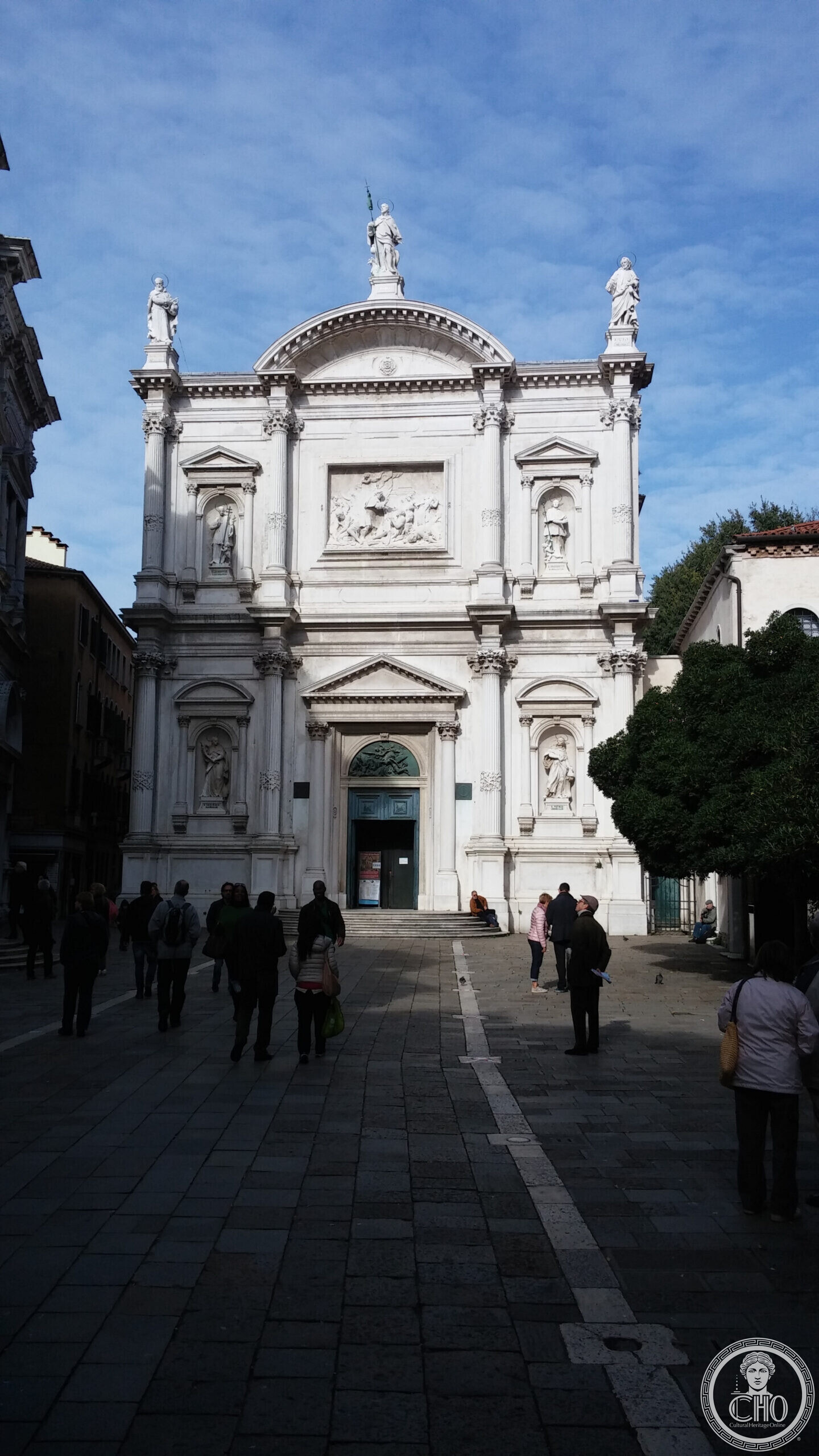
Two later campaigns changed what visitors see. Between 1726 and 1732 Giovanni Scalfarotto restructured the interior, taking out the flat ceiling and vaulting the nave, with large thermal windows cutting into the vault to bring light down onto the paintings. Then, between 1765 and 1769, Bernardino Maccaruzzi won a competition for a new front and built the one that stands: two levels of engaged columns, statues along the cornice and above the pediment, and a relief set into the upper wall.
Maccaruzzi’s design was not made in isolation. The Scuola Grande’s own facade, by Bon and Scarpagnino, faces the same small campo at right angles, and the church’s front was composed to be seen with it — the same two-storey rhythm, the same white stone, at a smaller scale. What the campo offers is not one building but a pair, built almost three hundred years apart and meant to be read together.
What you see
A white front in two tiers. Below, paired columns flank a pedimented doorway and two niches holding statues; above, a second order carries a large relief in the centre and two more niches, with a curved pediment over it all. Three further statues stand free against the sky, one on each corner and one on the apex. The carving is crisp and the whole surface is pale — this is stone kept clean, not a Venetian wall left to weather.
Turn slightly left and the Scuola Grande fills the side of the campo with a heavier, older version of the same idea: columns, niches, coloured marble. The two buildings crowd a space barely wide enough to stand back in, which is why most photographs of San Rocco are taken from the far corner, past the tree. On the church wall, a city plaque gives the dates and the roll of artists whose work is inside.
Practical information
- An active church, generally open in the mornings; entry is free
- The Scuola Grande next door is a separate visit with its own ticket, and holds the Tintoretto cycle
- The campo is small and busy at the middle of the day; early morning is better
- Twenty minutes for the church; two hours if the Scuola is included
Getting there
Campo San Rocco is immediately behind the Frari, three minutes’ walk from the San Tomà vaporetto stop and about fifteen from the railway station.
Nearby
- The Scuola Grande di San Rocco, on the same campo
- The Basilica of Santa Maria Gloriosa dei Frari, one minute east
- The State Archive in the former Frari convent, two minutes east
Sources
- Wikipedia (Italian), Chiesa di San Rocco (Venezia): the decision of the Scuola Grande in 1489, the inauguration in 1494 and the dome completed in 1507, the restructuring of 1726–1732 by Giovanni Scalfarotto with the vault and thermal windows, the facade won in competition by Bernardino Maccaruzzi and built 1765–1769 in echo of the Scuola’s front, the reliquary-sarcophagus of Saint Roch in the main chapel, and the four Tintoretto canvases of the saint
- The city plaque on the church, photographed and transcribed here: built in the fifteenth century, restructured in the eighteenth, and the list of artists
- Coordinates from the position supplied by the photographer and cross-checked against OpenStreetMap
Photo gallery
Photographs contributed by a Cultural Heritage Online member.
Find it on the map
See this place and what’s around it →Record researched and written by Carla Szathvary for Cultural Heritage Online, 2026.
📷 Become a Cultural Heritage Online photographer
Share your photos of places: they stay published under your name as the author. The more they're seen, the more you get noticed — and soon a contest will reward the most appreciated photos.
Log in or sign up free to add a photoIs this page about you?
This page is read by travellers and heritage enthusiasts who find it on Google. Tell us how you are connected to this place and we will take it from there.