
The first new crossing of the Grand Canal in seventy-five years: a shallow steel arch that came in at nearly twice its budget, injured people on its glass steps, and carried a lift for wheelchairs that never worked.
At a glance
Venice has four bridges over the Grand Canal. This is the newest, and the only one built in living memory: Santiago Calatrava’s design, begun in 2002 and opened on 11 September 2008, joining Piazzale Roma to the railway station across ninety-four metres of steel and glass. It is a fine piece of engineering and an unusually well-documented failure of procurement. The final bill was €11.3 million against a budget of €6.7 million, plus €1.8 million for an accessibility cabin that never worked and was taken away in 2020; and in 2019 the Court of Auditors ordered the architect to pay €78,000 for what it called macroscopic negligence.
Key facts
- Architect: Santiago Calatrava (born 1951)
- Built: 2002–2008; opened 11 September 2008
- Span: 94 metres overall, 80.8 metres between supports; width 5.58 to 9.38 metres; height 9.28 metres
- Materials: steel arch, glass deck and parapets, with steps originally in glass
- Budget and final cost: €6.7 million estimated; €11.3 million built, plus €1.8 million for the accessibility system
- Court of Auditors: found €3.467 million of cost inflation; in August 2019 ordered Calatrava to pay €78,000
- The cabin: a motorised pod on rails for wheelchair users; never worked properly; removed permanently on 22 May 2020
- The steps: glass treads proved slippery when wet and broke easily; replaced with trachyte at roughly €4,500 a step
- GPS: 45.43881, 12.31941 · Open in Google Maps
History
Before 2008 the last bridge built over the Grand Canal was the Ponte dell’Accademia, put up as a temporary structure in 1933. The gap between Piazzale Roma, where cars and coaches stop, and Santa Lucia station, where trains arrive, had to be crossed by water or by a long walk. Calatrava was commissioned in the late 1990s, construction began in 2002, and the bridge opened on 11 September 2008 — without a ceremony, after years of argument about its cost and its design.
The argument did not end at the opening. The Corte dei Conti, Italy’s public audit court, examined the project and identified €3.467 million of cost inflation. In August 2019 it ruled against the architect himself, finding “macroscopica negligenza” in the sizing of the structural tubes and in the expected life of the treads, and ordering him to repay €78,000. It is a rare thing for a court to find against a designer of international standing for the durability of a staircase.
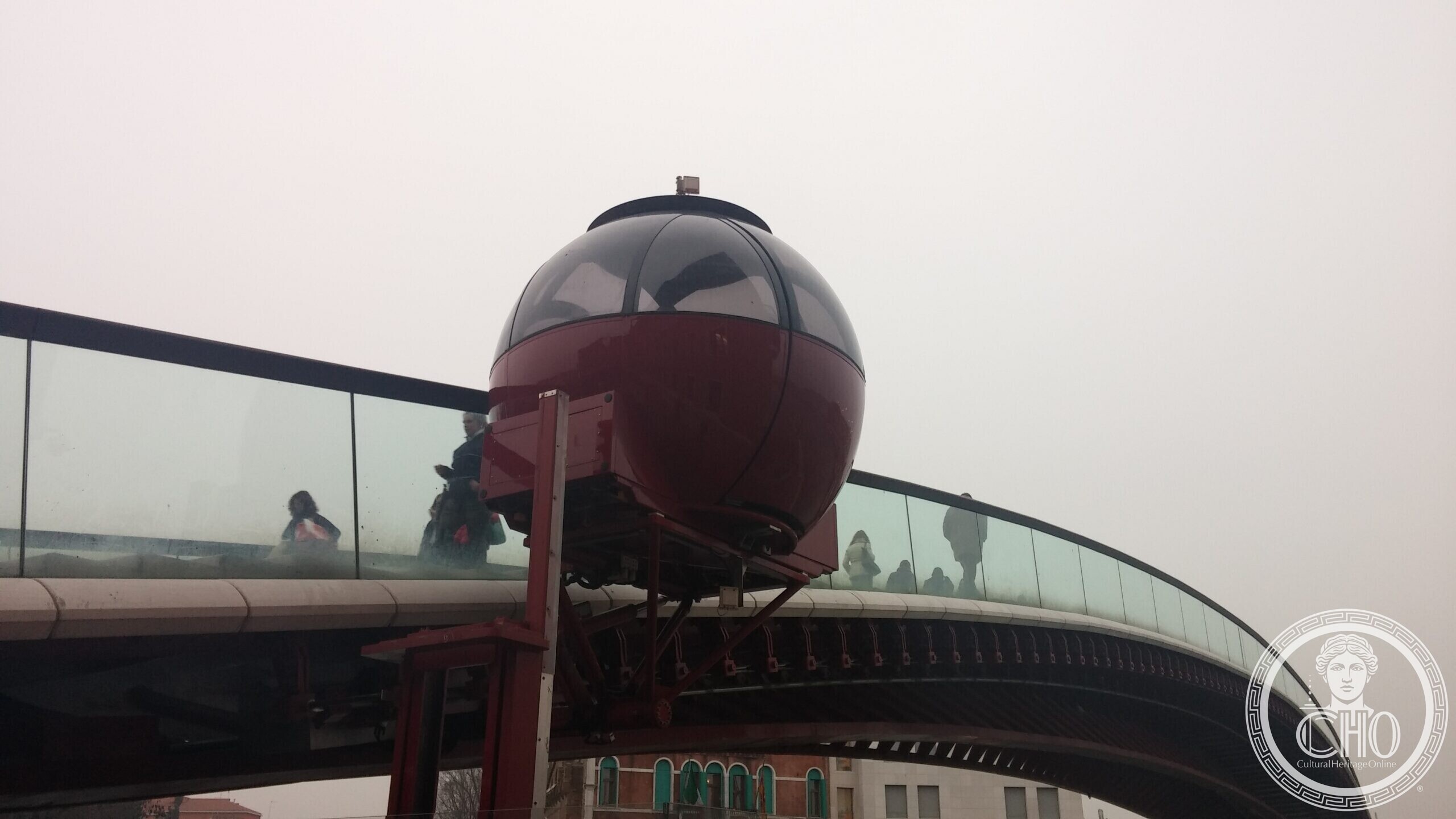
The accessibility system is the part that hurts most. Because the bridge is a ramp of shallow steps, wheelchair users could not cross it, and an €1.8 million motorised cabin was fitted to run on rails along the outside. It was slow, it broke down, and it was eventually shut off; on 22 May 2020 it was removed for good. The glass steps went the same way. Slippery in rain and prone to shattering, they have been replaced with trachyte — the grey volcanic stone Venice paves itself with — at about €4,500 each.
What you see
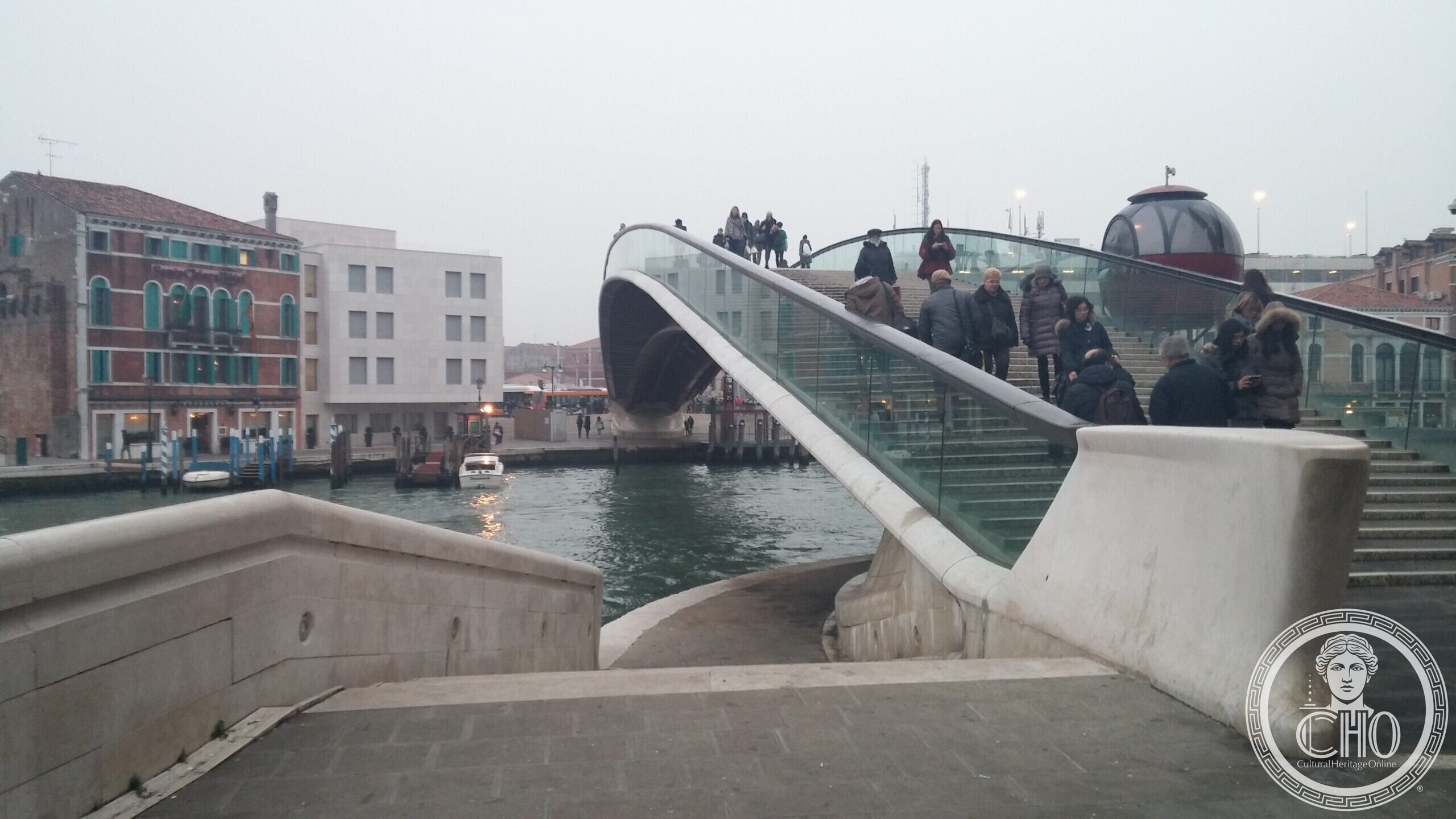
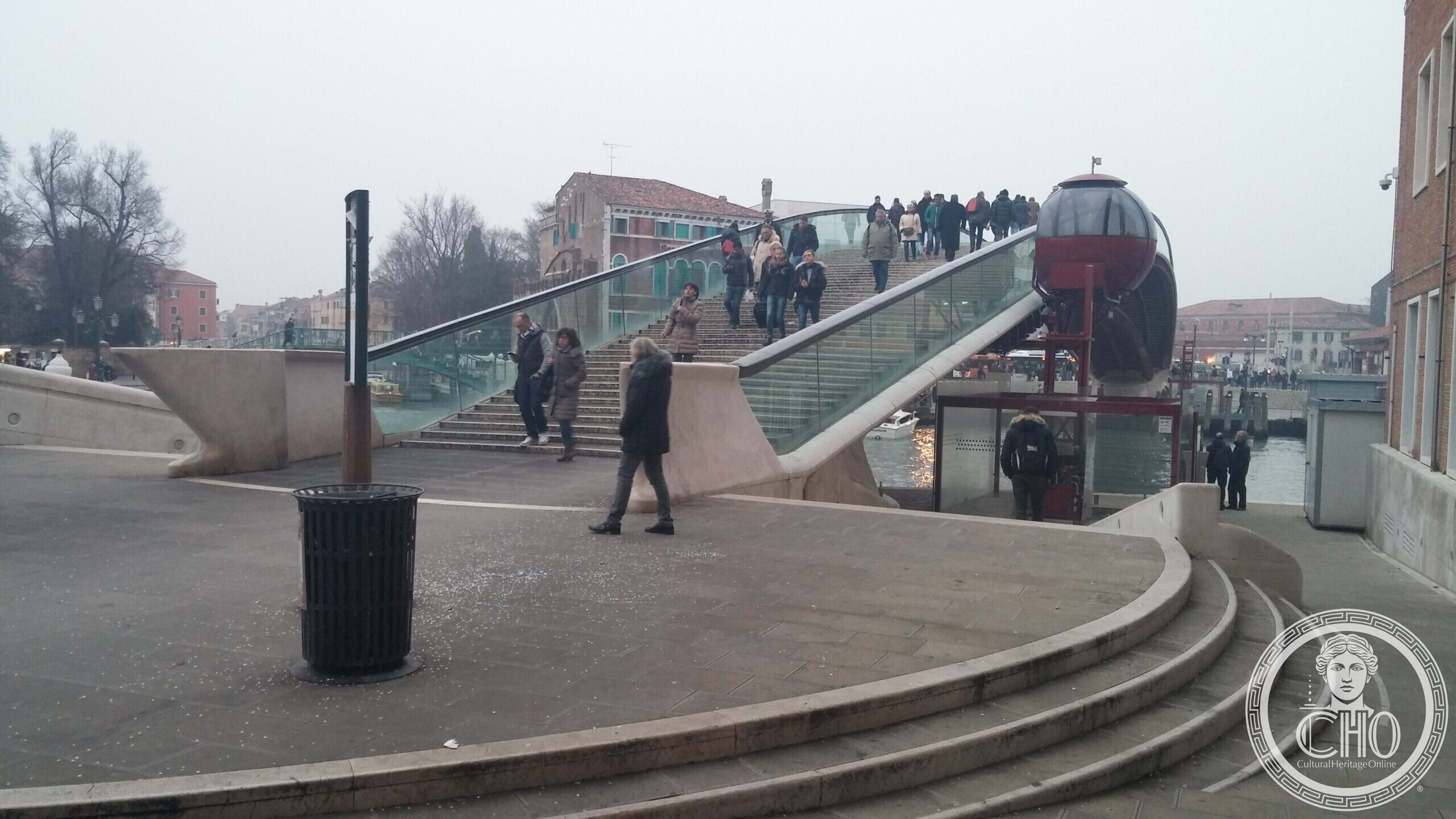
From the bank, the bridge is a single flattened arch, very low over the water, with glass parapets that make the structure look thinner than it is. The deck is a broad ramp of shallow steps that widens towards the middle, so the crossing feels like a slope rather than a stair. The abutments are solid pale stone, shaped into curves that fan out onto the pavement and double as seats.
In these photographs, taken in February 2016, the red cabin of the lift is still in place, parked at the Piazzale Roma end on its rail like a gondola cabin crossed with a funicular car. It is the most memorable thing in the picture and the least successful thing on the bridge. Since 2020 it is gone; the rail brackets on the parapet are what remain.
Practical information
- A public bridge, open at all hours, free
- It is not accessible by wheelchair: the lift has been removed and not replaced. The nearest step-free crossing is the vaporetto
- The stone treads are still slick in rain; the middle of the ramp is the shallowest part
- Five minutes
Getting there
The bridge links Piazzale Roma, the terminus for buses and the car parks, with the Fondamenta Santa Lucia in front of the railway station. Both are served by vaporetto; the walk across takes two minutes.
Nearby
- The former provincial hygiene office at Campo de la Lana, four minutes south
- The Ponte degli Scalzi, the next bridge downstream, six minutes east
- The Giardini Papadopoli, three minutes south
Sources
- Wikipedia (Italian), Ponte della Costituzione: the design by Santiago Calatrava, construction 2002–2008 and the opening of 11 September 2008, the dimensions, the budget of €6.7 million against a final €11.3 million plus €1.8 million for accessibility, the €3.467 million of cost inflation found by the Corte dei Conti, the August 2019 ruling citing “macroscopica negligenza” and the €78,000 order, the removal of the accessibility cabin on 22 May 2020, and the replacement of the glass treads with trachyte at about €4,500 each
- Coordinates from the position supplied by the photographer and cross-checked against OpenStreetMap
Photo gallery
Photographs contributed by a Cultural Heritage Online member.
Find it on the map
See this place and what’s around it →Record researched and written by Carla Szathvary for Cultural Heritage Online, 2026.
📷 Become a Cultural Heritage Online photographer
Share your photos of places: they stay published under your name as the author. The more they're seen, the more you get noticed — and soon a contest will reward the most appreciated photos.
Log in or sign up free to add a photo