
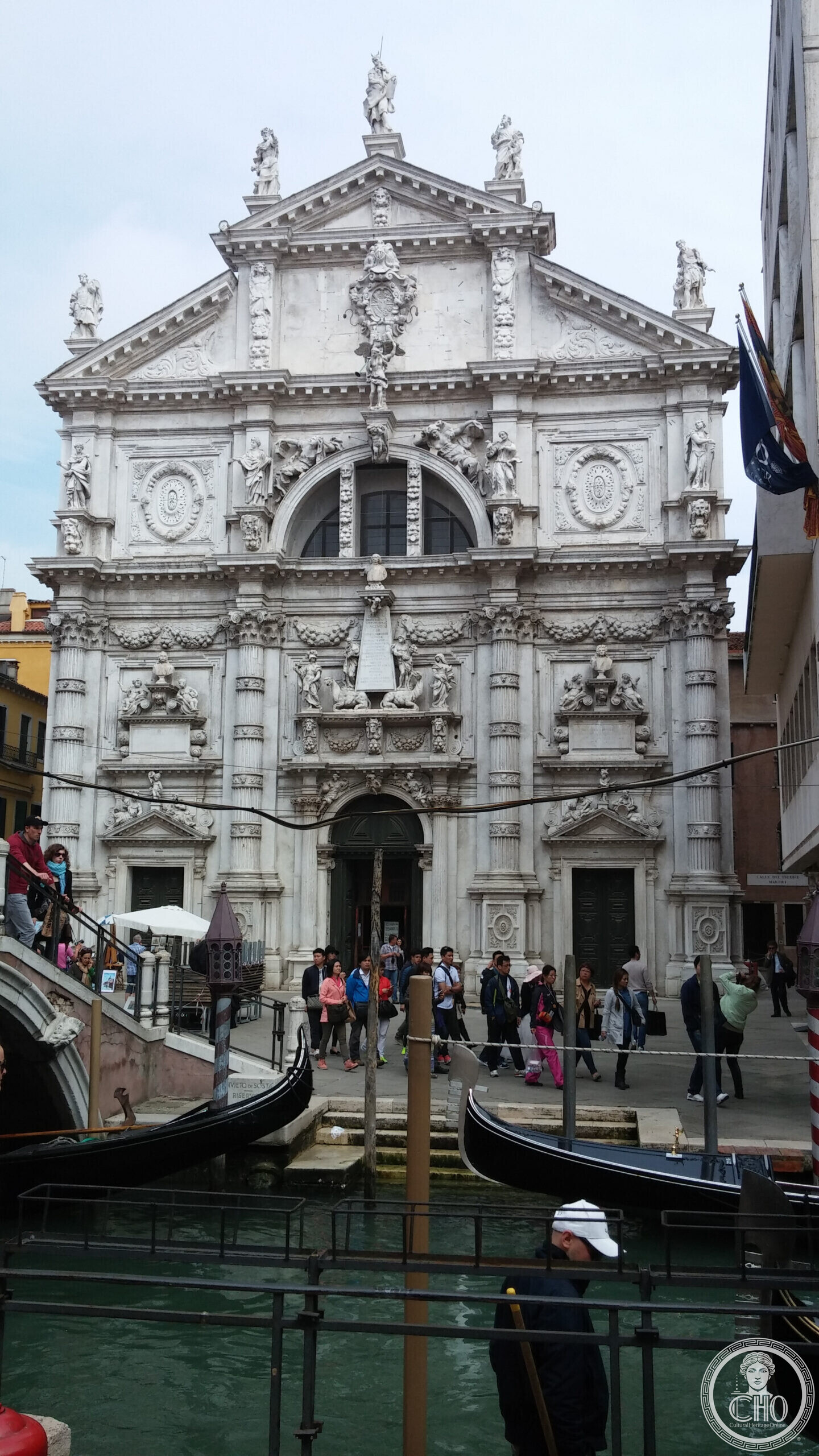
A church named after a Venetian who paid for it, wearing a front paid for by two brothers who put their own portraits on it, and which John Ruskin could not walk past without an insult.
At a glance
San Moise is the church everyone arriving from the Accademia or Piazzale Roma meets just before Piazza San Marco, and almost nobody goes into. Its facade is the most heavily carved in Venice after the Ospedaletto: figures, swags, camels, busts and broken cornices, piled up in 1668 by Alessandro Tremignon with money from the Fini brothers — ninety thousand ducats between them, and their heads above the side doors as the receipt. The church itself is far older. The dedication to Moses comes from a tenth-century Venetian benefactor called Moise Valier.
Key facts
- Founded: probably between the late eighth and early ninth century; Sansovino gives 796
- Original dedication: to San Vittore; rededicated to Moses in 947, when it was rebuilt by Moise Valier
- Facade: 1668, Alessandro Tremignon
- Paid for by: Vincenzo Fini (30,000 ducats) and Girolamo Fini (60,000 ducats), commemorated with busts above the side doors
- Bell tower: raised in the sixteenth century, the only surviving element of the medieval church
- High altar: 1685–1688, with sculpture by Enrico Merengo and frescoed angels by Michelangelo Morlaiter
- Inside: Tintoretto’s Washing of the Feet, and the burial of the Scottish financier John Law
- GPS: 45.43315, 12.33592 · Open in Google Maps
History
The first church here goes back to the beginnings of the city. Tradition, following Sansovino, gives 796 and names the Artigeri and Scoparii families as its founders, under a dedication to Saint Victor. In 947 it was rebuilt by a Venetian named Moise Valier, and by the custom of the city it took the name of the man who paid — which is why Venice has a church dedicated to Moses. The bell tower, raised in the sixteenth century, is all that remains of the medieval fabric.
The front belongs to a different Venice. In 1668 the brothers Vincenzo and Girolamo Fini, newly ennobled and extremely rich, commissioned Alessandro Tremignon to cover the facade in sculpture, and paid thirty and sixty thousand ducats respectively. Their busts sit above the two side doors, and the family obelisk-and-monument group is set in the middle of the wall, over the main entrance. The church became, in effect, a public monument to its donors.
That is what later visitors objected to. John Ruskin, writing on Venetian architecture in the nineteenth century, singled out San Moise for attack, and his condemnation stuck: for a century the facade appeared in guidebooks mainly as an example of what not to admire. The building also keeps a quieter memorial. John Law, the Scot whose paper-money scheme collapsed the French economy in 1720, retired to Venice and was buried here.
What you see
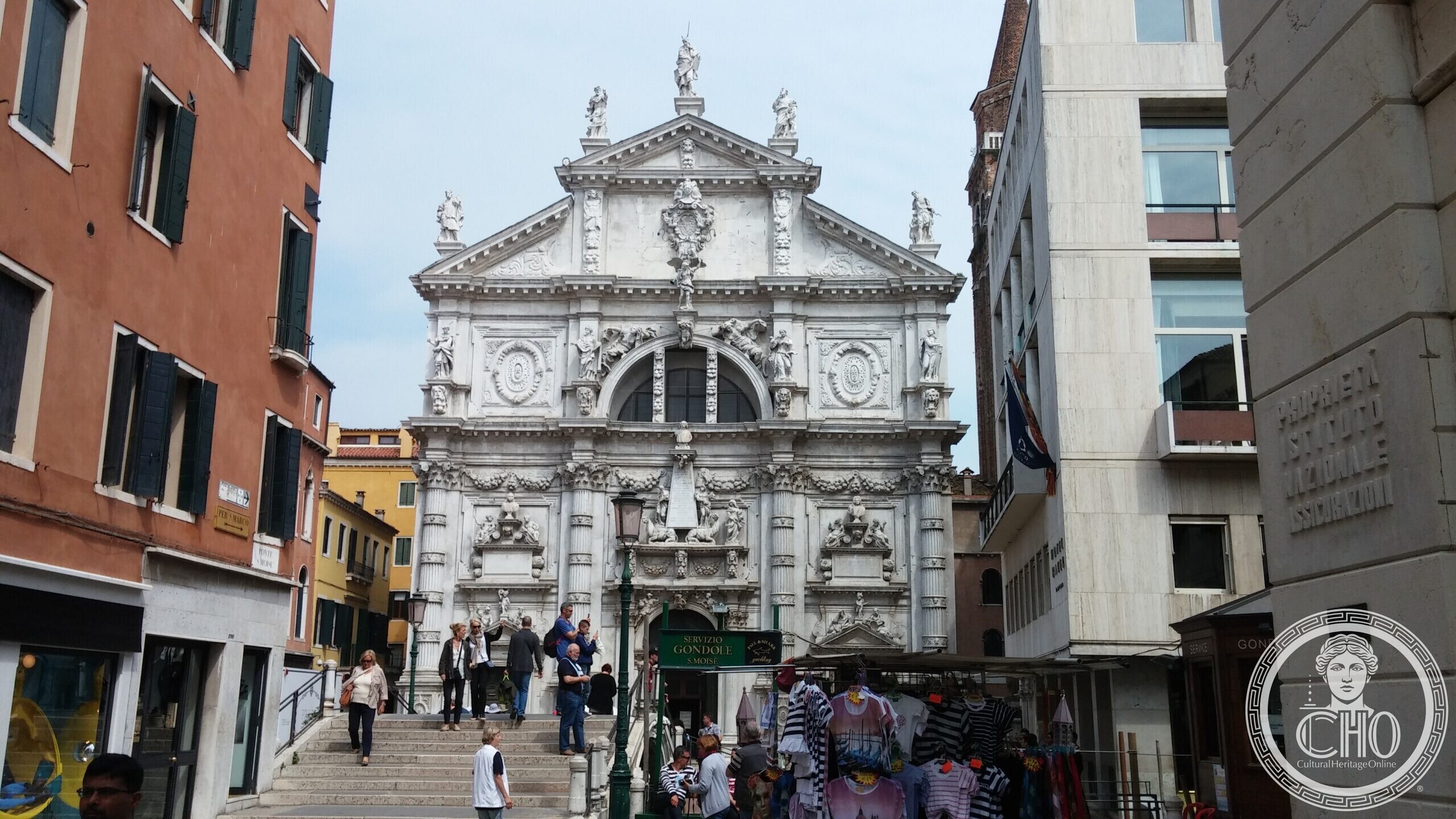
The wall is built up in layers and the eye cannot rest on any of them. Columns stand clear of the surface in pairs; between them, brackets carry free-standing statues; the central bay is filled by the Fini monument, an obelisk with figures at its base and camels below that. Above the two side doors, the brothers look out in Roman bust form. The ornament runs right to the top, where more statues stand along the pediments against the sky.
Step back onto the bridge and a second thing becomes clear: there is no room. The campo is narrow, the canal runs across the front of it, and the facade is designed to be met at close range by a crowd already moving past. Behind and to the right stands the twentieth-century wing of the Hotel Bauer, in travertine, and the contrast of the two walls — one covered in figures, one blank — is the whole argument about Venetian building compressed into twenty metres.
Practical information
- An active parish church; entry is free, with hours that vary and often close around midday
- The facade is on a public campo and can be seen at any hour
- The campo is a bottleneck: stand on the bridge, not in the flow
- Fifteen minutes inside; five for the facade
Getting there
Two minutes’ walk west of Piazza San Marco along the Salizada San Moise. The nearest vaporetto stops are Vallaresso and Santa Maria del Giglio.
Nearby
- The war memorial of the San Marco parish, on the church itself
- Santa Maria del Giglio, four minutes west
- Piazza San Marco and the Royal Gardens, two minutes east
Sources
- Wikipedia (Italian), Chiesa di San Moisè: the foundation between the late eighth and early ninth century and Sansovino’s date of 796, the Artigeri and Scoparii families, the original dedication to San Vittore and the rededication of 947 under Moise Valier, the 1668 facade by Alessandro Tremignon, the sums given by Vincenzo and Girolamo Fini and their busts above the side doors, Ruskin’s condemnation, the sixteenth-century bell tower as the only medieval survival, the high altar of 1685–1688 with sculpture by Enrico Merengo, Tintoretto’s Lavanda dei piedi, and the burial of John Law
- Coordinates from the position supplied by the photographer and cross-checked against OpenStreetMap
Photo gallery
Photographs contributed by a Cultural Heritage Online member.
Find it on the map
See this place and what’s around it →Record researched and written by Carla Szathvary for Cultural Heritage Online, 2026.
📷 Become a Cultural Heritage Online photographer
Share your photos of places: they stay published under your name as the author. The more they're seen, the more you get noticed — and soon a contest will reward the most appreciated photos.
Log in or sign up free to add a photoIs this page about you?
This page is read by travellers and heritage enthusiasts who find it on Google. Tell us how you are connected to this place and we will take it from there.