

A fourteenth-century campanile that stands apart from its church, on the other side of the street, resting on two Romanesque lions that Venice has spent centuries telling stories about.
At a glance
Most Venetian bell towers rise beside their church. This one does not. The campanile of San Polo was raised in 1362 on the far side of the salizada, and the street has to squeeze past it – which is why the tower is usually met before the church is. At its foot sit two marble lions, reused from the narthex of the earlier building: one holds a serpent between its paws, the other a human head. They are ordinary Romanesque carving, and Venice long ago decided they were something else entirely.
Key facts
- Bell tower: raised in 1362, brick, with a conical cusp
- Position: detached from the church, on the opposite side of the Salizada San Polo
- At the base: two stylophore lions in marble, reused from the narthex of the original church
- Parish church: San Polo, founded in the ninth century, traditionally dated to 837
- Church portal: late Gothic, attributed to the workshop of Bartolomeo Bon
- Location: Salizada San Polo, San Polo, Venice
- GPS: 45.43694, 12.32945 · Open in Google Maps
History
The parish of San Polo is one of the oldest in the city. Tradition places its foundation in 837, under Doge Pietro Tradonico and his co-regent son Giovanni, and the church that stands today keeps the plan of a building rebuilt in the Gothic centuries rather than the ninth-century one. The bell tower belongs to that second Venice: it went up in 1362, at a moment when the city was covering its parishes in brick towers and its campi in stone.
The tower was built where there was room, not where it would look tidy. The result is one of the sharpest bottlenecks in the sestiere. Where a campanile is usually read from a distance, this one is read by touch and by shoulder, as pedestrians funnel between its plinth and the houses opposite.
In 1804 the architect Davide Rossi reworked the church interior in neoclassical taste, one of the many Venetian rebuildings of the years around the fall of the Republic. The tower kept its own century. Its lions are older still: carved for the narthex of the earlier church, they were set at the base of the new campanile as supports, in the Romanesque manner that put beasts under columns.
What you see
From the salizada the tower reads as a single unbroken brick shaft, tapering slightly, with shallow pilaster strips running its full height and small openings punched almost at random. The base is Istrian stone, stepped and worn smooth at the corners by six centuries of people brushing past. It is the last stretch before the belfry that gives the tower its silhouette: the conical cusp, visible above the roofline from several calli away.
The two lions repay a stop. One grips a serpent; the other holds a human head between its paws. Venetian storytelling has long attached those figures to the two most notorious beheadings in the city’s political memory – Doge Marin Falier, executed in 1355, and the condottiero Francesco Bussone da Carmagnola, executed in 1432. The identification is impossible: the carvings are older than both men. What survives in them is a standard Romanesque motif, and a good example of how a city reads its own street furniture centuries after the carver has been forgotten.
Practical information
- The tower itself is not open to visitors; it is seen from the street, free of charge, at any hour
- The church of San Polo belongs to the Chorus circuit of Venetian churches, open Monday to Saturday, 10.30–17.00, with an entrance ticket
- Inside the detached Oratorio del Crocifisso are the fourteen stations of the Via Crucis painted by Giandomenico Tiepolo in 1749–1750
- Ten minutes is enough for the tower and its lions; allow forty for the church as well
Getting there
The nearest vaporetto stops are San Silvestro and San Tomà, both on the Grand Canal, each about five minutes on foot. From the Rialto bridge the walk through Campo San Polo takes roughly ten minutes.
Nearby
- Campo San Polo, the largest campo in Venice after Piazza San Marco, immediately west of the tower
- The Basilica of Santa Maria Gloriosa dei Frari, about six minutes on foot
- The Rialto market and the Fabbriche Vecchie, about eight minutes in the other direction
Sources
- Chorus Venezia, the association of Venetian churches, page on the Chiesa di San Polo — chorusvenezia.org: ninth-century foundation, the two stylophore lions at the base of the bell tower, the portal attributed to Bartolomeo Bon, the 1804 neoclassical rebuilding by Davide Rossi, Giandomenico Tiepolo’s Via Crucis of 1749–1750, opening hours
- Wikipedia (Italian), Chiesa di San Polo (Venezia): the 1362 date of the bell tower and its conical cusp, its position across the salizada, the serpent and the human head held by the two lions, and the explicit note that the popular attribution to Marin Falier and Francesco Bussone is impossible because the sculptures predate both
- Coordinates cross-checked against OpenStreetMap Nominatim, which places the Campanile di San Polo six metres from the point recorded in the photograph
Photo gallery
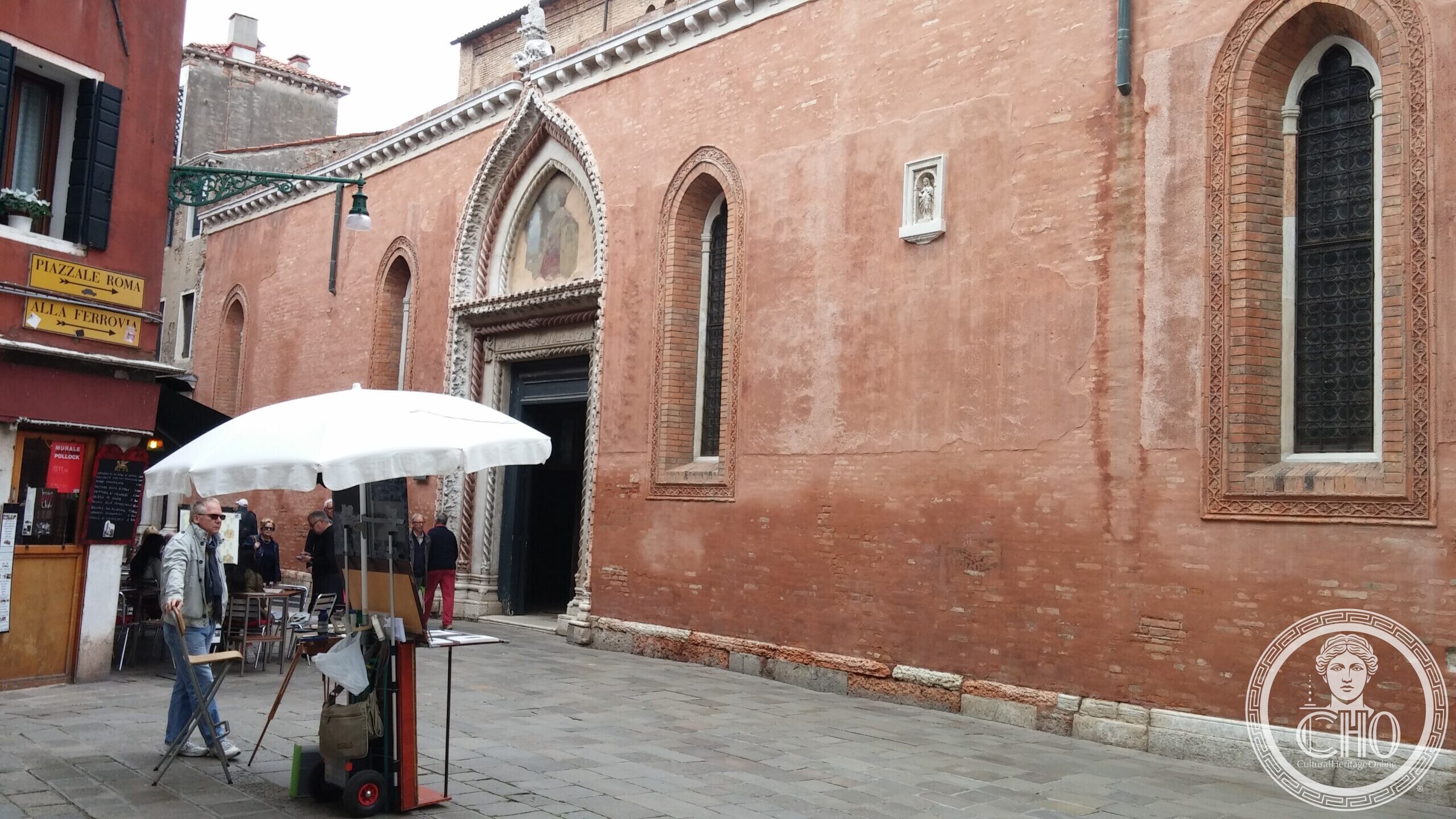
Photographs contributed by a Cultural Heritage Online member.

Find it on the map
See this place and what’s around it →Record researched and written by Carla Szathvary for Cultural Heritage Online, 2026.
📷 Become a Cultural Heritage Online photographer
Share your photos of places: they stay published under your name as the author. The more they're seen, the more you get noticed — and soon a contest will reward the most appreciated photos.
Log in or sign up free to add a photoIs this page about you?
This page is read by travellers and heritage enthusiasts who find it on Google. Tell us how you are connected to this place and we will take it from there.