
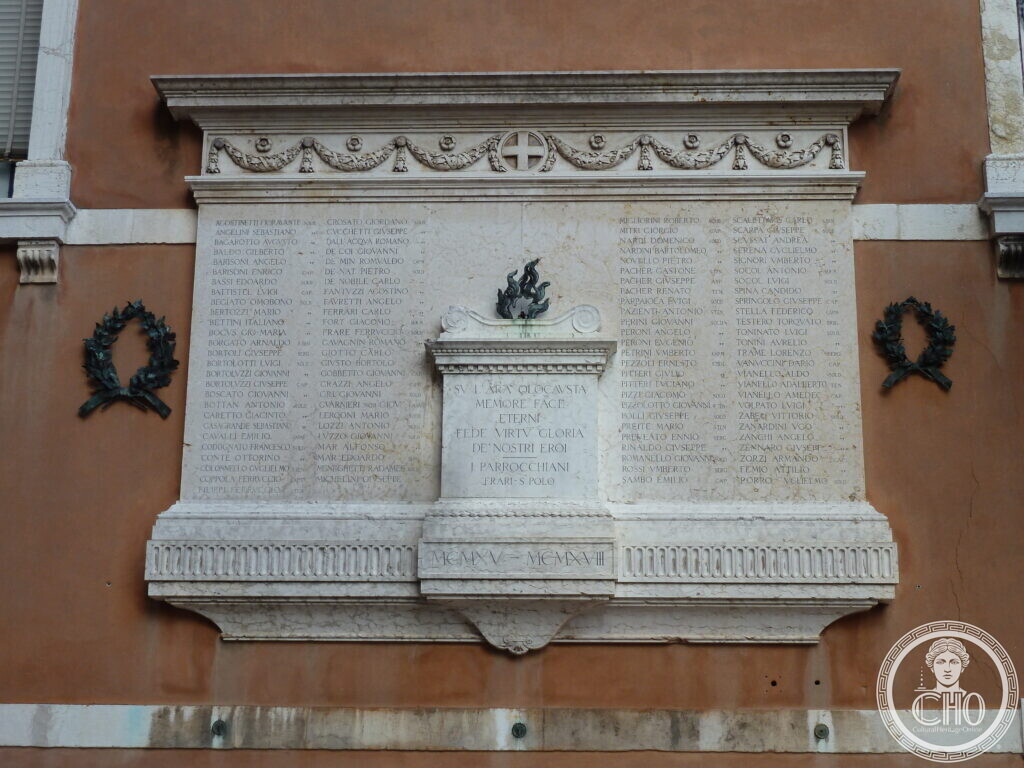
A marble roll of the parish’s First World War dead, shaped as a Roman sacrificial altar — and moved, before it was even built, from the basilica it was meant to honour.
At a glance
Two columns of names run either side of a raised central altar — the ara olocausta, the sacrificial altar of Roman tradition, chosen to stand for the sacrifice of the parish’s own fallen. Above, a stone garland strung between the years 1915 and 1918. Below, in Roman numerals, the same dates repeat: MCMXV–MCMXVIII. The plaque was designed in 1924 by Romeo Dall’Era (Venice, 1874–1963), sculptor and professor at the Venice Academy of Fine Arts.
Key facts
- Commissioned by: the Comitato Caduti Grande Guerra dei Frari, the parish committee for the war dead
- Designer: Romeo Dall’Era (Venice, 1874 – Venice, 1963), sculptor and art professor
- Proposed: May 1924, for the facade of the Basilica dei Frari itself
- Built as: a Roman-style sacrificial altar (ara), flanked by two panels of names under a garlanded pediment
- Location: the exterior wall of the State Archives (Archivio di Stato), beside Campo San Polo
- GPS: 45.43735, 12.32697 · Open in Google Maps
History
In May 1924 the parish committee for the Frari’s war dead asked the city for permission to raise a monument to the men who had not come home, and their first choice was the most obvious one: the facade of Santa Maria Gloriosa dei Frari, one of the great Gothic churches of Venice. Rome-born sculptor and Academy professor Romeo Dall’Era drew up the design. The city’s Commission for Urban Ornamentation said no — not to the memorial, but to the site. A modern marble plaque, however dignified, did not belong on a thirteenth-century church facade whose stone the commission was not prepared to disturb.
The compromise moved the memorial a few steps sideways, onto the exterior wall of the State Archives that faces Campo San Polo — still within sight of the basilica, still the parish’s own ground, but off the protected medieval fabric. The design changed with the move: what had been conceived for a church front became a free-standing composition, built up as a Roman sacrificial altar between two panels of names, with the years of the war cut into its base twice over, once in a stone garland above and once in Roman numerals below.
Sources
- Pietre della Memoria, Lapide ai Caduti della parrocchia Santa Maria Gloriosa dei Frari (Venezia) nella Grande Guerra — pietredellamemoria.it: the 1924 committee request, Romeo Dall’Era’s original design for the basilica facade, and the Commission’s decision to relocate it to the State Archives wall
- On-site inscription, verified from the contributed photograph: the dedication text, the 1915–1918 dates, and the parish attribution (“Frari · S. Polo”)
- Coordinates cross-checked against OpenStreetMap Nominatim for Campo San Polo
Find it on the map
See this place and what’s around it →Record researched and written by Carla Szathvary for Cultural Heritage Online, 2026.
📷 Become a Cultural Heritage Online photographer
Share your photos of places: they stay published under your name as the author. The more they're seen, the more you get noticed — and soon a contest will reward the most appreciated photos.
Log in or sign up free to add a photoIs this page about you?
This page is read by travellers and heritage enthusiasts who find it on Google. Tell us how you are connected to this place and we will take it from there.