
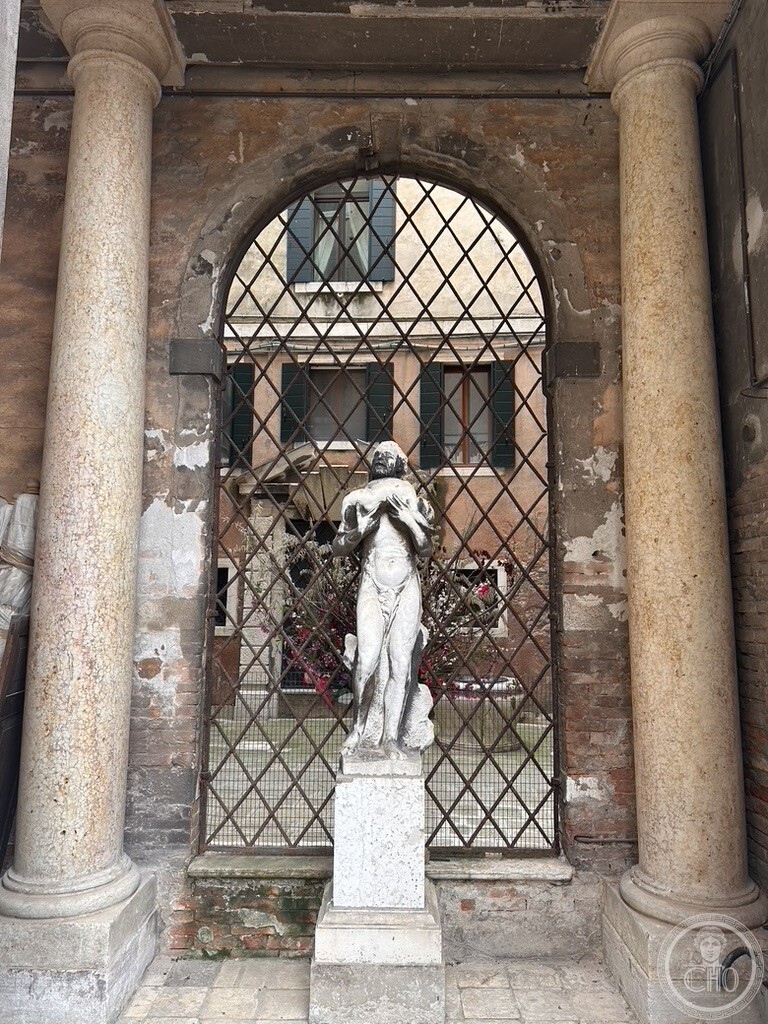
A Gothic palace and a Scamozzi palace, built two centuries apart and stitched into a single Contarini residence. In 2024, its courtyard held Jim Dine’s bronze heads instead of doges.
At a glance
On the left bank of the Grand Canal, between the Accademia bridge and the church of San Trovaso, two facades stand side by side under one name. Palazzo Corfù, on the right, is a late-Gothic house of the 1400s. Palazzo degli Scrigni, on the left, is Vincenzo Scamozzi’s work of 1609–1616. The Contarini family who owned both wanted the old façade kept and the rooms behind it joined into one residence — which is exactly what Scamozzi built them, one of the last and most personal designs of his career.
Key facts
- Palazzo Corfù (right): late-Gothic, 15th century; tripartite façade with a central group of ogee-arched windows; interior remodelled in the 17th century, work attributed to Francesco Smeraldi
- Palazzo degli Scrigni (left): built 1609–1616 by Vincenzo Scamozzi (Vicenza, 1548 – Venice, 1616); rusticated ground floor, upper storeys divided by pilasters; an oval staircase inside, rising to a small turret
- Commissioned by: the Contarini family, one of Venice’s ducal dynasties
- Interior decoration: a library in the Scrigni wing with paintings by Pietro Liberi and Alessandro Varotari, called Il Padovanino
- The names: “Corfù” recalls the family’s trading interests on the island; “degli Scrigni” — “of the caskets” — refers to this branch’s legendary wealth
- 1838: Girolamo Contarini donated his art collection to the city of Venice
- Later history: passed to Mathilde Berthold, with restoration work in the 19th century
- GPS: 45.43198, 12.32760 · Open in Google Maps
History
The Contarini were among the most powerful families of the Republic, and by the seventeenth century one branch of them owned two adjoining houses on this stretch of the Grand Canal. The older one, Palazzo Corfù, was already two hundred years old: a Gothic façade of the kind the Grand Canal is built from, its centre pierced by a tall group of pointed windows. Rather than pull it down, the family asked Vincenzo Scamozzi to build them a new palace next door and to unify the two behind the scenes — new rooms joined to old, both façades kept standing.
Scamozzi was the obvious choice. He had inherited Palladio’s unfinished commissions after 1580 and spent the following decades as the leading architectural mind in the Veneto, the hinge between Palladio and the next generation’s Baldassarre Longhena. At the Scrigni palace, built in the last years of his life, he gave the Grand Canal a façade unlike his other Venetian work: a rusticated ground floor and pilasters marking the storeys above, a flatter, more classical language than the Gothic tracery next door. Inside, he turned the stair into an oval, rising to a little belvedere turret, and the family filled a library with paintings by Pietro Liberi and Padovanino.
The palace stayed in Contarini hands into the nineteenth century. In 1838 Girolamo Contarini gave his art collection to the city, a gift still traceable in Venice’s civic museums. The building itself later passed to Mathilde Berthold, who restored it later in the century — work that, along with an eighteenth-century restoration, is why the Gothic wing looks as crisp today as the seventeenth-century one beside it.
What you see
From the water, the two façades read as a lesson in contrast: Gothic tracery on one side, Scamozzi’s flat rusticated classicism on the other, under a single roofline. From the land side, where a visitor actually enters, the palace shows a different face — a stone portico on slender columns, worn brick courtyard walls, and a private garden behind a wrought-iron gate, with an old wellhead still standing on the lawn. It is a working Venetian palace plan: a public front for the canal, a working, planted world behind it that the canal never shows.
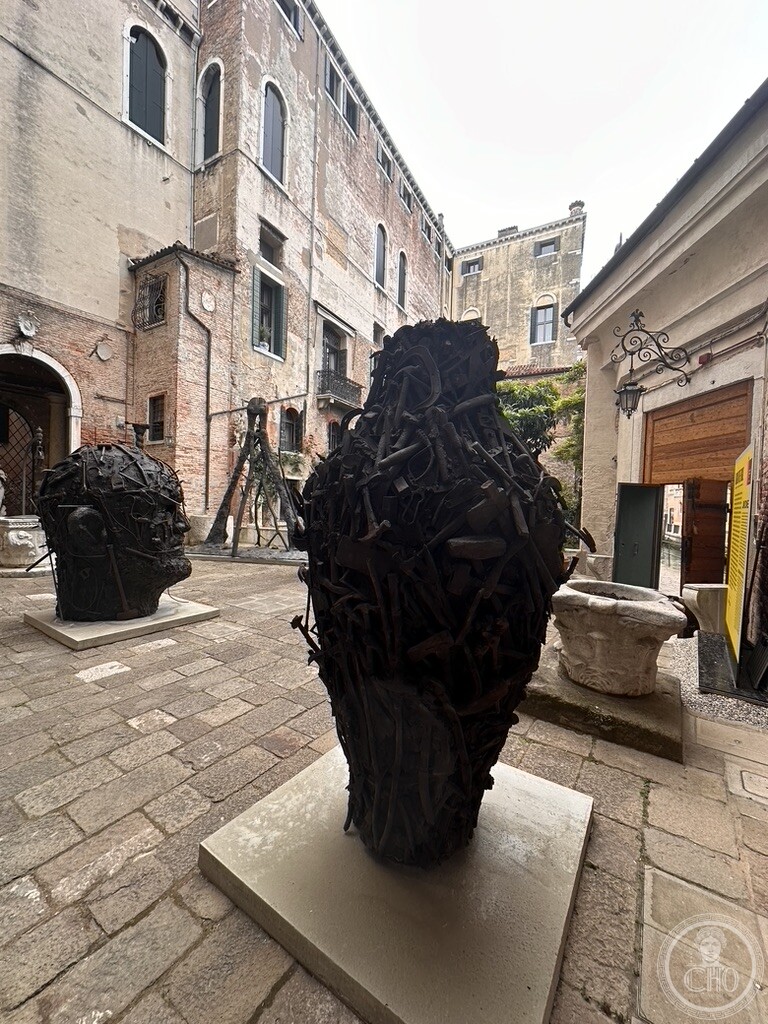
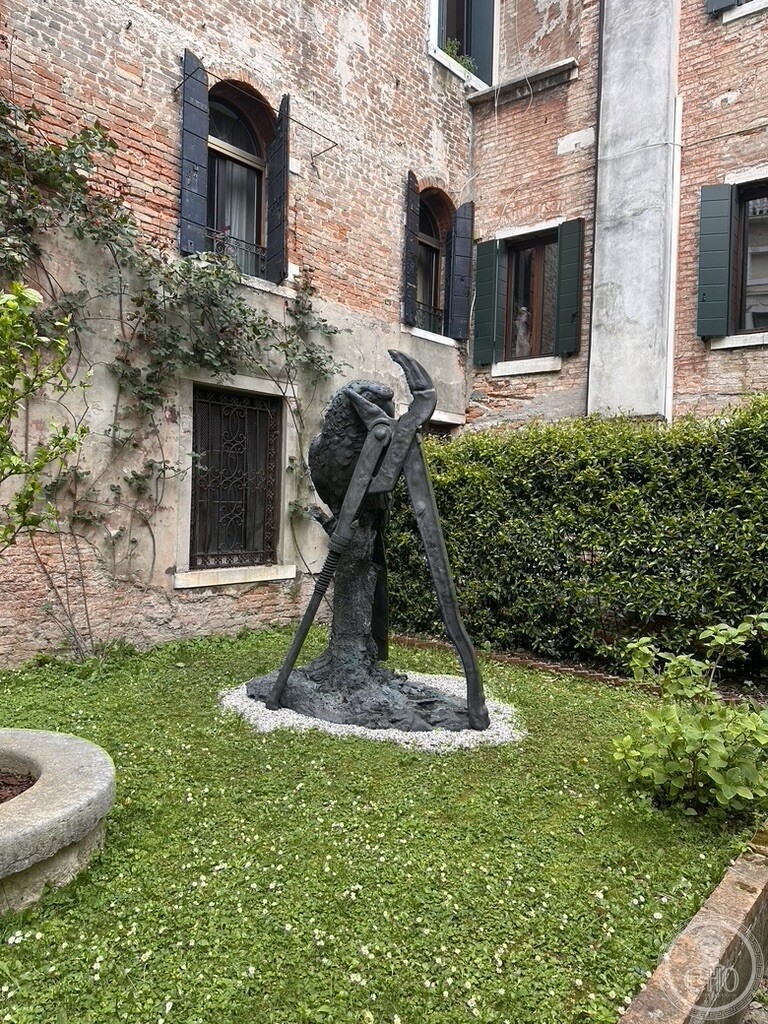
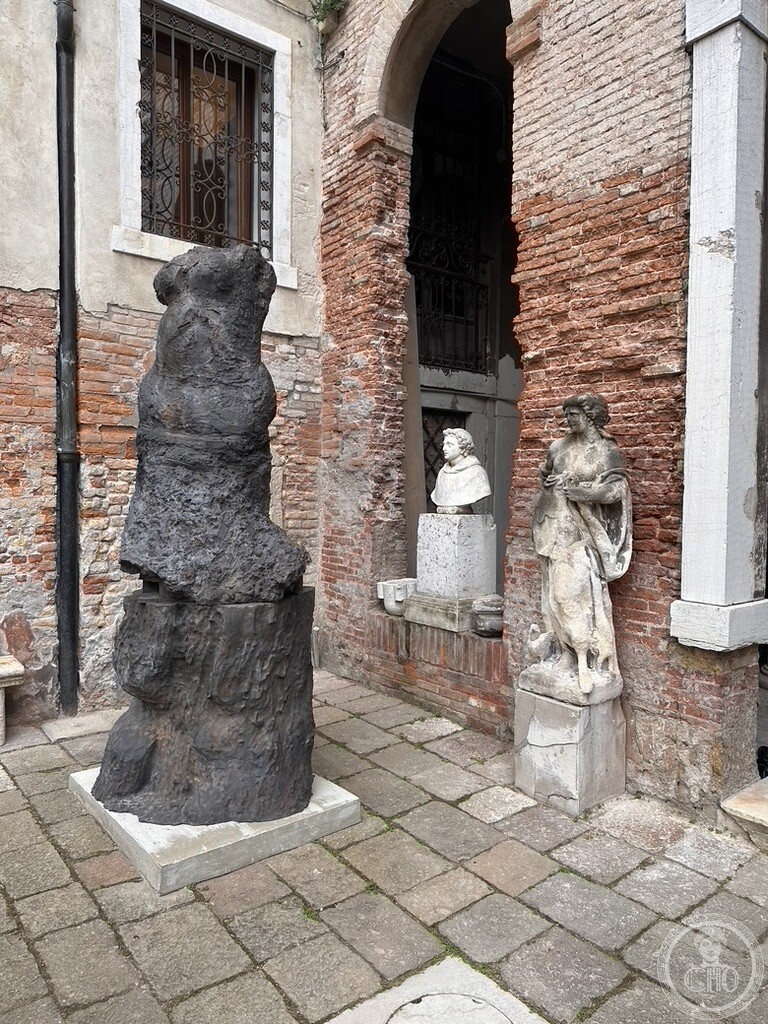
In spring 2024 that garden and courtyard held something the Contarini never imagined: Jim Dine’s bronze sculptures for Dog on the Forge, a Biennale Arte collateral exhibition running 20 April–21 July 2024. Assemblage heads built from scrap iron stood against the brick where marble busts usually keep watch, and a giant bronze pliers-and-hammer rose from the grass beside the wellhead — about fifty works in all, the courtyard and garden turned into open-air galleries for a few months. The contrast was the point: a seventeenth-century palace built to be looked at, holding twentieth- and twenty-first-century sculpture built to look unfinished.
Practical information
- Access: privately owned; the interior and garden open to the public only during temporary exhibitions and events — check current listings before planning a visit
- The façades: visible year-round from the Grand Canal, by vaporetto or on foot from the Accademia bridge
- Time needed: a few minutes for the façades from the water; longer if an exhibition is open
Getting there
The palace stands in Dorsoduro, on the Grand Canal a short walk from the Ponte dell’Accademia and the Gallerie dell’Accademia. The Accademia vaporetto stop is the closest; on foot, it is a few minutes from Campo San Vidal along Calle Contarini Corfù.
Nearby
- Chiesa di San Trovaso
- Squero di San Trovaso — one of Venice’s last working gondola boatyards
Sources
- Canal Grande di Venezia, Palazzo Contarini degli Scrigni e Corfù — canalgrandevenezia.it: the two building phases, the 1609 Scamozzi wing, Francesco Smeraldi’s attributed 17th-century interior work on Palazzo Corfù, the oval staircase and library, the 1838 Contarini donation and the later Berthold ownership
- Wikipedia (Italian), Palazzi Contarini degli Scrigni e Corfù — the 1609–1616 construction dates, the Gothic Corfù wing, and the meaning of the two names
- Touring Club Italiano, Palazzo Contarini degli Scrigni-Corfù — touringclub.it: location and coordinates
- Mousse Magazine, Jim Dine — Dog on the Forge, Palazzo Rocca Contarini Corfù, Venice — moussemagazine.it: the 2024 exhibition dates and scope
- Coordinates cross-checked against OpenStreetMap Nominatim (building record for Palazzi Contarini degli Scrigni e Corfù)
Photo gallery
Photos contributed by a Cultural Heritage Online member.
Find it on the map
See this place and what’s around it →Record researched and written by Carla Szathvary for Cultural Heritage Online, 2026.
📷 Become a Cultural Heritage Online photographer
Share your photos of places: they stay published under your name as the author. The more they're seen, the more you get noticed — and soon a contest will reward the most appreciated photos.
Log in or sign up free to add a photoIs this page about you?
This page is read by travellers and heritage enthusiasts who find it on Google. Tell us how you are connected to this place and we will take it from there.