
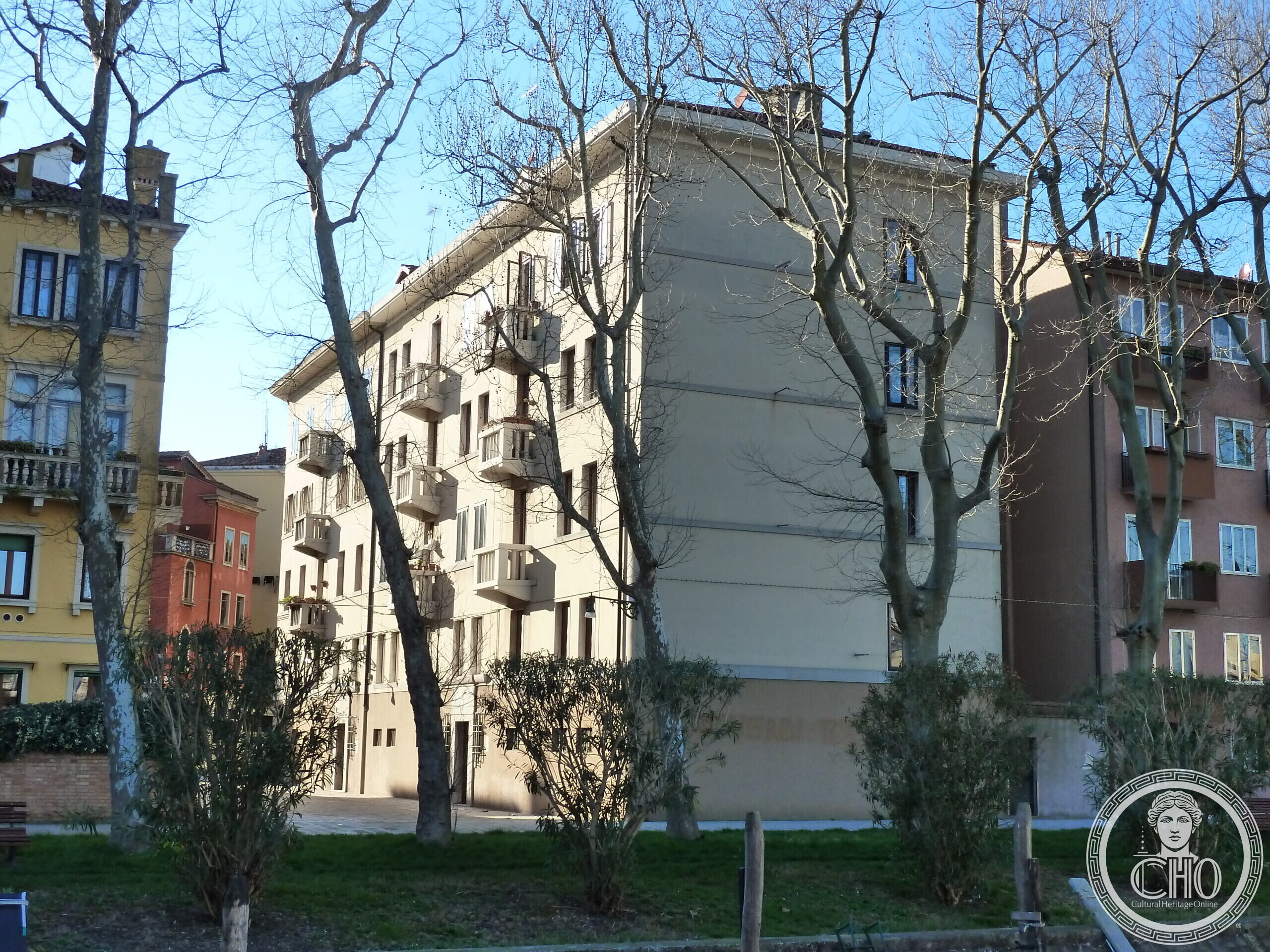
Like most of Sant’Elena’s streets, Calle Coni Zugna takes its name from a First World War battlefield; the apartment block that lines it is the work of Paolo Bertanza, the IACP engineer responsible for the bulk of the island’s 1920s public housing.
At a glance
This building on Calle Coni Zugna, dated to 1925, is part of the same IACP campaign that gave Sant’Elena its “Vittorio Emanuele III” quarter: uniform apartment blocks built on land reclaimed at the eastern edge of historic Venice, designed largely by engineer Paolo Bertanza after the Comune of Venice entrusted the operation to the IACP of the Province of Venice from 1924. Its street name, like several others on the island, commemorates a First World War engagement — Monte Zugna (the “Coni Zugna” ridge) in the Vallarsa, defended against Austro-Hungarian attack in 1916.
Key facts
- Built: 1925
- Engineer: Paolo Bertanza, for the IACP of the Province of Venice
- Quarter: “Vittorio Emanuele III,” Sant’Elena’s 1920s public-housing district
- Earlier groundwork: engineer Francesco Marsich’s 1906 planimetric map first marked out Sant’Elena’s building areas
One engineer’s street, among many
Francesco Marsich’s 1906 map gave Sant’Elena its first outline for future building; it was Paolo Bertanza, nearly two decades later, who actually put up the apartment blocks that still line the island’s streets today, as the IACP carried out what remains the largest single public-housing operation ever built inside historic, insular Venice. Calle Coni Zugna is one of several streets in the quarter named after the mountains and battle sites of the 1915–18 war — a naming pattern that runs through Sant’Elena’s whole street plan, tying its very ordinary 1920s housing blocks to the extraordinary conflict its first residents had just lived through.
Getting there
Calle Coni Zugna is on Sant’Elena, near Campo Monte Grappa, a short walk from the Sant’Elena vaporetto stop.
Sources
- conoscerevenezia.it, “Case dello IACP e di altri enti pubblici a Sant’Elena, già quartiere ‘Vittorio Emanuele III'” — on Paolo Bertanza’s role as IACP engineer for the quarter.
- storiadellacitta.it (Ferrighi, “Venezia e la casa salubre”) — on Francesco Marsich’s 1906 planimetric map.
- Stefano Vigolo, who photographed the building.
Find it on the map
See this place and what’s around it →Record researched and written by Stefano Vigolo for Cultural Heritage Online, 2026.
📷 Become a Cultural Heritage Online photographer
Share your photos of places: they stay published under your name as the author. The more they're seen, the more you get noticed — and soon a contest will reward the most appreciated photos.
Log in or sign up free to add a photo