

A belfry is not a church tower. It belongs to the townsmen, and it exists because in 1239 the counts of Luxembourg granted them the right to build a wall and post a watchman on it.
At a glance
The beffroi stands in the old centre of Thionville, in the Moselle, and has been partly listed as a monument historique since 27 May 1980. It is the surviving piece of a medieval municipal complex: a tower that held the town’s great bell, and beside it a communal building with an audience chamber and a hospital for the poor. The tower now holds three vaulted rooms, one above the other.
Key facts
- What it is: the municipal belfry of Thionville, symbol of the town’s communal liberties
- Origin: the charter of franchise granted by the counts of Luxembourg in 1239, which allowed a wall and a watchtower; a watchman is recorded from 1315
- The present tower: rebuilt in the first half of the sixteenth century, when Charles V ordered major fortification works
- Upper stage: remade in 1699, with the clock level and a tall imperial roof
- Protection: partly listed as a monument historique since 27 May 1980
- Where: quai Sainte-Catherine, 57100 Thionville
History
In 1239 the counts of Luxembourg granted the burghers of Thionville a charter of franchise: they could raise an enclosure and keep a watchtower with a watchman on it. A watchman is named in the records from 1315. In the fourteenth century the town built a first belfry, the tower proper together with a municipal building on what is now the rue de l’Ancien-Hôtel-de-Ville, which housed an audience chamber and a hospital for the poor. The great bell of the town hung in the tower; it is mentioned from 1363 and was recast many times.
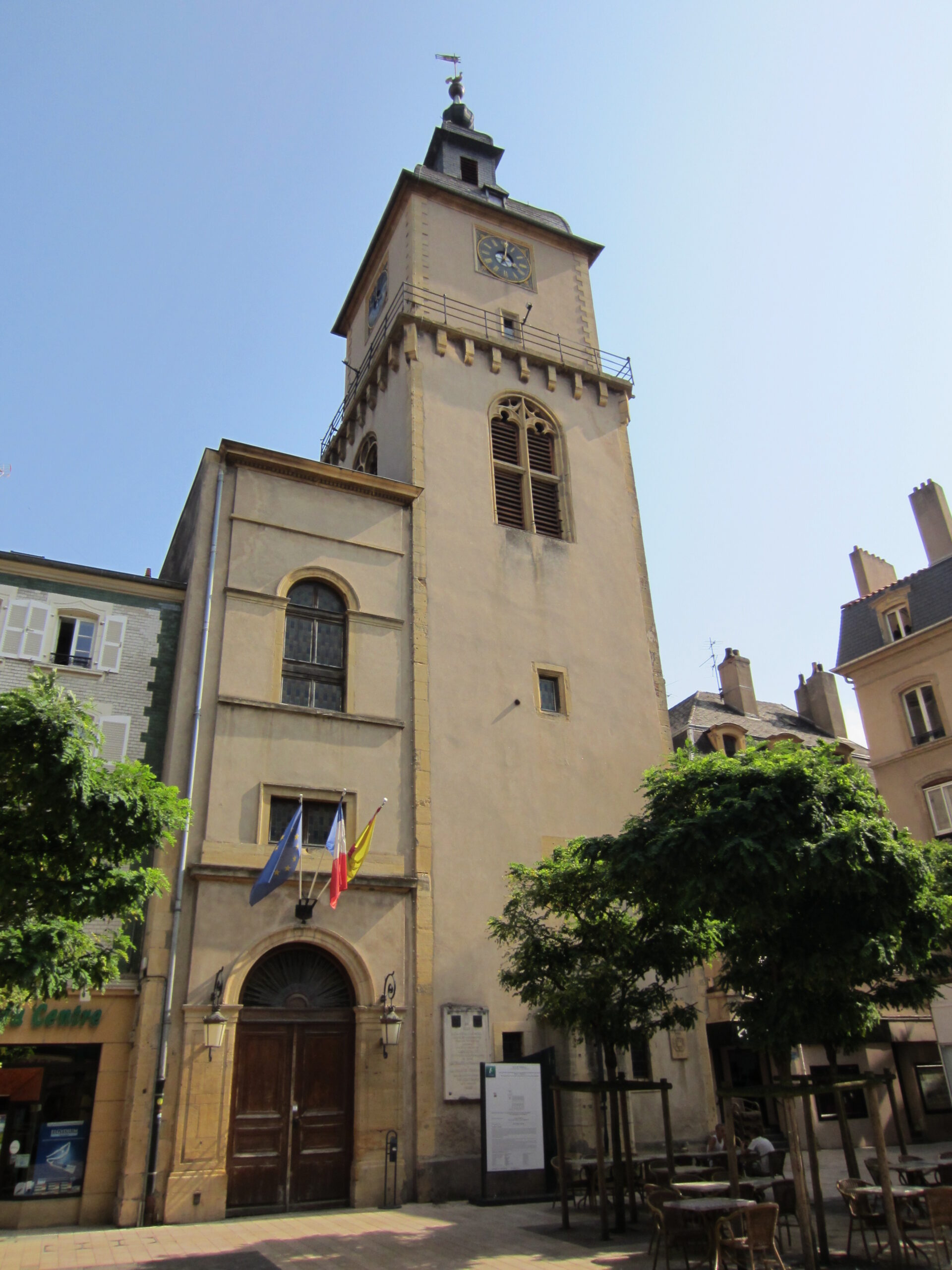
The tower standing today was rebuilt in the first half of the sixteenth century, while Charles V was having Thionville fortified; it appears clearly on Jacques de Deventer’s plan of about 1565. In 1699 the town had the upper part remade, with the clock stage under a high imperial roof. In 1708 the municipality moved into the large adjoining building, and stayed there until the early nineteenth century; that building was rebuilt in neoclassical style in 1836.
What you see
A square tower in pale stone, blank for most of its height, then a tall Gothic window with stone tracery and louvres where the bell hangs. Above that a walkway rides out on corbels, and the stage over it carries the clock face; the roof, with its little lantern, is the work of 1699. Inside, three vaulted rooms sit one above the other, their ribs restored.
The proportion is the point. A belfry of this kind was built to be seen from the fields outside the wall: it told you, before you reached the gate, that this was a town with its own liberties.
Practical information
- The tower is in the pedestrian centre of Thionville and can be seen from the street at any time.
- The interior opens for guided visits and for the European Heritage Days; check the organiser’s dates.
- The Salle du Beffroi, in the adjoining municipal building, is used for exhibitions and talks.
Getting there
Thionville is on the main line between Metz and Luxembourg; the station is about ten minutes on foot from the old centre.
Nearby
- The Tour aux Puces, the eleventh- or twelfth-century keep of the counts of Luxembourg, a museum of the town since 1904.
- The banks of the Moselle, along the quai Sainte-Catherine.
- Luxembourg City, half an hour north by train.
Sources
- French Wikipedia, Beffroi de Thionville — the charter of 1239 and the watchman recorded from 1315, the fourteenth-century belfry and the adjoining municipal building, the great bell from 1363, the sixteenth-century rebuilding under Charles V and the Deventer plan, the works of 1699, the municipality’s move in 1708 and the rebuilding of 1836, and the listing of 27 May 1980.
- French Wikipedia, Tour aux Puces — the keep’s date and its use as the municipal museum from 1904.
- Wikidata (Q815437) — coordinates and address.
Find it on the map
See this place and what’s around it →Historical events at this place (1)
📷 Become a Cultural Heritage Online photographer
Share your photos of places: they stay published under your name as the author. The more they're seen, the more you get noticed — and soon a contest will reward the most appreciated photos.
Log in or sign up free to add a photoIs this page about you?
This page is read by travellers and heritage enthusiasts who find it on Google. Tell us how you are connected to this place and we will take it from there.