
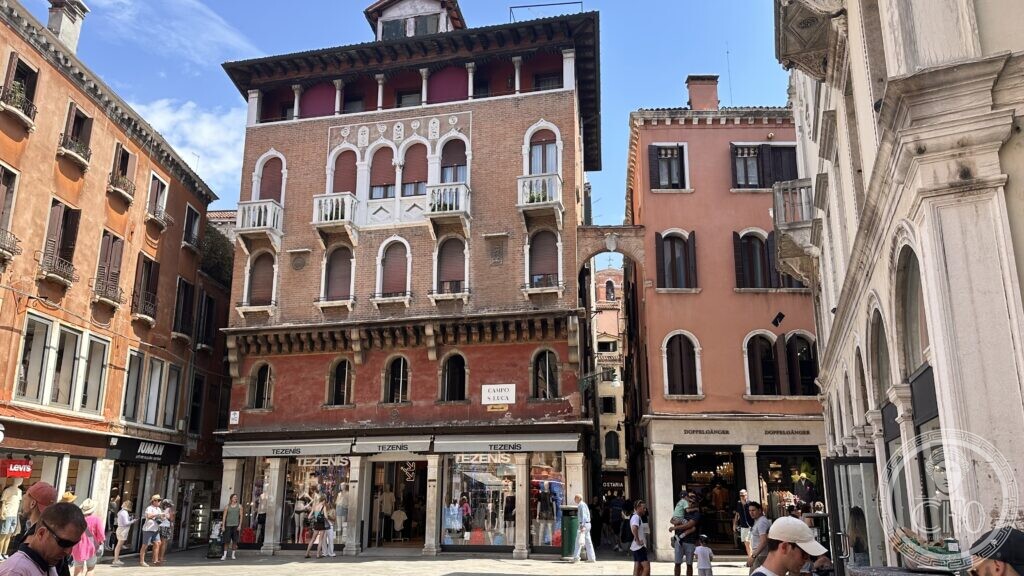
Halfway between Rialto and St Mark’s, Campo San Luca is one of Venice’s busiest meeting points — a small square with a legend attached to its flagpole and Gothic palaces standing on every side.
At a glance
Campo San Luca sits on the direct route between the Rialto Bridge and Piazza San Marco, which has made it, for centuries, one of the natural gathering points of the city — Venetians still use “vedemose a San Luca” (“let’s meet at San Luca”) as a stock phrase for arranging to meet. The square takes its name from the nearby church of San Luca, a hundred metres or so away overlooking the Rio di San Luca, and is ringed by Gothic and Gothic-Byzantine palace facades, among them Palazzo Corner Piscopia Loredan, Palazzo Dandolo Farsetti and Palazzo Grimani.
History
Tradition — recorded by the Venetian chronicler Cappellari, though its precision cannot be checked — credits the church of San Luca to Ottone Dandolo, son of a Domenico Dandolo who lived around the year 1000; the same family tradition also credits Ottone with the first Rialto Bridge and a residence of his own nearby. What is better documented is that in 1442 Fantino Dandolo increased the church’s revenues and assigned adjoining houses for a phase of rebuilding, and that the church underwent a further major reconstruction in 1581. In the nineteenth century its front suddenly collapsed; it was repaired and modernised under the parish priest Don Giuseppe Lazzari.
The campo itself once had its own theatre, the Teatro Vendramin a San Luca, which operated from 1622 to 1833 on the site now partly occupied by the Fenice’s rival stages of the day; the name survives in the nearby Corte del Teatro.
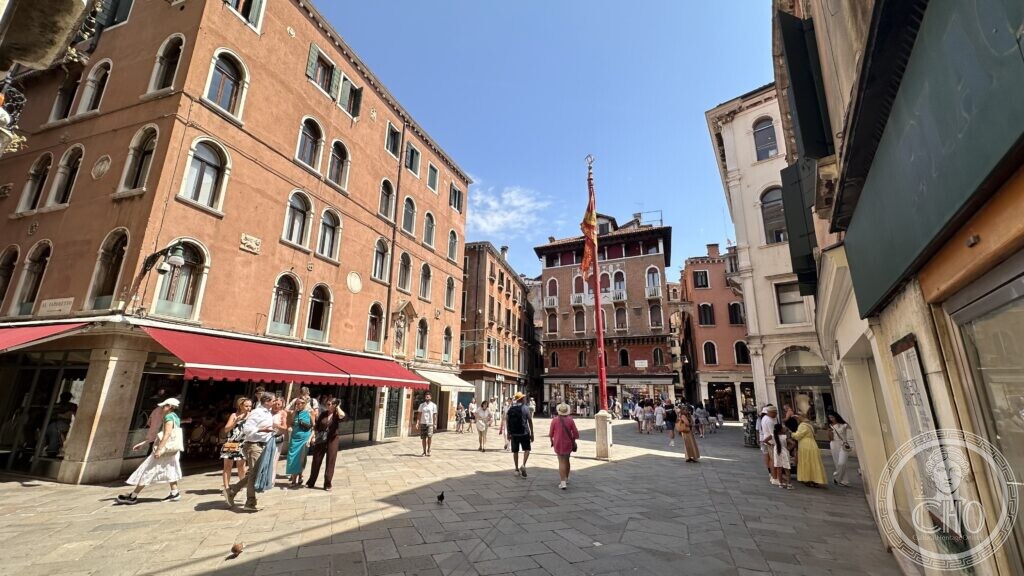
At the centre of the square stands a stone flagpole base, or cippo, first erected in 1310 and restored in 1791 (the date MDCCXCI is cut into the stone) and again in the twentieth century. Local tradition ties it to the defeat, on this spot, of rebels in the 1310 conspiracy of Baiamonte Tiepolo against the Republic — put down, the story goes, chiefly by the guardian of the Scuola Grande della Carità. The base carries carvings of a Venetian lion in the distinctive “moeca” (soft-shell crab) form, the emblem of the Carità confraternity, and Saint Luke, patron of the Venetian painters’ guild — a coincidence of dedication with the square’s own name. Some Venetians have long liked to say the flagpole marks the geographical centre of the city; the claim is true only in spirit, not on a map.
What you see
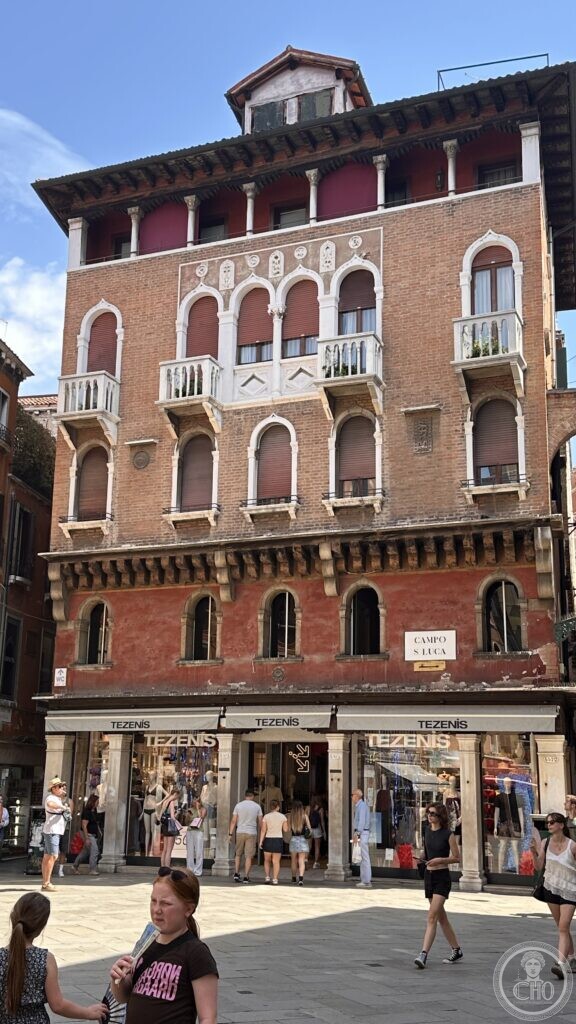
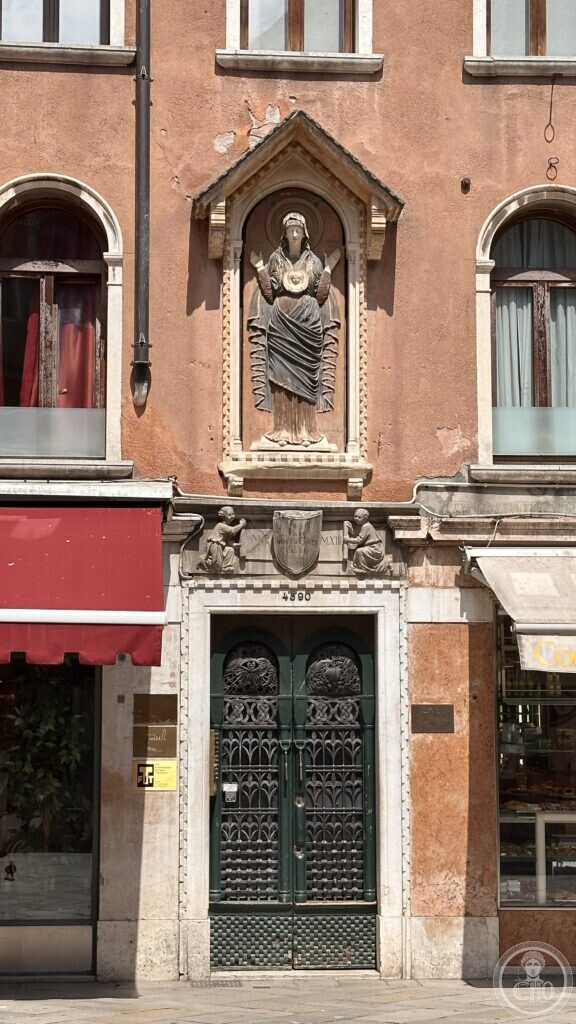
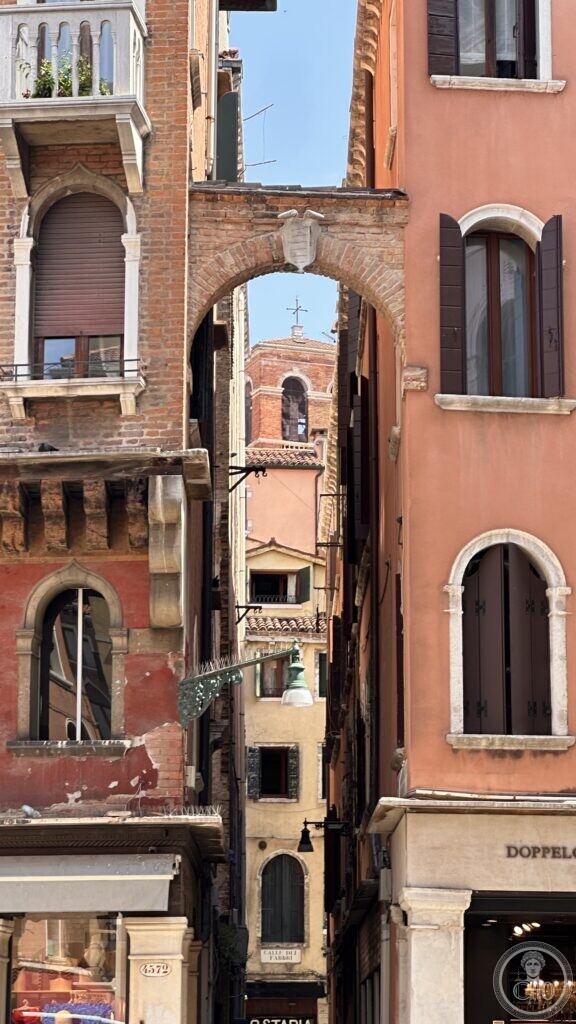
The square is closed on every side by tall Gothic and Gothic-Byzantine facades, their upper floors carrying mullioned windows, quatrefoil tracery and marble balconies, with a timber-roofed altana rooftop loggia crowning at least one of them — a rare survival of a feature that once let Venetian households dry laundry and bleach hair in the open air, high above the calli. Ground floors have long since been given over to shops; a low archway (sottoportego) beside the square opens onto a narrow calle with a bell tower visible in the distance. On the flank of one building a carved stone relief of a robed, haloed figure stands in a niche above a wrought-iron door, one of the many small devotional images that punctuate Venice’s streets and squares.
Key facts
- Location: Sestiere San Marco, Venice, midway between the Rialto Bridge and Piazza San Marco
- Named after: the nearby church of San Luca, traditionally linked to the Dandolo family
- Flagpole (cippo): erected 1310, restored 1791
- Former theatre: Teatro Vendramin a San Luca, 1622–1833
- Notable facades: Palazzo Corner Piscopia Loredan, Palazzo Dandolo Farsetti, Palazzo Grimani
- Coordinates: 45.4358° N, 12.3353° E
Getting there
Campo San Luca is a short walk from either the Rialto Bridge or Piazza San Marco, and from the Rialto or Sant’Angelo vaporetto stops. Google Maps.
Photo gallery
Sources
- Conoscere Venezia — Campo San Luca — church history, palaces, theatre
- Conoscere Venezia — the flagpole base of Campo San Luca — the cippo, its dates and its legend
Find it on the map
See this place and what’s around it →📷 Become a Cultural Heritage Online photographer
Share your photos of places: they stay published under your name as the author. The more they're seen, the more you get noticed — and soon a contest will reward the most appreciated photos.
Log in or sign up free to add a photoIs this page about you?
This page is read by travellers and heritage enthusiasts who find it on Google. Tell us how you are connected to this place and we will take it from there.