
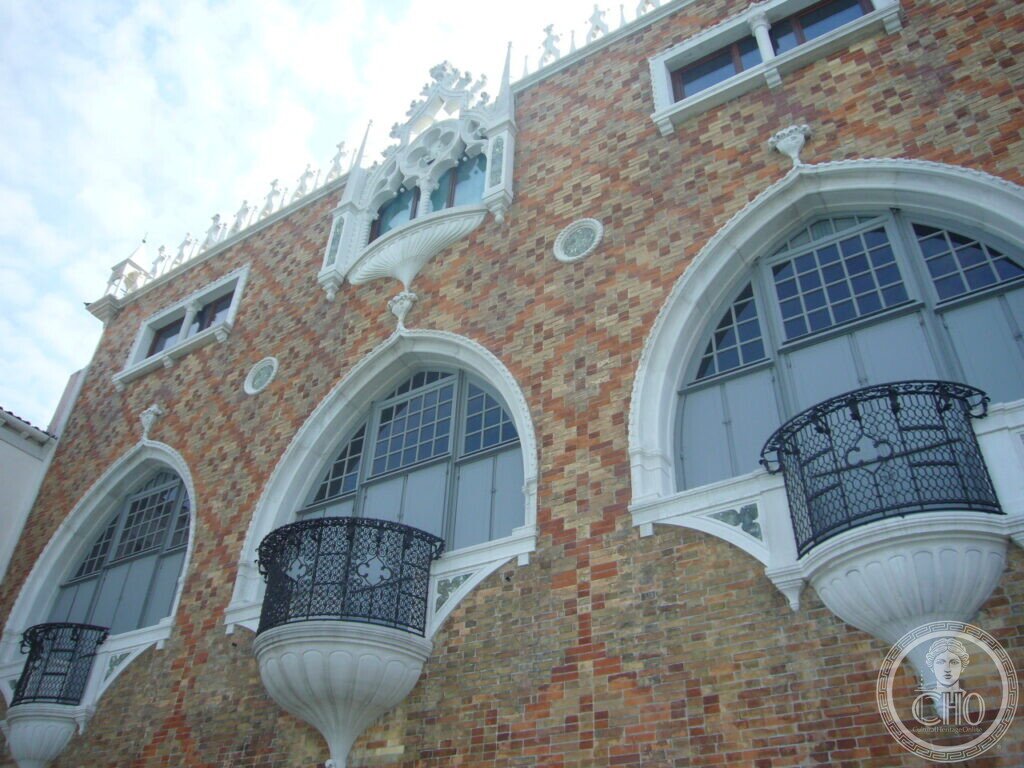
The painter Mario de Maria built himself a house with three great eyes on the Giudecca waterfront. Today the neo-Gothic landmark is the European seat of the Berggruen Institute.
At a glance
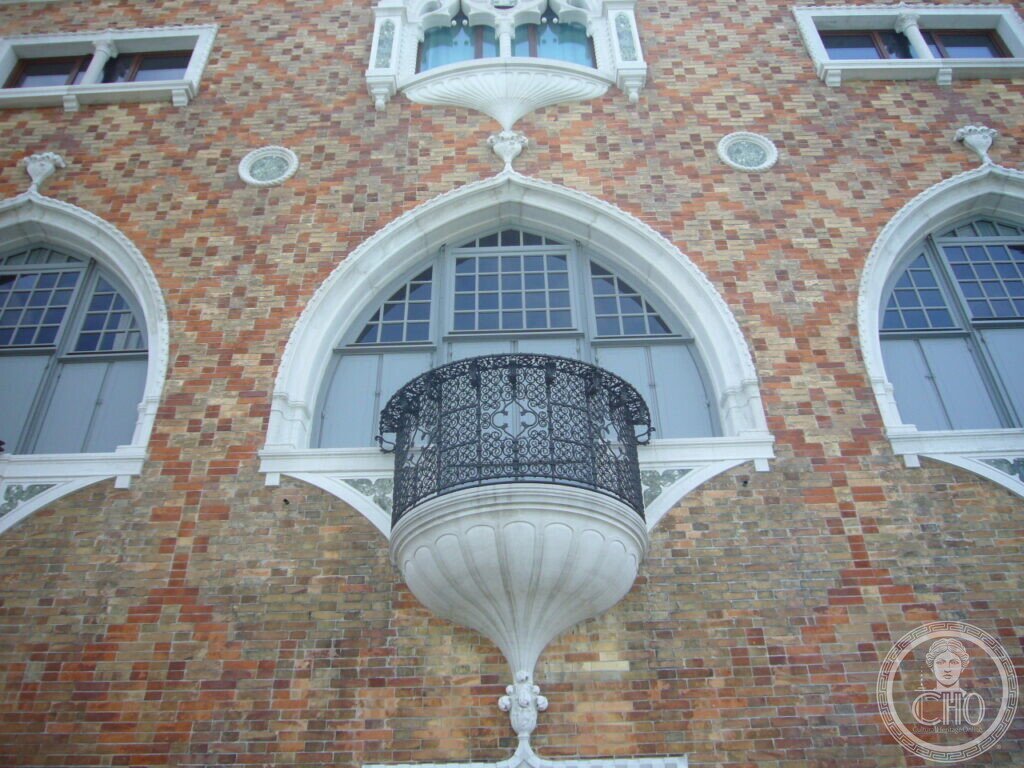
On the fondamenta delle Zitelle, looking straight across the Giudecca Canal at St Mark’s Basin, Casa dei Tre Oci takes its name from the three tall ogival windows — òci, eyes, in Venetian — that dominate its piano nobile. The painter and architect Mario de Maria, known as Marius Pictor (Bologna, 1852–1924), conceived it between 1912 and 1913 as his Venetian home and studio. The facade plays traditional Venetian Gothic against early-twentieth-century invention: patterned polychrome brickwork, white ogival frames, wrought-iron balconies swelling from fluted corbels. After decades as one of Italy’s best-known photography exhibition houses, the building was bought in 2021 by the Berggruen Institute, which runs it as its European hub.
Key facts
- Built: 1912–1913, as the home and studio of Mario de Maria (Marius Pictor, Bologna 1852–1924), painter and architect
- Style: neo-Gothic with modernist accents, on the model of the Venetian merchant house
- The three “eyes”: de Maria meant the three great windows to stand for the surviving members of his family — himself, his wife Emilia Voight and his son Astolfo; the bifora above them remembers his daughter Silvia, who died young
- Later life: home to architect Renzo Piano and, in the 1960s, to American Fulbright scholars; acquired by the Fondazione di Venezia in 2000 and long used for photography exhibitions
- Today: seat of Berggruen Institute Europe (purchased February 2021) — lectures, exhibitions and a publishing programme
- Location: Fondamenta de le Zitelle, Giudecca — approx. 45.4266 N, 12.3385 E — Google Maps
History
Mario de Maria was the only painter among the founders of the Venice Biennale generation to build his own manifesto in brick. Trained in Bologna and celebrated for his moonlit nocturnes as Marius Pictor, he designed the house between 1912 and 1913 on the Giudecca’s north shore, borrowing the tripartite front of the Venetian-Byzantine merchant house and stretching its proportions until the piano nobile became three enormous pointed eyes staring at St Mark’s. The programme was intimate as much as architectural: one window for himself, one for his wife, one for his son, and above them a smaller double window for the daughter he had lost.
The house stayed a house of images after him. Renzo Piano lived and worked here; American Fulbright scholars passed through in the 1960s. In 2000 the Fondazione di Venezia acquired it, and for years its floors carried the exhibitions that made “Tre Oci” shorthand for photography in Venice. In February 2021 the Berggruen Institute bought the building as its European seat: the eyes now watch over seminars on philosophy, technology and world order, alongside exhibitions that keep the address on the city’s cultural circuit.
What you see
From the fondamenta the facade reads as a single woven surface: courses of red, ochre and dark brick laid in diaper patterns, stitched with stone roundels. The three òci rise nearly the full height of the piano nobile, each glazed with slender iron mullions and fronted by a bulging wrought-iron balcony on a fluted white corbel — part Gothic pulpit, part ship’s prow. A crown of white pinnacles runs along the roofline. The detail rewards a slow look from the Zitelle vaporetto pontoon: no two patterned panels repeat exactly.
Practical information
- The building opens for exhibitions, lectures and public programmes of the Berggruen Institute Europe; check the institute’s calendar at berggruen.org before visiting.
- The facade is best seen from the fondamenta delle Zitelle at any time, or from a vaporetto crossing the Giudecca Canal.
Getting there
The house stands a few steps from the Zitelle vaporetto stop, at the eastern end of the Giudecca; the crossing from the San Marco side takes a few minutes. Google Maps.
360° view of the facade from the fondamenta on Google Street View
Photo gallery
Nearby
- Villa Hériot — the neo-Byzantine villa complex a short walk west along the Giudecca
- Former church of Santi Cosma e Damiano — the island’s restored craft and culture centre
- Cantiere Nautico Crea — the traditional gondola boatyard in the former shipbuilding compound
Sources
- Wikipedia — Casa dei Tre Oci — construction, symbolism, ownership history
- Wikipedia — Mario de Maria — the painter-architect’s dates and career
- Berggruen Institute (official) — the Venice hub at Casa dei Tre Oci and its programme
Find it on the map
See this place and what’s around it →Record researched and written by Carla Szathvary for Cultural Heritage Online, 2026.
📷 Become a Cultural Heritage Online photographer
Share your photos of places: they stay published under your name as the author. The more they're seen, the more you get noticed — and soon a contest will reward the most appreciated photos.
Log in or sign up free to add a photoIs this page about you?
This page is read by travellers and heritage enthusiasts who find it on Google. Tell us how you are connected to this place and we will take it from there.