
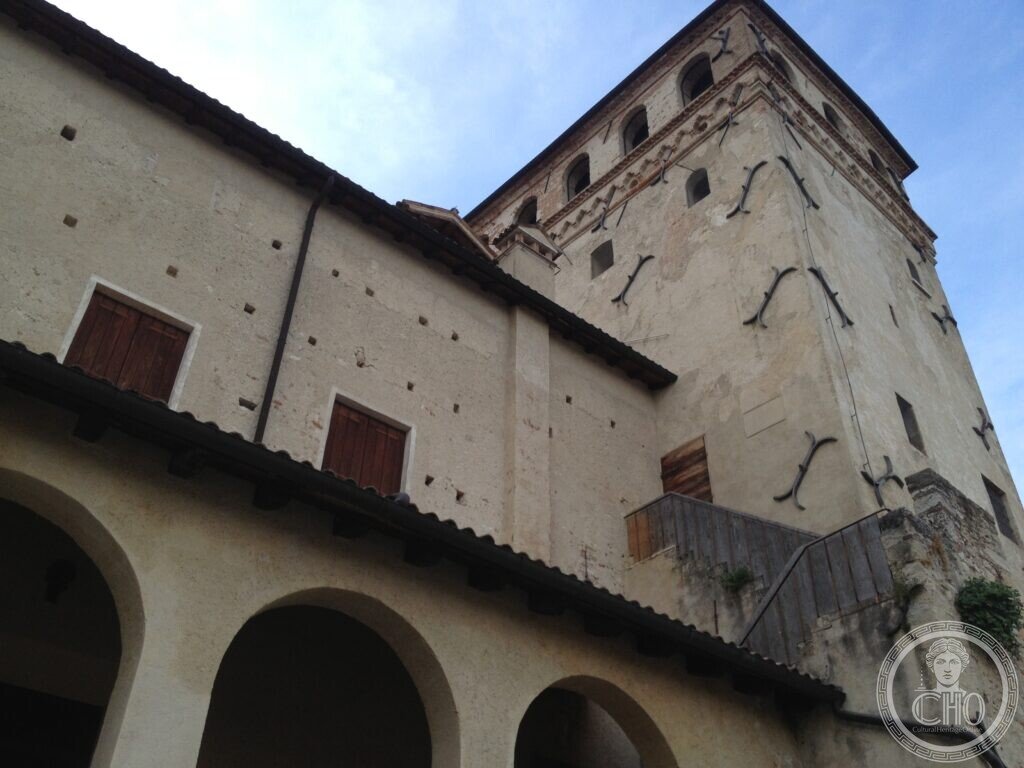
The hilltop castle where Caterina Cornaro, dethroned Queen of Cyprus, kept her Renaissance court for twenty years — and where Asolo now keeps its theatre, named for Eleonora Duse.
At a glance
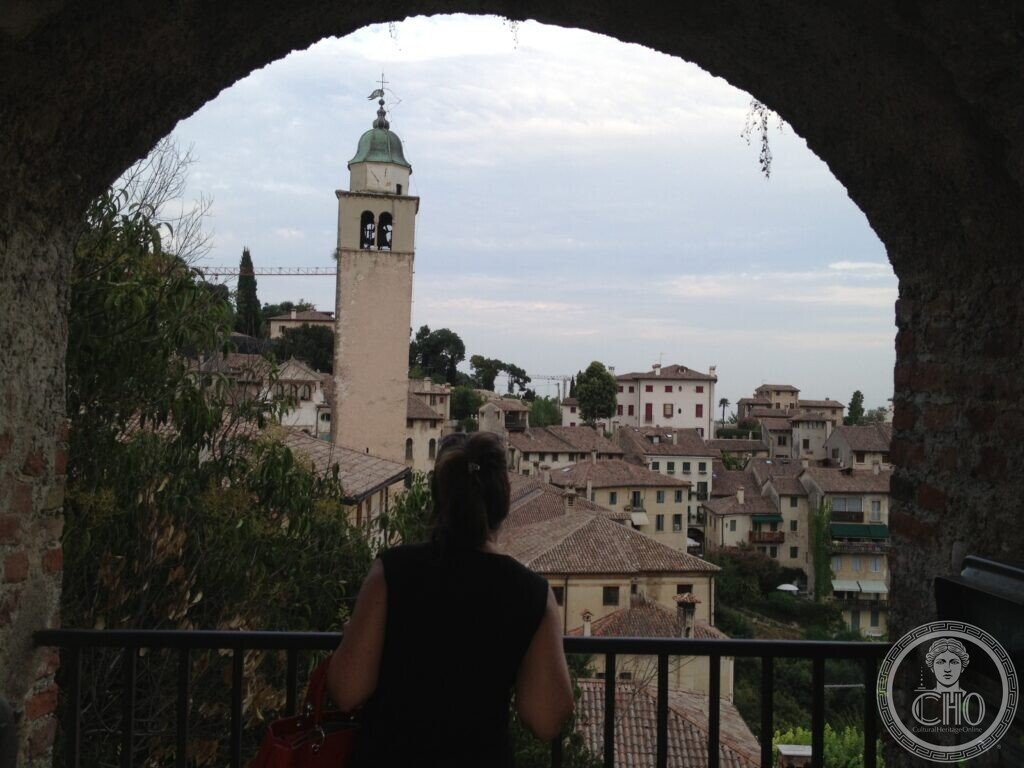
The castle stands at the top of Asolo’s historic centre, a compact complex of stone towers and walled gardens above the town’s arcaded streets. Documented from the end of the tenth century, it served Ezzelino da Romano, then the Venetian governors, and most famously Caterina Cornaro, Queen of Cyprus, from 1489 to 1510. Its great hall has been a theatre since the nineteenth century — today’s Teatro Duse — so the castle is that rare thing: a medieval fortress you can enter with a theatre ticket. From its terraces the view runs over the roofs of the town to the plain below, the “hundred horizons” Asolo is named for.
Key facts
- First documented: end of the 10th century
- Medieval lords: residence of Ezzelino da Romano in 1242; seat of the Venetian podestà from 1339
- Royal court: residence of Caterina Cornaro, Queen of Cyprus, Jerusalem and Armenia and Lady of Asolo, 1489–1510
- Her circle: Pietro Bembo — who set his dialogue Gli Asolani at this court — Andrea Navagero, Luigi da Porto
- Transformation: one wing demolished in 1820; the great hall converted into a theatre; since 1932 the Teatro Duse, named for Eleonora Duse
- Location: Via Regina Cornaro, Asolo (TV) — approx. 45.8021 N, 11.9130 E
History
Asolo’s castle enters the record at the end of the tenth century and spent the Middle Ages as the town’s seat of power: Ezzelino da Romano held it in 1242, and from 1339 it housed the podestà sent from Venice to govern the town and its hills. Its defining tenant arrived in 1489. Caterina Cornaro, the Venetian noblewoman who had become Queen of Cyprus, was persuaded by the Republic to abdicate her island throne; in exchange she received a pension and the lordship of Asolo. For twenty years, until her death in 1510, she kept court in this castle — a small, brilliant Renaissance world that drew poets and humanists. Pietro Bembo set Gli Asolani, his dialogues on love, at Caterina’s Asolo, and gave the town a verb: asolare, to pass time pleasantly and without purpose.
The castle’s later centuries were harder. By 1820 its condition forced radical surgery: an entire wing came down, and the great hall was rebuilt as a theatre, with the castle tower doing duty as civic and bell tower. After a period as a prison, the theatre was named for Eleonora Duse in 1932 — the great tragic actress who loved Asolo and is buried here — and the Teatro Duse still performs inside the castle today.
What you see
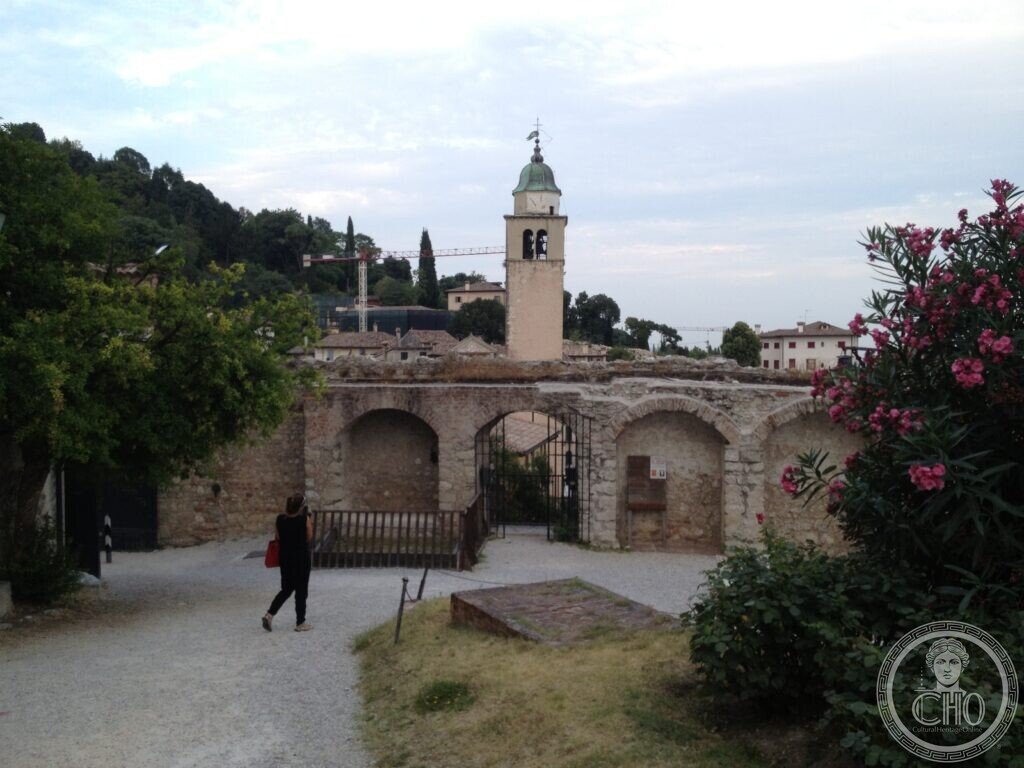
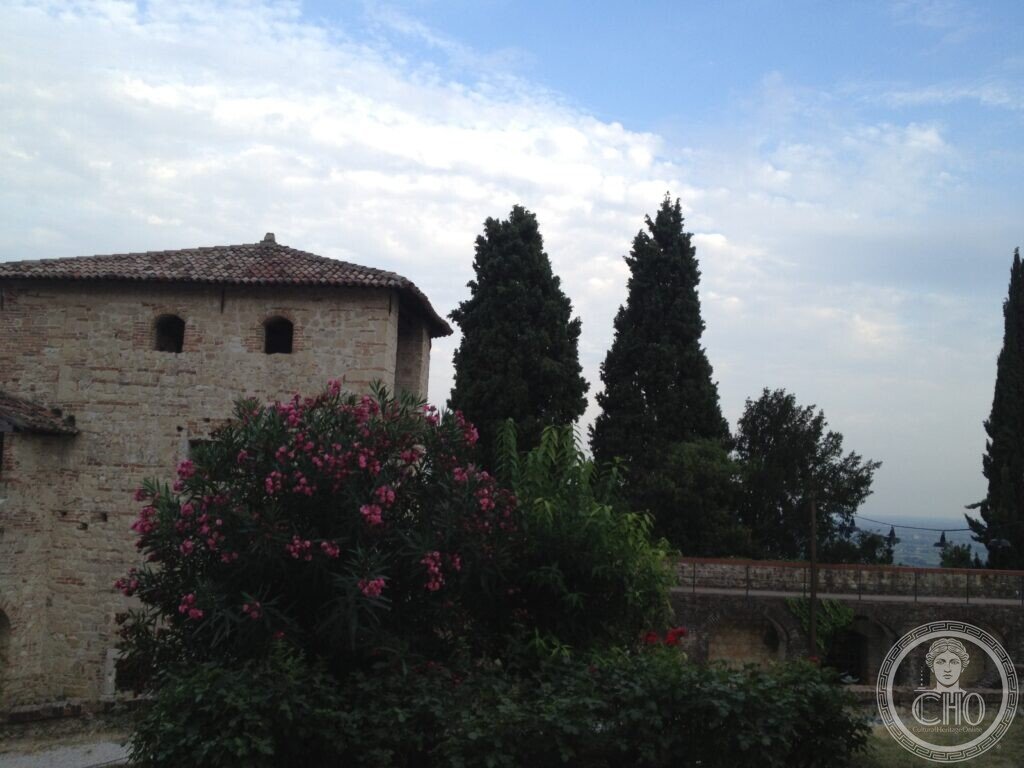
What survives is the fortress’s skeleton, legible and walkable: the main tower with its crown of brick arches, the lower stone tower — softened now by oleanders flowering against the walls — and the circuit of walls that closes the garden where the court once gathered. Through the arched gateway, the town drops away in a cascade of tiled roofs around the Duomo’s bell tower. The stone is bare and honest; almost nothing ornamental remains, which makes it easy to read the castle’s working life — fortress, palace, prison, theatre — in its patched walls.
Cultural significance
Few small-town castles carry so much literary weight. Caterina Cornaro’s court made Asolo a byword for cultivated leisure in Renaissance letters, and the association never faded: Robert Browning titled his last book Asolando after Bembo’s verb, and Eleonora Duse chose the town as her refuge and resting place. The castle is the anchor of that whole tradition — the reason a small hilltop town counts a queen, a poet and the greatest actress of her age among its ghosts.
Practical information
- The castle grounds are freely accessible from the historic centre; the Teatro Duse opens for performances and events.
- Combine the visit with the Civic Museum in the frescoed Loggia della Ragione, which holds the town’s collections on Caterina Cornaro and Eleonora Duse.
- The Rocca, the older fortress on the summit above the town, is a separate site reached on foot.
Getting there
Asolo is about 35 km north-west of Treviso; buses from Montebelluna and Bassano del Grappa stop below the historic centre, with a shuttle or a short uphill walk to the town. The castle is at the top of Via Regina Cornaro, a few steps from Piazza Garibaldi.
Nearby
- Asolo — the town, with its arcaded streets and hundred horizons
- Civic Museum of Asolo — in the frescoed Loggia della Ragione below the castle
Sources & resources
Find it on the map
See this place and what’s around it →Record researched and written by Carla Szathvary for Cultural Heritage Online, 2026.
📷 Become a Cultural Heritage Online photographer
Share your photos of places: they stay published under your name as the author. The more they're seen, the more you get noticed — and soon a contest will reward the most appreciated photos.
Log in or sign up free to add a photoIs this page about you?
This page is read by travellers and heritage enthusiasts who find it on Google. Tell us how you are connected to this place and we will take it from there.