
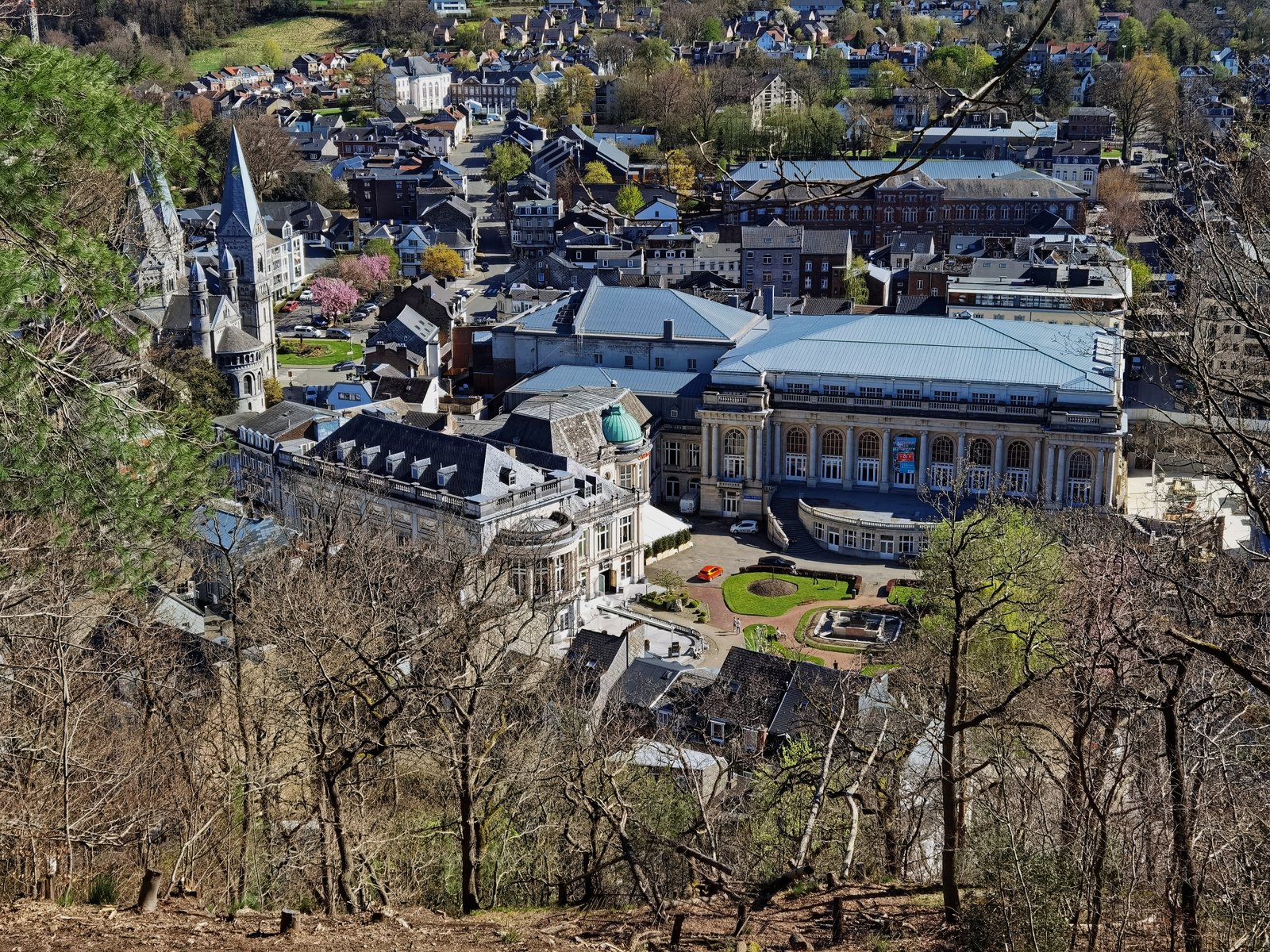

The town gave the world its word for this. Its 1868 bathhouse stands shuttered behind a protected facade; the tradition itself moved uphill, and now arrives by funicular.
At a glance
Spa gave English, French and most of Europe’s languages their generic word for a wellness resort, centuries before the concept had a name of its own. Visitors have come to take the waters at its mineral springs since at least the sixteenth century, and a stay by Tsar Peter the Great in 1717 turned a regional cure into an international fashion. The town’s grandest bathhouse, a Renaissance Revival hall by architect Leon Suys, opened in 1868 and served the town for a century and a half before closing in 2003. Today’s Thermes de Spa continues the tradition from a new building on a wooded hilltop above the old town, drawing on the same natural springs and reachable only by a funicular built for the purpose in 2004.
Key facts
- Institution founded: 1868, first purpose-built municipal baths, Place Royale
- Historic building (1862-68): architect Leon Suys, who also designed the Brussels Stock Exchange; Renaissance Revival style, facade sculpture by Jacques Van Omberg and the Van Den Kerkhove brothers
- Historic building status: closed 2003; protected heritage property of Wallonia since 1992, “exceptional heritage” status since 2016
- Current building: opened 2004 on Colline d’Annette et Lubin, architect Claude Strebelle; reached by a dedicated funicular from the town centre
- Recognition: Spa is the origin town of “The Great Spa Towns of Europe,” inscribed on the UNESCO World Heritage List on 24 July 2021 — eleven towns across seven countries, all built on the model Spa began
History
People have travelled to Spa to drink and bathe in its iron-rich mineral springs since at least the 1500s, but it was Tsar Peter the Great’s stay in 1717, at the spring later renamed Pouhon Pierre-le-Grand in his honour, that turned a local cure into a European fashion. Aristocrats and royals followed for two centuries; Belgium’s own Queen Marie-Henriette lived in the town for her final years and died there in 1902, her name later given to one of its springs.
In 1862 the town commissioned architect Leon Suys, who would soon design the Brussels Stock Exchange, to build a grand new bathhouse on Place Royale. It opened on 15 August 1868, with 54 individual baths and two treatments new to the town, effervescent baths and peat baths, built at a cost of 1.5 million Belgian francs. The building was modernised in 1905 and kept working through most of the twentieth century.
By 2003 the ageing Suys building could no longer serve the town’s needs, and it closed. A new facility opened in 2004 on the wooded Colline d’Annette et Lubin, designed by Liege architect Claude Strebelle and linked to the town centre by a funicular built the same year. The old bathhouse survives as a protected monument, its sculpted facade intact but its doors closed to bathers. In 2021, UNESCO recognised the wider pattern Spa had started three centuries earlier, inscribing the town alongside ten other spa towns across Europe as a single World Heritage Site.
What you see
On Place Royale, the 1862-68 bathhouse still reads as a civic monument built to impress: a two-storey Renaissance Revival stone facade carrying the sculpted work of Jacques Van Omberg and the Van Den Kerkhove brothers, closed to visitors but standing exactly where the whole idea of a European spa town took its most confident architectural form.
The current baths sit a world away in style. Strebelle’s 2004 building is glass and local stone set into the hillside, its rooms and pools oriented toward the forested slopes of the Ardennes rather than the street. The funicular ride up is part of the experience: a few minutes of climbing tree cover before the building opens onto the same mineral water that has drawn visitors here since before the town had a name for what it offered them.
Practical information
- Opening hours: Monday-Thursday and Saturday 9:00-21:00, Friday 9:00-22:00, Sunday 9:00-20:00
- Treatments: thermal pools, balneotherapy, facials, massage
- Access: by the funicular from the town centre, or by car (parking on site, EUR 2-3)
- Languages: staff assist in French, Dutch and English
- Time needed: half a day for a full visit
Getting there
Spa sits in Belgium’s Liege Province, about 35 km southeast of Liege and 140 km from Brussels. Trains run to Spa station via the SNCB network; the nearest airport is Liege Airport, roughly 40 minutes by car, with Brussels Airport about 1 hour 30 minutes away. From the town centre, the funicular built in 2004 climbs directly to the baths’ entrance.
Nearby
- Pouhon Pierre-le-Grand, the spring pavilion named for Peter the Great’s 1717 visit
- Parc de Sept Heures, with the 1878 Galerie Leopold II and its cast-iron colonnade
- The former 1862-68 Bains de Spa building on Place Royale, still standing as a protected monument
- Villa Marie-Henriette (1885), named for the Belgian queen who made Spa her home
Sources
Find it on the map
See this place and what’s around it →📷 Become a Cultural Heritage Online photographer
Share your photos of places: they stay published under your name as the author. The more they're seen, the more you get noticed — and soon a contest will reward the most appreciated photos.
Log in or sign up free to add a photoIs this page about you?
This page is read by travellers and heritage enthusiasts who find it on Google. Tell us how you are connected to this place and we will take it from there.