
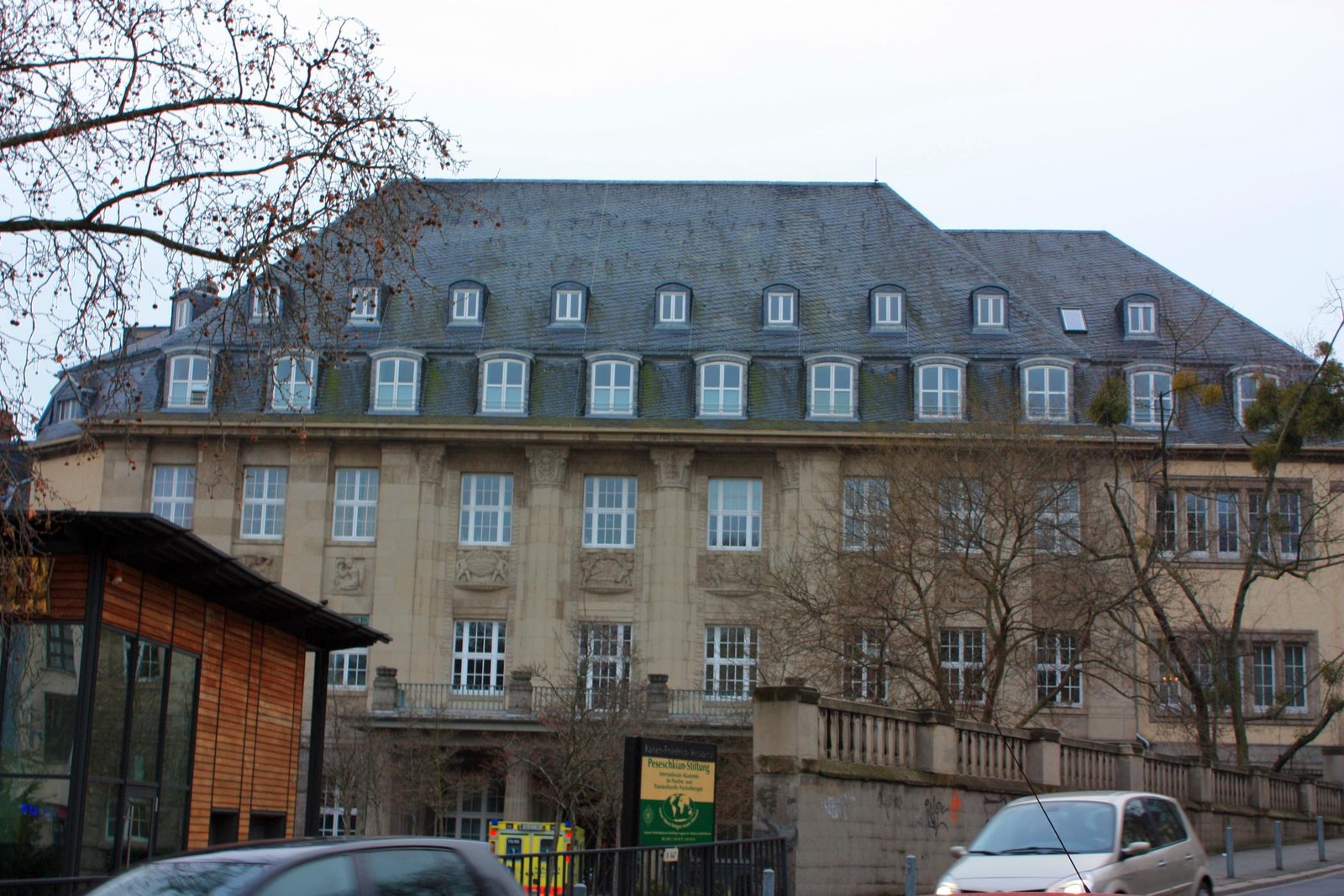

Excavators found a Roman sweat bath under this plot before the Jugendstil one went up around it — and the new building borrowed the old one’s plumbing logic.
At a glance
The Kaiser-Friedrich-Therme is a working thermal bath, not a museum piece: bathers still move naked between a tiled sudatorium and a cold plunge the way Wiesbaden’s Roman garrison once did on the same ground. City building inspector August O. Pauly designed the building between 1910 and 1913 in a reform-architecture idiom shot through with Jugendstil, feeding it from the Adlerquelle, the city’s second-largest thermal spring after the Kochbrunnen.
Key facts
- Address: Langgasse 38-40, 65183 Wiesbaden
- Built: 1910-1913, architect August O. Pauly, city building inspector
- Interior fittings: painter and interior architect Hans Völcker
- Tilework: Tepidarium and Sudatorium lined in glazed tiles by Josef Vinecký, a student of Henry van de Velde
- Water source: Adlerquelle spring, 64.6°C, second-largest thermal source in Wiesbaden
- Bathing policy: textile-free throughout
- Renovation: Irish-Roman bath section restored 1999
History
Before Pauly drew a single wall, workers on the site uncovered the foundations of a Roman sweat bath — Wiesbaden had been a garrison spa town since the first century, and its hot springs never stopped drawing bathers between then and 1910. Pauly took the discovery as a brief rather than an inconvenience: his Kaiser-Friedrich-Bad, completed in 1913, reproduces the Roman sequence of rooms almost exactly, heated the Roman way, through hypocausts under the tiled floors rather than visible radiators.
Around that Roman-derived plan, Pauly and his collaborators built a Jugendstil shell. Hans Völcker fitted the interiors to match the architecture room by room; Josef Vinecký, who had trained under the Belgian Art Nouveau architect and designer Henry van de Velde, lined the hot-air rooms in colored glazed tile that survives unaltered today. The foyer received the full decorative treatment — stucco and figurative reliefs meant to prepare visitors for the bath before they undressed for it.
The Irish-Roman bath wing underwent a four-million-Deutschmark restoration in 1999 that expanded the historic room sequence without replacing Vinecký’s tilework or Völcker’s fittings. A senior residence now stands attached to the bathhouse, and the pools remain in daily public use.
What you see
The building reads in two registers at once, the way most reform-era spa architecture does: functional volumes sized to Roman bathing logic, dressed in Jugendstil ornament that has nothing to do with ancient Rome. The 1,450-square-metre Irish-Roman bath sequence moves a bather through tepidarium, sudatorium and sanarium, past a Russian steam bath and Finnish sauna, before a tropical ice-rain room and frigidarium reverse the temperature curve — a full Roman circuit rebuilt in tile and glazed brick rather than marble.
The separate historic swimming hall keeps its water at a brisk 22°C under a foyer thick with stucco and relief work, the one room built purely to impress rather than to heat, steam or cool.
Practical information
- Dress code: textile-free (nude bathing) throughout the historic bath
- What to see even on a short visit: the tiled Tepidarium/Sudatorium and the stucco foyer
- Time needed: 2-3 hours for a full circuit through the Irish-Roman sequence
- Note for visitors: mixed-gender bathing is standard practice at this facility
Getting there
The Kaiser-Friedrich-Therme stands in central Wiesbaden on Langgasse, a short walk from the Kurhaus and the city’s other thermal-spring sites. Frankfurt Airport is roughly 30-40 minutes away by car or train via Wiesbaden Hauptbahnhof.
Nearby
- The Kochbrunnen, Wiesbaden’s largest thermal spring, feeding a public drinking fountain nearby
- The Wiesbaden Kurhaus and its surrounding spa gardens
- Wiesbaden is one of the “Great Spa Towns of Europe” inscribed on the UNESCO World Heritage List in 2021
Sources
Find it on the map
See this place and what’s around it →📷 Become a Cultural Heritage Online photographer
Share your photos of places: they stay published under your name as the author. The more they're seen, the more you get noticed — and soon a contest will reward the most appreciated photos.
Log in or sign up free to add a photoIs this page about you?
This page is read by travellers and heritage enthusiasts who find it on Google. Tell us how you are connected to this place and we will take it from there.