
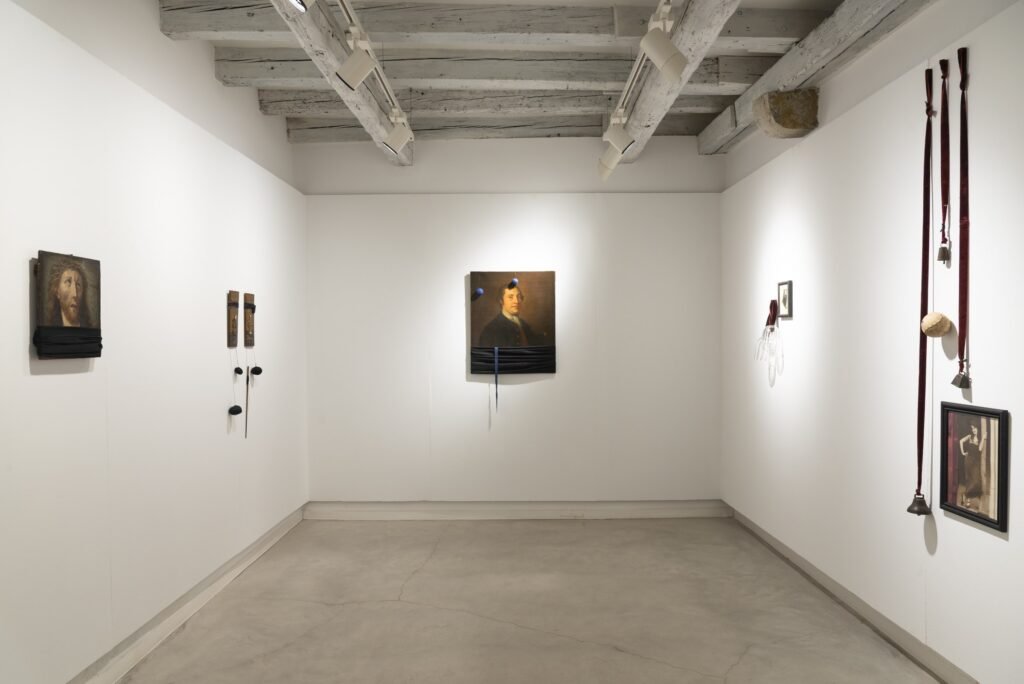
A contemporary art gallery on a Venetian street that used to be a canal, on the short walk between the Peggy Guggenheim Collection and the Punta della Dogana. White walls, a beamed ceiling, and a brick pier left where it was.
At a glance
- What — a private contemporary art gallery, the main exhibition space of Marignana Arte
- Where — Dorsoduro 141, Rio Terà dei Catecumeni, 30123 Venice
- Since — 2013, founded by Emanuela Fadalti and Matilde Cadenti
- Programme — more than eighty exhibitions and over a hundred artists, with institutional partners including Ca’ Pesaro, the Academy of Fine Arts in Venice and the Botanical Garden of Padua
The street it stands on
A rio terà, in Venice, is a street that used to be water: a canal filled in, paved over, and left with the shape of the waterway still legible in the way the houses face it. Rio Terà dei Catecumeni is one of them, a short run of paving in the southern corner of Dorsoduro, between the Salute and the Zattere.
Its name comes from the institution that once stood along it. In 1557 the Venetian Republic founded the Pia Casa dei Catecumeni, a house for prisoners of war and enslaved people of non-Christian faith who chose to convert — a very Venetian arrangement, part charity, part diplomacy, part bookkeeping of a maritime empire. After Lepanto in 1571 the numbers grew and the institution was moved to a plot near the Dogana da Mar. In 1727 Giorgio Massari, one of the last great architects of the Republic, was commissioned to replace its oratory with a proper church; the church of San Giovanni Battista ai Catecumeni still stands on the street, an Istrian stone front with a round window, and inside it a Baptism of Christ by Leandro Bassano. Massari built it facing the canal. The canal is the street.
The space
The gallery occupies a ground-floor Venetian interior that has been cleared rather than reconstructed. The walls are plain white and the floor is a continuous grey screed; above, the original timber ceiling has been left exposed, joists and beams and all, with track lighting run along them. In one corner a structural brick pier and the springing of an old arch have been stripped back to the brick and left visible against the white.
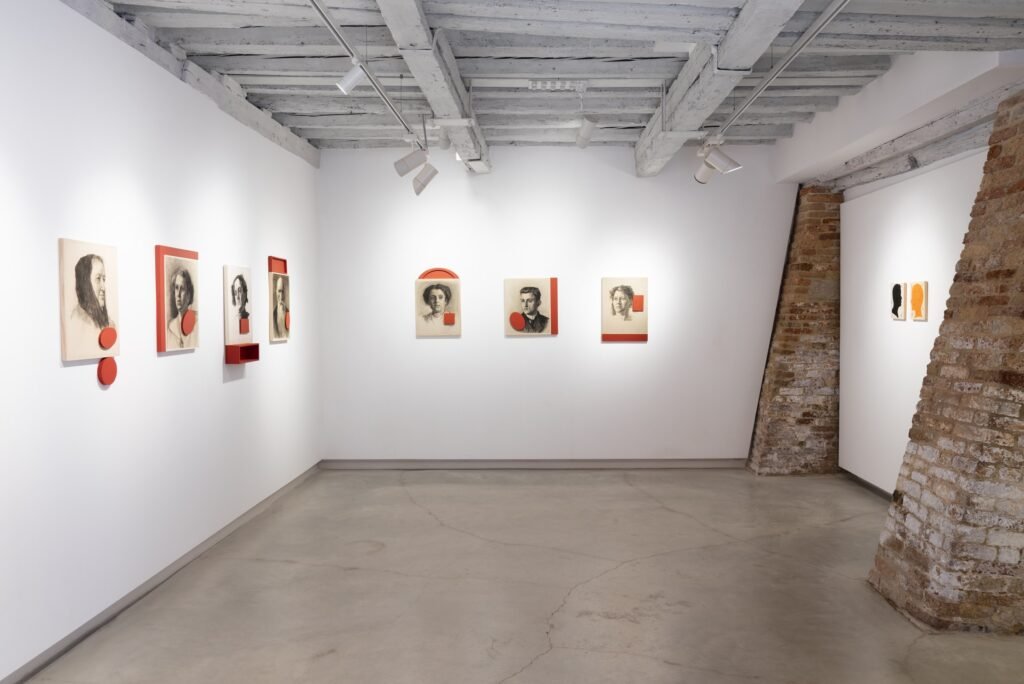
It is a small space and it is worked hard: the rooms are hung tightly, and the ceiling, which in most galleries would be a distraction, becomes part of the argument — contemporary work shown under the beams of an old Venetian house, without either being asked to pretend the other is not there.
What it does
Marignana Arte was founded in 2013 by Emanuela Fadalti and Matilde Cadenti, and has grown into four spaces: this gallery; Marignana Project, a few doors along the same street, for emerging practice and for exhibitions arising from open calls and prizes; Spazio Berlendis, a restored historic carpentry workshop in Cannaregio, opened in 2021, which also hosts residencies and concerts; and a studio at Mogliano Veneto on the mainland. Since 2025 the Berlendis Venice Art Prize and the Berlendis Venice Residency have run out of the Cannaregio space.
The gallery has worked with more than a hundred artists and has taken on institutional projects as well as its own programme, including national pavilions at the Venice Biennale. For a visitor, the practical point is the position: it sits on the walk between the Guggenheim and the Punta della Dogana, which is to say on one of the densest stretches of contemporary art in the city, and it is free.
Practical information & getting there
Dorsoduro 141, Rio Terà dei Catecumeni. The nearest vaporetto stops are Salute (line 1) and Zattere (lines 2, 5.1, 6); from the Accademia the walk is about ten minutes past the Guggenheim. Admission is free. Opening hours change with the exhibition — check the gallery’s own site before setting out.
Exhibitions currently running: I Ritratti Perduti — Maurizio Pellegrin, to 21 November 2026.
Sources & resources
- Marignana Arte — for the founding date, the founders, the four spaces, the exhibition history and the addresses.
- Chiesa dei Catecumeni — for the Pia Casa dei Catecumeni of 1557, the move after 1571, Giorgio Massari’s church of 1727 and the Leandro Bassano altarpiece.
- Photographs supplied by the gallery, for the state of the rooms.
Find it on the map
See this place and what’s around it →Events here — now on & upcoming
- I Ritratti Perduti: Maurizio Pellegrin at Marignana Gallery, Venice22 May 2026 — 21 Nov 2026See the event →
📷 Become a Cultural Heritage Online photographer
Share your photos of places: they stay published under your name as the author. The more they're seen, the more you get noticed — and soon a contest will reward the most appreciated photos.
Log in or sign up free to add a photo