

A stone village on the left bank of the Trebbia, grown in the shelter of the Anguissola castle, where the lanes end in river light and the dark cone of Pietra Parcellara closes the horizon.
At a glance
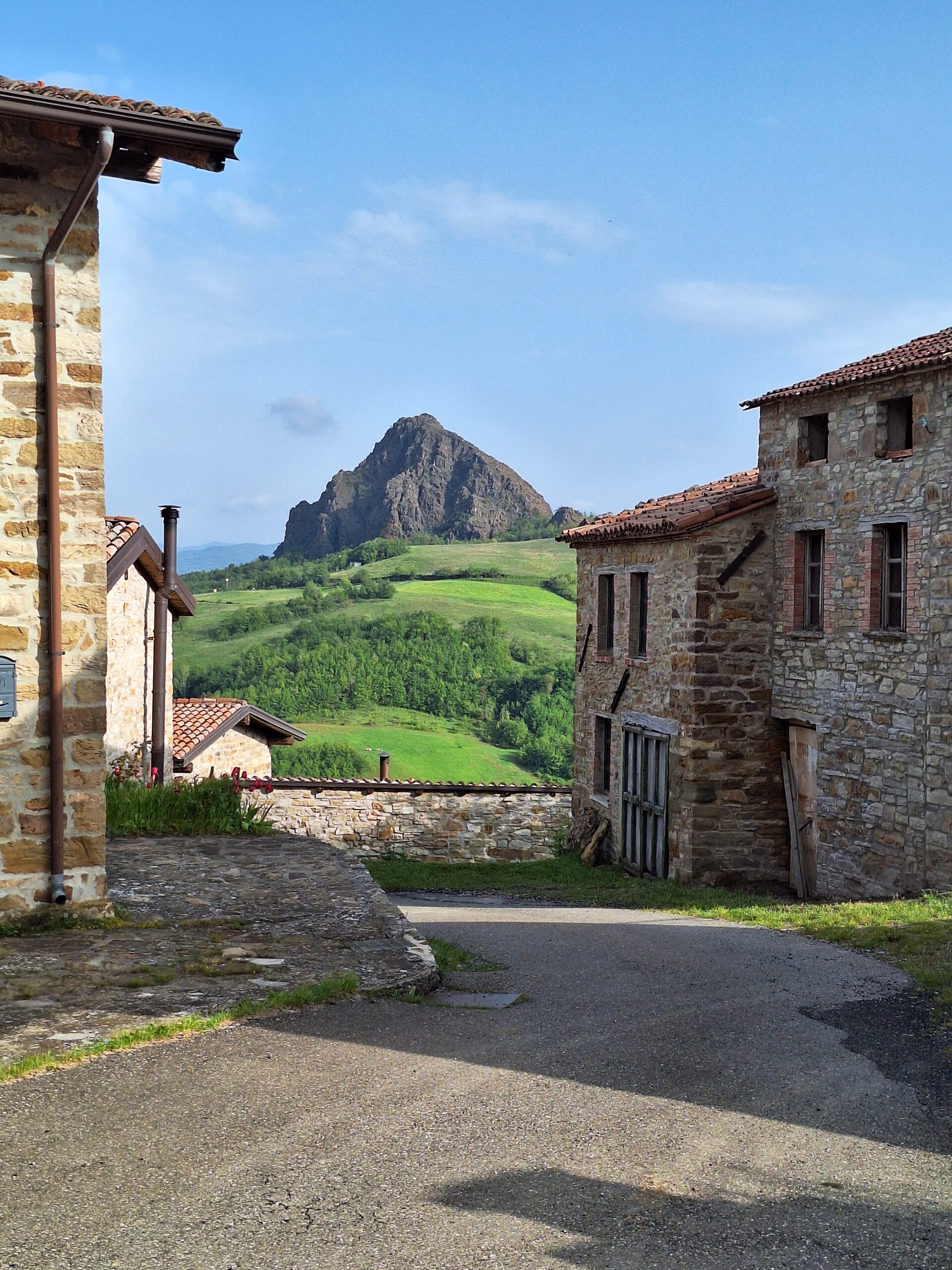
Travo sits where the Trebbia broadens over pale gravel, twenty-odd kilometres upstream from Piacenza. The village is compact and mineral: rubble-stone houses under sandstone roofs, lanes that open without warning onto the river or onto green terraces of the valley. It grew behind the castle of the Anguissola counts, protected by the fortress on one side and the water on the other, and it has kept that medieval logic intact. An arched road bridge crosses the Trebbia below the bell tower, and on clear days the profile of Pietra Parcellara, the bare ophiolite peak of the lower valley, stands over the rooftops.
Key facts
- Setting: left bank of the Trebbia, Val Trebbia, province of Piacenza
- Origin: medieval village formed behind the Anguissola castle
- Fabric: stone houses and lanes, river terraces, arched road bridge over the Trebbia
- Landmark: the ophiolite cone of Pietra Parcellara above the valley
- Cultural life: Civic Archaeological Museum in the castle; Neolithic park at Sant’Andrea; the Giana Anguissola literary evenings
History
The valley made the village. The Trebbia has been a road since antiquity, and the terrace at Travo has drawn settlers for six thousand years: the Neolithic farmers of Sant’Andrea chose the same bank, a few hundred metres upstream, at the end of the fifth millennium BC. The medieval borgo formed in the shadow of the Anguissola fortress, its houses packed inside the natural defences of river and castle, and the pattern never broke; the counts remodelled their walls into a residence in the late 1700s, the village kept its lanes.
Its quiet twentieth century had one literary exception. From 1948 the writer Giana Anguissola (1906–1966) spent her summers here, writing in the castle tower, and the village has built a small cultural season around her memory, with readings in the piazzetta and a national literary prize. Between the museum in the castle, the reconstructed Neolithic huts at the park, and the swimmers who claim the gravel beaches each July, Travo carries more history per metre of riverbank than almost any village of the valley.
What you see
Walk in from the bridge and let the lanes do the work. The walls are river stone laid in rough courses, warmed by brick around the openings; a gutter of light runs down each alley and ends in a rectangle of landscape, green pasture, poplars, the sudden dark pyramid of Pietra Parcellara. From the far bank the whole village composes itself in one line: gravel, water the colour of pale jade, the terrace wall, the roofs, the bell tower with its clock and lantern top.
Practical information
- The village is freely accessible year-round; summer is high season for river bathing on the Trebbia.
- The Civic Archaeological Museum in the castle and the Neolithic park at Sant’Andrea follow their own opening hours.
- Allow an hour for the village and riverbank, half a day with park and museum.
Getting there
Travo is about twenty kilometres south-west of Piacenza on the SS45 Piacenza–Bobbio road; buses on the Val Trebbia line stop in the village. GPS: 44.86246, 9.54537 — open in Google Maps.
Nearby
- Castello Anguissola — Travo — the fortress the village grew behind.
- Archaeological Park, Neolithic Village of Travo — the Sant’Andrea site upstream.
Sources
- Turismo a Piacenza — Comune di Travo, on the village, the castle and the valley.
- Soprintendenza ABAP Parma e Piacenza — Parco Archeologico del Villaggio neolitico di Travo S. Andrea, on the Neolithic settlement.
- Visit Piacenza — Giana Anguissola, on the writer’s summers in Travo.
- Travo e le due Pietre (travoeleduepietre.com) — local association, on the village and the Pietra Parcellara landscape.
Gallery
Photographs by Roberta Valla.
Find it on the map
See this place and what’s around it →📷 Become a Cultural Heritage Online photographer
Share your photos of places: they stay published under your name as the author. The more they're seen, the more you get noticed — and soon a contest will reward the most appreciated photos.
Log in or sign up free to add a photo