
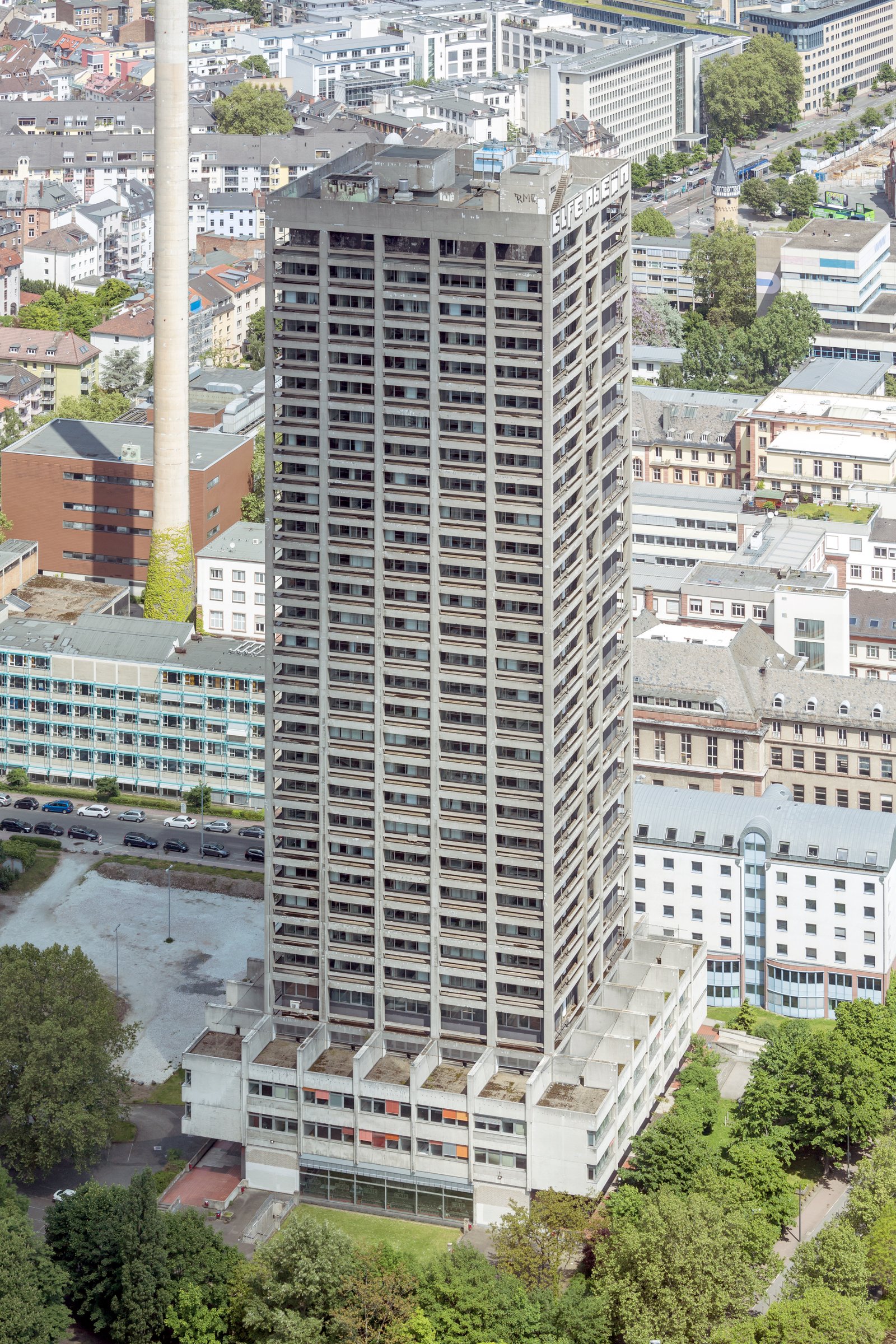
A 38-storey modernist tower that dominated Frankfurt’s skyline for two years, housing university departments before its demolition in 2014.
At a glance
The AfE-Turm was a 116-metre (381 ft) skyscraper in the Westend district, featuring 30 floors on its south side and 22 on its north. Completed in 1972, it briefly held the distinction of being Frankfurt’s tallest building—a title it retained until 1974.
History
The tower was built as part of the Bockenheim campus of Johann Wolfgang Goethe University. Its acronym, AfE, stood for Abteilung für Erziehungswissenschaft (Department of Pedagogy), yet ironically that department never occupied the building. The pedagogical department was closed before construction finished, leaving the tower to serve other university functions. From its completion until 2013, the AfE-Turm housed offices and seminar rooms for the departments of Social Sciences and Education. The building was demolished on 2 February 2014.
What you see
The tower’s asymmetrical profile—with differing floor counts on its north and south faces—gave the building its distinctive silhouette. The modernist structure exemplified 1970s German institutional architecture and urban ambition.
Cultural significance
The AfE-Turm represented Frankfurt’s rapid vertical expansion during the early 1970s, when the city competed to build ever-taller structures. Though its reign as the city’s highest building lasted only two years, it marked a pivotal moment in the metropolis’s transformation into a financial and architectural powerhouse.
Key facts
- Height: 116 metres (381 feet)
- Storeys: 38 (30 on south side, 22 on north)
- Location: Westend district, Frankfurt-Innenstadt II
- Completed: 1972
- Demolished: 2 February 2014
- Frankfurt’s tallest building: 1972–1974
Practical information & getting there
The AfE-Turm no longer stands. The site was located in Frankfurt’s Westend, a district accessible by public transport; however, the building’s demolition means no visit is possible.
Sources & resources
Find it on the map
See this place and what’s around it →📷 Become a Cultural Heritage Online photographer
Share your photos of places: they stay published under your name as the author. The more they're seen, the more you get noticed — and soon a contest will reward the most appreciated photos.
Log in or sign up free to add a photoIs this page about you?
This page is read by travellers and heritage enthusiasts who find it on Google. Tell us how you are connected to this place and we will take it from there.