
Anniversary: The Destruction of the Abbey of Monte Cassino — February 15, 1944
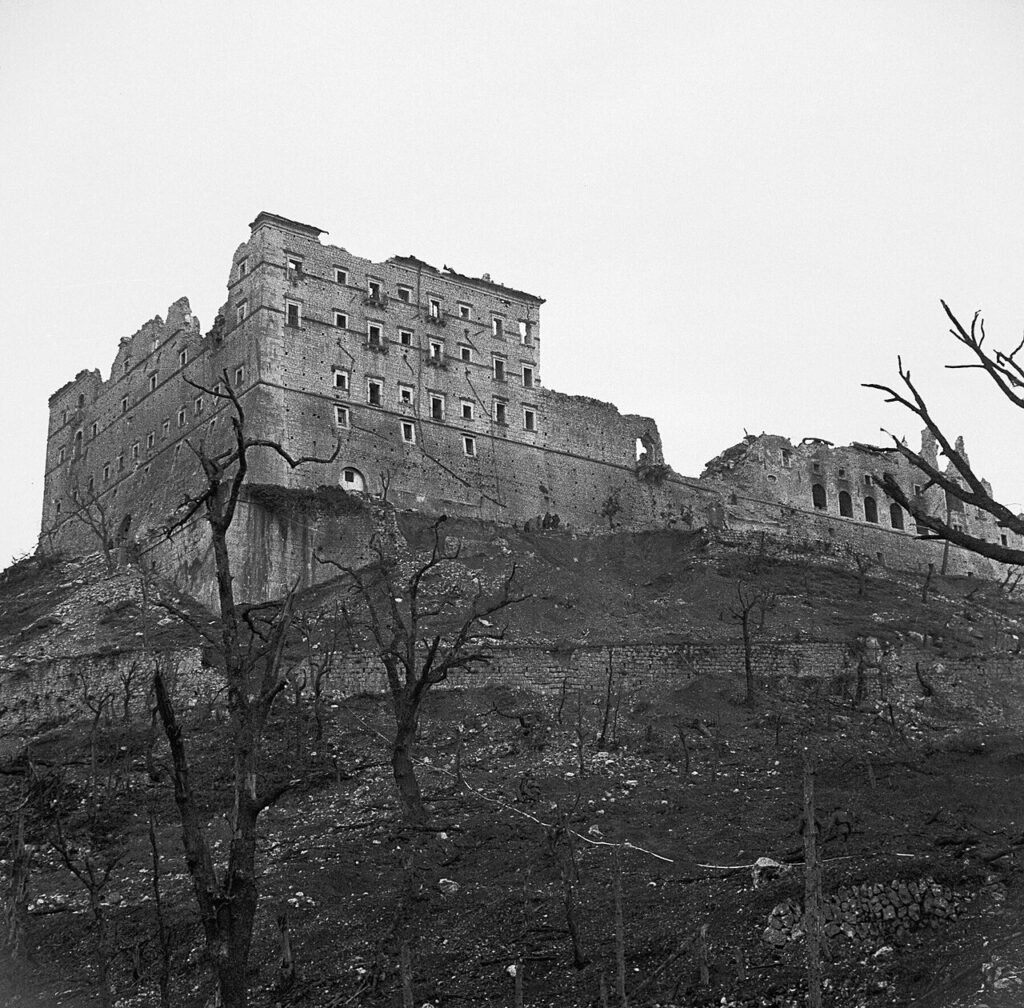
On the morning of 15 February 1944, 142 B-17 heavy bombers and 87 B-25 and B-26 medium bombers dropped roughly 1,150 tonnes of high explosive and incendiaries on the abbey of Monte Cassino, founded by Benedict of Nursia in 529. One wall of the building was left standing. There were no soldiers inside: there were civilians from the surrounding villages who had taken refuge there, and roughly 230 of them died under the bombs.
The decision was made on evidence that part of the Allied command already considered thin at the time. The bombing was requested by Gen. Francis Tuker of the 4th Indian Division and passed on by Gen. Freyberg; Mark Clark opposed it and gave way only under a direct order from Alexander — «give me a direct order and we’ll do it». Air force Gen. Ira Eaker reported seeing a radio aerial and German uniforms drying overhead; Geoffrey Keyes, commanding US II Corps, flew over the same position and saw nothing, remarking that people who kept looking eventually began to see things that were not there. The Germans, for their part, had committed not to use the abbey for military purposes, and the positions they held were on the slopes below its walls.
The military result was the opposite of what was sought. Paratroopers of the German 1st Parachute Division moved into the ruins and turned them into a fortress and observation post: the rubble offered cover the intact building never would have. New Zealand Brigadier Howard Kippenberger, summing up the day, wrote that they had asked themselves whether they had gained anything. A month later, on 15 March, it was the town of Cassino’s turn: 750 tonnes of bombs in three and a half hours, only half of which fell within a mile of the target. The abbey was rebuilt after the war to its original plans.
The Monte Cassino abbey entry tells the fourteen centuries that preceded that morning, and the reconstruction that followed it.
📷 Become a Cultural Heritage Online photographer
Share your photos of events: they stay published under your name as the author. The more they're seen, the more you get noticed — and soon a contest will reward the most appreciated photos.
Log in or sign up free to add a photo