

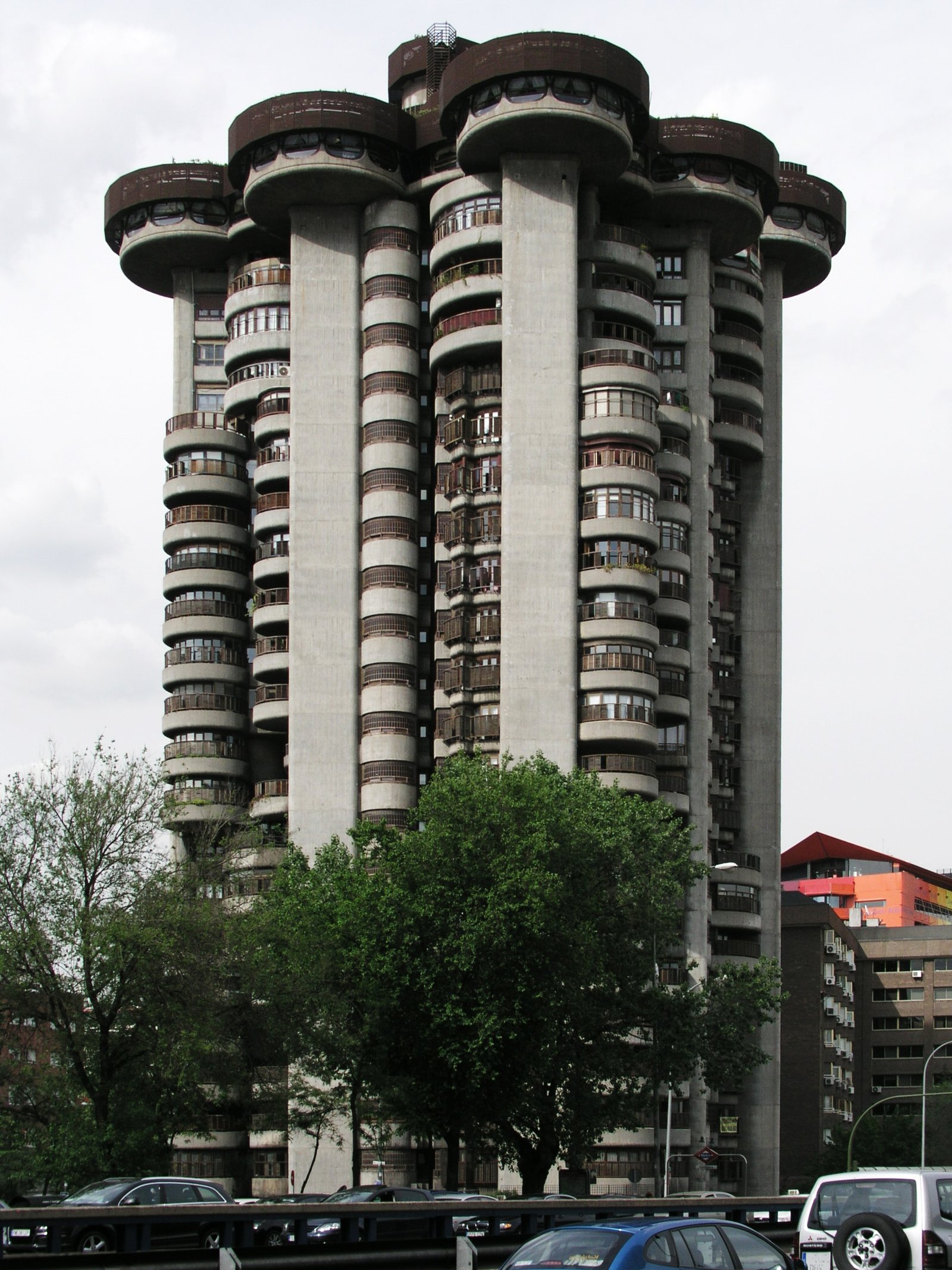
A landmark concrete mixed-use building that exemplifies Spanish Organicism, commissioned by industrialist Juan Huarte and designed by architect Francisco Javier Sáenz de Oiza.
At a glance
Torres Blancas stands as a significant work of modern Spanish architecture. The building combines residential and mixed-use functions within a sculptural concrete form. Its organic architectural language distinguishes it from the rationalist modernism of its era.
History
Commissioned by Spanish industrialist Juan Huarte, Torres Blancas was designed by Francisco Javier Sáenz de Oiza in 1961. The project initially comprised two residential towers, reflecting the post-war expansion and modernization of Madrid’s urban fabric during Spain’s economic development.
What you see
The building’s concrete structure unfolds with organic, flowing forms characteristic of the Organicist movement. The sculptural massing and textured surfaces create dramatic interplay of light and shadow across the façade. Interior spaces respond to the building’s curved geometry, offering distinctive spatial experiences within the mixed-use program.
Cultural significance
Torres Blancas represents a distinctive voice within European modernism, positioning Spanish Organicism as an alternative to both rigid functionalism and decorative traditionalism. The building has attracted cultural attention beyond architecture, serving as a location for contemporary music and media production.
Key facts
- Designed by Francisco Javier Sáenz de Oiza
- Completed in 1961
- Location: Madrid, Spain
- Coordinates: 40.43987, -3.67187
- Architectural style: Spanish Organicism
- Commissioned by Juan Huarte
Practical information & getting there
Torres Blancas is located in Madrid at coordinates 40.43987, -3.67187. As a private mixed-use building, access to interior spaces may be limited. The exterior can be appreciated from surrounding streets in the Chamartín district.
Sources & resources
Find it on the map
See this place and what’s around it →📷 Become a Cultural Heritage Online photographer
Share your photos of places: they stay published under your name as the author. The more they're seen, the more you get noticed — and soon a contest will reward the most appreciated photos.
Log in or sign up free to add a photoIs this page about you?
This page is read by travellers and heritage enthusiasts who find it on Google. Tell us how you are connected to this place and we will take it from there.