
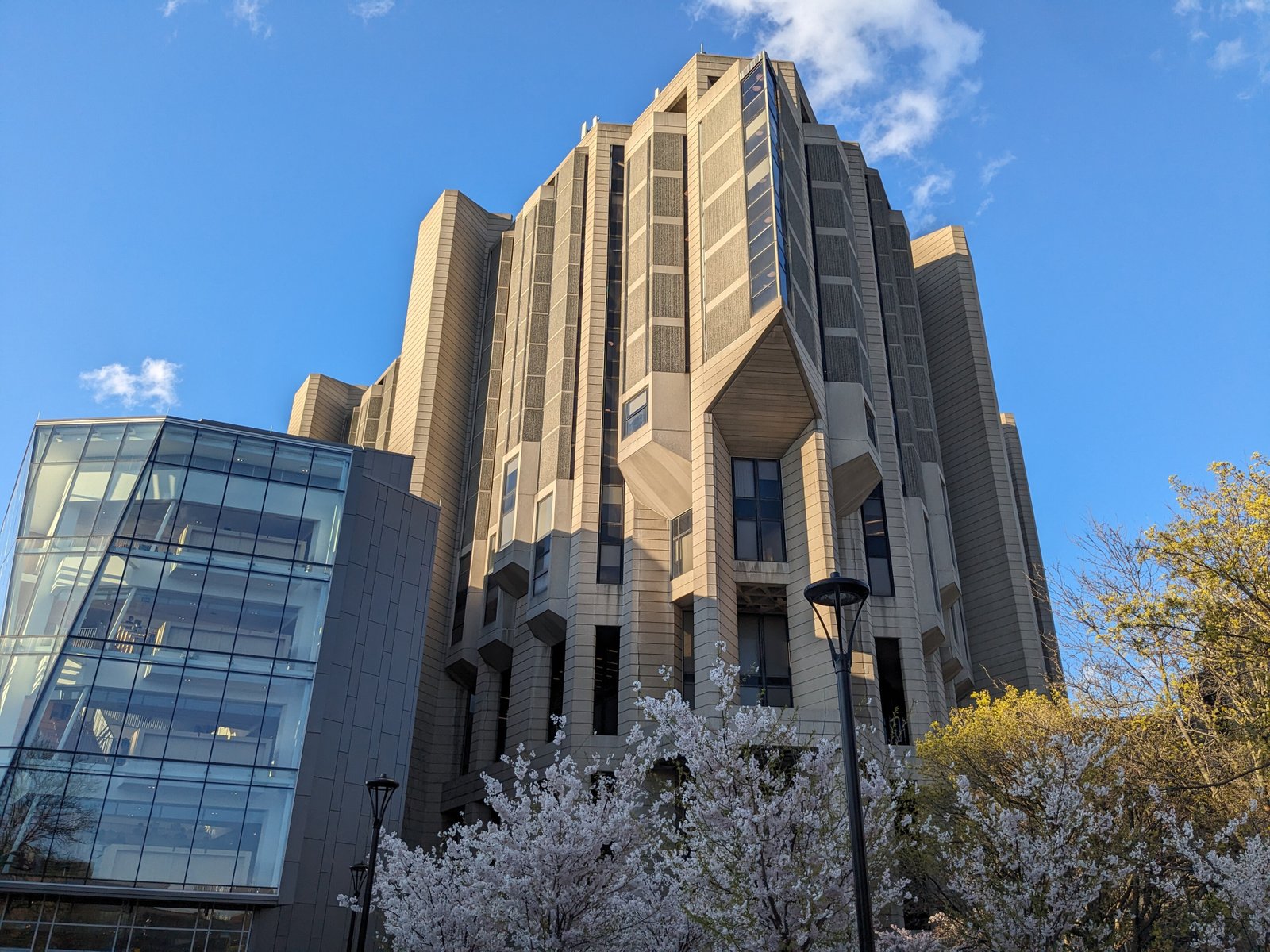
The University of Toronto’s principal humanities library combines bold brutalist design with monumental purpose, anchoring a three-tower complex in the heart of downtown.
At a glance
Robarts Library serves as the flagship humanities and social sciences library for the University of Toronto, holding over 4.5 million books alongside millions of microform and other research items. Its striking architectural presence dominates the St. George campus.
History
The library opened in 1973 and was named for John Robarts, Ontario’s 17th Premier. It emerged from the university’s expansion during a period of ambitious institutional building across Canadian universities.
What you see
The building exemplifies brutalist design through its imposing concrete mass and dramatic geometric vocabulary. Its towering main structure stands on an equilateral triangular footprint, with triangular patterns recurring throughout the interior and exterior. Massive volumes and fortress-like proportions define the experience. The library forms the central element of a three-tower complex that includes the Thomas Fisher Rare Book Library and the Claude T. Bissell Building, home to the Faculty of Information.
Cultural significance
Robarts ranks among Canada’s most recognizable brutalist landmarks. Its nicknames—Fort Book and The Peacock/Turkey—reflect both its defensive monumentality and the mixed reactions its bold aesthetic has provoked. The library stands as a defining example of 1970s institutional architecture.
Key facts
- Location: University of Toronto, St. George campus, Toronto, Canada
- Opened: 1973
- Collections: 4.5 million books; 4.1 million microform items; 740,000 other items
- Architectural style: Brutalism
- Part of: Three-tower library complex
Practical information & getting there
The library is located on the St. George campus in downtown Toronto. It is open to members of the university community and visiting researchers. Check the University of Toronto Libraries website for current hours and access policies before visiting.
Sources & resources
Find it on the map
See this place and what’s around it →📷 Become a Cultural Heritage Online photographer
Share your photos of places: they stay published under your name as the author. The more they're seen, the more you get noticed — and soon a contest will reward the most appreciated photos.
Log in or sign up free to add a photoIs this page about you?
This page is read by travellers and heritage enthusiasts who find it on Google. Tell us how you are connected to this place and we will take it from there.