
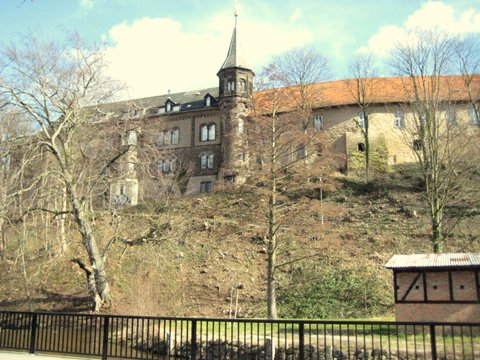
A Neo-Romanesque stately home built alongside a medieval monastery, now poised to become a cultural and hospitality centre.
At a glance
Ilsenburg House is a 19th-century palace built in the Neo-Romanesque style in the Harz region of Saxony-Anhalt. It adjoins the surviving medieval cloisters of Ilsenburg Abbey, a Romanesque monastery. The house is now owned by the Ilsenburg Abbey Foundation and is being prepared for conversion into an art and cultural centre with accommodation and dining facilities.
History
Construction of the house began in 1860, continuing through the second half of the 19th century on the west and north sides of Ilsenburg Abbey. The building served as the official seat of the princes of Stolberg-Wernigerode until 1945. Since 2005, it has been held in stewardship by the Ilsenburg Abbey Foundation, marking a transition from aristocratic residence to public cultural space.
What you see
The house exemplifies the Neo-Romanesque architectural style, executed during an era of romantic revival of medieval forms. Its design integrates with the adjacent monastery cloisters, creating a layered historical landscape where 19th-century ambition meets medieval fabric. The surviving monastic cloisters remain a defining feature of the ensemble.
Cultural significance
Ilsenburg House represents the marriage of monastic heritage and aristocratic grandeur. Its location adjacent to a functioning Romanesque monastery gives it dual historical weight—both a document of princely taste and a guardian of medieval religious life. The foundation’s commitment to reopening it as a cultural centre honours both dimensions.
Key facts
- Country: Germany
- City: Ilsenburg, Saxony-Anhalt
- Coordinates: 51.85972222, 10.67861111
- Built: from 1860 onwards
- Style: Neo-Romanesque
- Former occupants: Princes of Stolberg-Wernigerode (until 1945)
- Current owner: Ilsenburg Abbey Foundation (since 2005)
Practical information & getting there
Ilsenburg House is located in the town of Ilsenburg in the Harz region. The site is not currently open to the public in its former capacity, as it is undergoing conversion to an art and cultural centre. Check local tourism resources for updates on opening dates and programme details.
Sources & resources
Find it on the map
See this place and what’s around it →📷 Become a Cultural Heritage Online photographer
Share your photos of places: they stay published under your name as the author. The more they're seen, the more you get noticed — and soon a contest will reward the most appreciated photos.
Log in or sign up free to add a photoIs this page about you?
This page is read by travellers and heritage enthusiasts who find it on Google. Tell us how you are connected to this place and we will take it from there.