
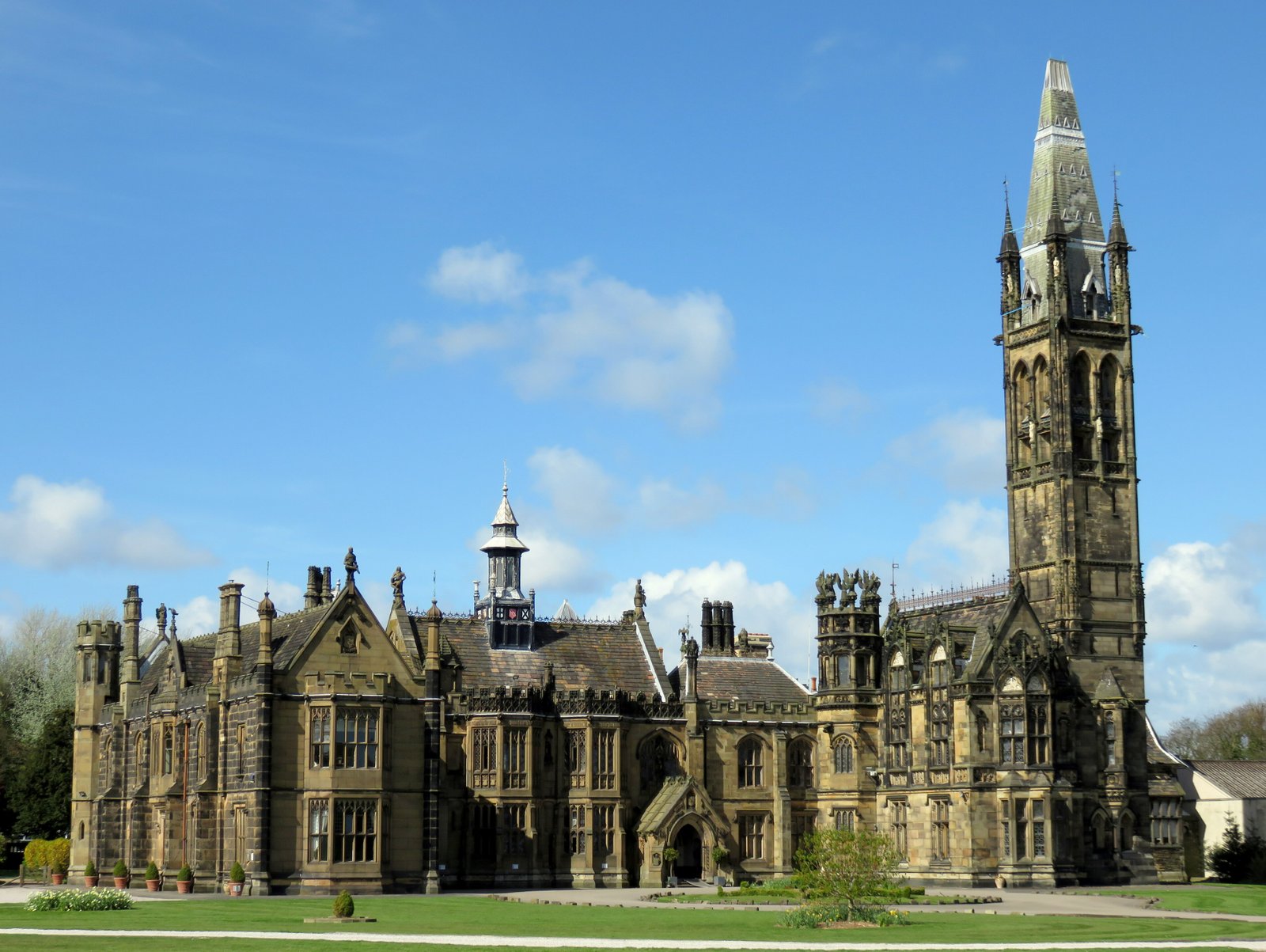
A commanding Victorian Gothic country house in Lancashire, celebrated for its soaring 100-foot tower and design by architect Augustus Pugin.
At a glance
Scarisbrick Hall stands as one of the finest examples of Victorian Gothic architecture in England. The dramatic tower, visible across the surrounding Lancashire landscape for miles, remains its most striking architectural feature. Today the hall operates as Scarisbrick Hall School.
History
The country house developed over time, with significant portions designed by Augustus Pugin, the pioneering Victorian architect and designer. The building reflects the Gothic Revival sensibility that shaped mid-19th-century English country estates.
What you see
The hall exemplifies Victorian Gothic style through its pointed arches, decorative stonework, and soaring vertical emphasis. The 100-foot tower dominates the composition, its height and visibility from distant vantage points making it a landscape landmark. Pugin’s hand is evident in the refined Gothic detailing throughout the structure.
Cultural significance
Scarisbrick Hall represents a key achievement in the Gothic Revival movement that reshaped English architecture during the Victorian period. As a work associated with Pugin, whose influence on 19th-century design was profound, it demonstrates the enduring appeal of medieval aesthetic principles to Victorian patrons and architects.
Key facts
- Location: Scarisbrick, Lancashire, United Kingdom
- Coordinates: 53.6065, -2.921
- Architect: Augustus Pugin (partial design)
- Style: Victorian Gothic
- Signature feature: 100-foot tower
- Current use: Scarisbrick Hall School
Practical information & getting there
The hall is situated south-east of Scarisbrick village in Lancashire. As the building now operates as a school, access may be limited. Check ahead before visiting for current opening arrangements and any public tours.
Sources & resources
Find it on the map
See this place and what’s around it →📷 Become a Cultural Heritage Online photographer
Share your photos of places: they stay published under your name as the author. The more they're seen, the more you get noticed — and soon a contest will reward the most appreciated photos.
Log in or sign up free to add a photoIs this page about you?
This page is read by travellers and heritage enthusiasts who find it on Google. Tell us how you are connected to this place and we will take it from there.