
A café owner opened it in 1886 on a narrow street of the Barrio de las Letras. Electricity before almost anyone, a restaurant inside the hotel before everyone — and after decades of decline, it came back in 2018.
At a glance
The Gran Hotel Inglés is the oldest hotel in Madrid, opened in 1886 by Agustín Ibarra, the proprietor of the celebrated Café Inglés, on what was then Calle del Lobo — today Calle de Echegaray 8, in the heart of the literary quarter. Ibarra’s two wagers became standards: his was the first hotel in the city to put a first-class restaurant inside the house, and among the first buildings in Madrid to run on electric light. After a golden half-century, a war, a renaming and a slow slide into closure, the building was restored by Hidden Away Hotels and reopened in 2018 with 48 rooms behind the old facade.
Key facts
- Opened: 1886 — the hotel’s own chronicle gives 27 July; other accounts place the opening in November of that year
- Founder: Agustín Ibarra, owner of the Café Inglés, who brought his restaurant trade into the hotel — a first for the city
- Firsts: in-house restaurant, electric lighting, bathrooms on every floor, lift, heating — the modern hotel, assembled early
- The guest book: Galdós, Clarín and Valle-Inclán from the literary cafés; later Virginia Woolf, Carlos Gardel, Raquel Meller — who has a suite named for her — and Imperio Argentina, who married here
- The break: the Civil War turned the hotel into a hospital; afterwards came a change of name and a long decline into abandonment
- Rebirth: restored for Hidden Away Hotels under Carmen Cordón and Ignacio Jiménez, interiors by New York’s Rockwell Group; reopened 2018 with 48 rooms, down from the original 56
History
In the Madrid of the 1880s the café was where public life happened, and Agustín Ibarra ran one of the most famous. The hotel he opened in 1886 was the café owner’s idea of what a hotel should be: you should not have to leave the house to dine well. That inversion — the restaurant inside the hotel — had no precedent in the city, and the Inglés added the newest machinery of comfort around it: electric light when most of Madrid burned gas, bathrooms on every floor, a lift, central heating. The hotel’s chronicle also counts a piece of world history among its toasts, linking its dining rooms to José Rizal and the cause of Philippine independence.
Standing a street away from the Ateneo and the theatres, the Inglés absorbed the literary life of the quarter. Galdós and Valle-Inclán knew its tables; the Generation of ’27 passed through; Virginia Woolf stayed, as did Carlos Gardel. The cupleté star Raquel Meller was faithful enough to earn a suite named after her, and the actress Imperio Argentina celebrated her wedding in the house. The 1920s were the peak of that world — and its end. In the Civil War the hotel served as a hospital; the decades that followed brought a change of name and a gradual fall from fashion into disrepair, until the doors closed altogether in the 2010s.
The rescue came from the hoteliers Carmen Cordón and Ignacio Jiménez, who made the building the flagship of their Hidden Away Hotels collection. After a restoration of roughly five years, the hotel reopened in 2018, its interiors redrawn by the Rockwell Group in an Art Deco key — brass, dark wood, leather-panelled walls — that reads as a memory of the 1920s rather than a reproduction of 1886. The gamble repeated Ibarra’s: fewer, larger rooms and a kitchen worth staying in for.
What you see
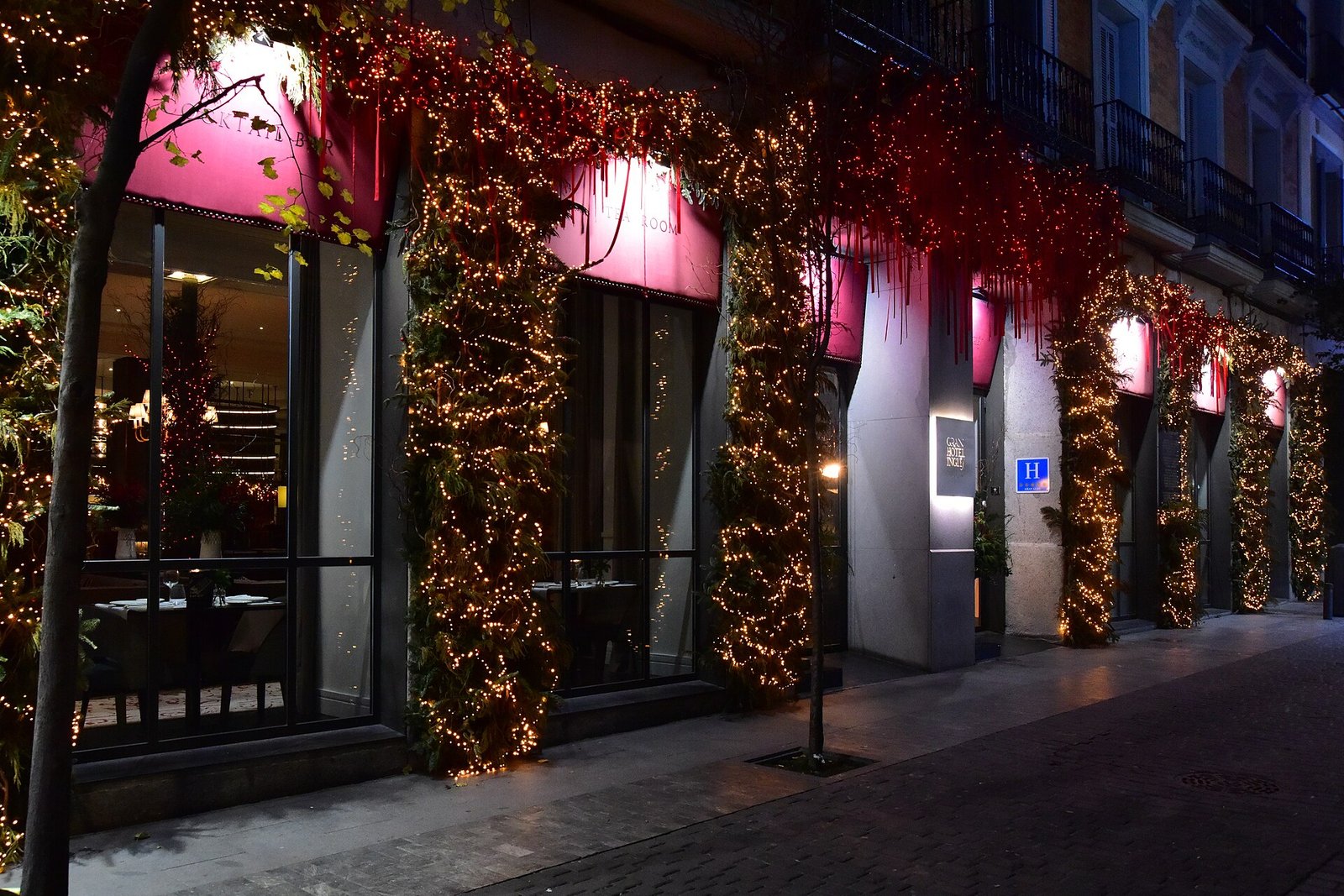
Calle de Echegaray is barely wide enough to step back in, which is part of the experience: the hotel’s long white facade, with its balconied windows and its name lettered across the front, has to be read at an angle, the way its first guests read it. The building holds the street line of the Barrio de las Letras, where the ground floors are taverns and the upper floors are nineteenth century nearly unbroken.
Inside, the register changes. The lobby bar — the hotel calls it LobByto — sits under an elliptical counter in bronze and leather, with a library wall of some six hundred volumes; marble bathtubs and custom bronze-and-glass furniture carry the Rockwell Group’s Deco vocabulary through the 48 rooms. The pleasure of the place is the contrast: the tight, noisy, sixteenth-century street plan outside, and the wide, lacquered calm within.
Practical information
- The building operates as a five-star hotel; the lobby bar and the restaurant are open to non-guests
- The Barrio de las Letras is best walked: the Ateneo, the Teatro Español and the quarter’s tiled taverns are all within three minutes
- The street is narrow and pedestrian-paced — arrive on foot; taxis stop at the corner of Carrera de San Jerónimo
- Quotations from the quarter’s writers are set into the pavements of the surrounding streets — look down as well as up
Getting there
The hotel stands at Calle de Echegaray 8, one street south of the Carrera de San Jerónimo in the Barrio de las Letras. Coordinates: 40.415942, -3.699808 (Google Maps). Sevilla metro station (line 2) is four minutes on foot; Puerta del Sol is seven.
Nearby
- The Westin Palace, the 1912 giant at the foot of the same quarter
- Prado Museum, ten minutes down the Carrera de San Jerónimo
- Mercado de San Miguel, past Sol beside the Plaza Mayor
Sources
- Gran Hotel Inglés, official history — the 27 July 1886 opening, Ibarra and the Café Inglés, the restaurant and electricity firsts, the Rizal toast, the 2018 reopening
- Nexos, “El hotel más antiguo de Madrid” — the amenities of 1886, the guest book, the Civil War hospital, the decline, the 48-from-56 room count
- Trendencias — the Rockwell Group interiors, the LobByto bar and library, the Hidden Away Hotels restoration
- Coordinates verified against OpenStreetMap Nominatim for Calle de Echegaray 8, Madrid
Find it on the map
See this place and what’s around it →📷 Become a Cultural Heritage Online photographer
Share your photos of places: they stay published under your name as the author. The more they're seen, the more you get noticed — and soon a contest will reward the most appreciated photos.
Log in or sign up free to add a photoIs this page about you?
This page is read by travellers and heritage enthusiasts who find it on Google. Tell us how you are connected to this place and we will take it from there.