
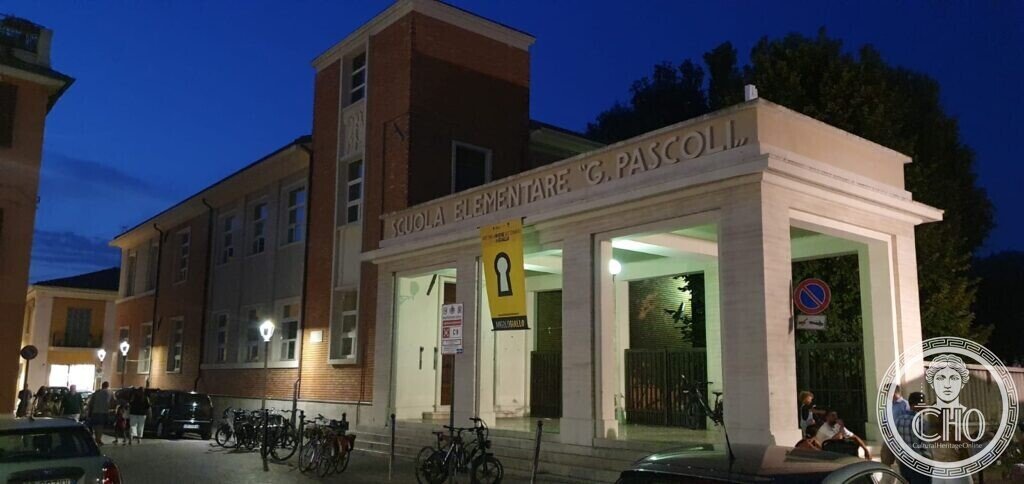
A rationalist school built on the site of a demolished sixteenth-century convent, first named after an admiral, renamed after a poet — and still full of children.
At a glance
The school stands in the heart of Senigallia, between via Oberdan and Piazza del Duca, a block from the Rocca Roveresca. It was designed at the end of the 1930s by the architect Marcello Diamantini and opened in 1938, part of the renewal of the city centre that followed the earthquake of 30 October 1930. It still works as a school — kindergarten and primary classes of the Istituto Comprensivo Senigallia Centro-Fagnani — and since 2019 it has also housed a small museum of school life. The exterior can be seen at any time.
Key facts
- Architect: Marcello Diamantini; structural design by Gualtiero Minetti, engineer of the town technical office
- Opened: 1938
- The site: previously the Benedictine convent of Santa Cristina (1574), damaged by the 1930 earthquake and demolished
- The name: first dedicated to admiral Costanzo Ciano; renamed after Giovanni Pascoli with the fall of fascism
- Today: a working school, with the Museo della Scuola inside
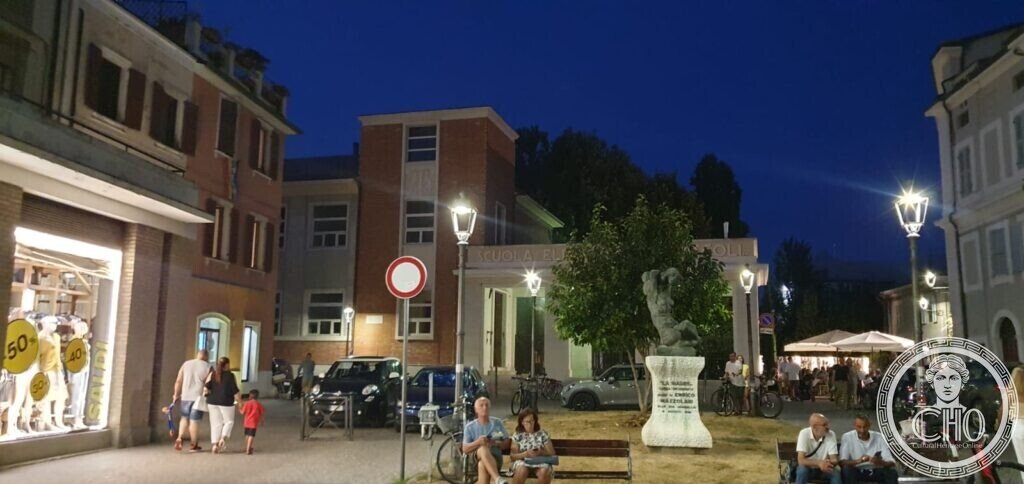
- In the square: La Madre, a sculpture by the Senigallia-born artist Enrico Mazzolani, dedicated — as its plinth says — to his own city
- Location: Via Oberdan 6, 60019 Senigallia (AN) — 43.7143 N, 13.2204 E
History
On 30 October 1930 an earthquake struck Senigallia and damaged much of its centre. Among the casualties of the reconstruction was the Benedictine convent of Santa Cristina, built in 1574: too compromised to save, it was demolished, and its site — a full block in the middle of the town — was given to a new elementary school.
The project was drawn at the end of the 1930s by Marcello Diamantini, with the structural engineering of Gualtiero Minetti of the municipal technical office, and the school opened in 1938. Like the other public buildings of those years it carried a regime dedication: it was named after admiral Costanzo Ciano, president of the Chamber and father of foreign minister Galeazzo — the same dedication that a fishing village near Jesolo received in the same months, with its Casa del Fascio e del Marinaio. With the fall of fascism the admiral’s name came off, and the school took the name of Giovanni Pascoli.
The building never stopped teaching. Since 2019 part of it houses the Museo della Scuola: five rooms of desks, report cards, textbooks, teaching machines and photographs, kept in the school or donated by former teachers and pupils — a museum of everyday school life from 1939 onwards, run with the town.
What you see
The entrance is a travertine-framed portico of square pillars, one room deep, with SCUOLA ELEMENTARE «G. PASCOLI» carved across the architrave. Behind it the building steps up in brick: a compact tower marks the corner, with a vertical bas-relief panel of figures set into its face, and the long classroom wings run off in banded brick and render with regular rows of windows. It is the sober, well-built rationalism of the Marche school buildings of the late Thirties — the same season as Mario De Renzi’s Corridoni school in Fano, forty kilometres down the coast.
In the little square in front, among the benches and the evening bicycles, stands La Madre: a mother bending over her child, by Enrico Mazzolani, the sculptor born in Senigallia, given — as the base records — to his city.
Cultural significance
The Pascoli is a compressed history of the Italian twentieth century in one block: a Renaissance-era convent lost to an earthquake, a rationalist school built in its place, a Fascist dedication quietly replaced by a poet’s name, and now a museum where the school preserves the memory of itself. For anyone tracing what the 1930 earthquake did to Senigallia — and what the Thirties built in the Marche — it is an essential stop.
Practical information
- A working school: the interior is not open during lessons.
- The Museo della Scuola opens with guided visits and on heritage days; check the school and town channels for dates.
- The exterior, the portico and the square with Mazzolani’s La Madre are visible at any time.
Getting there
The school is in the pedestrian heart of Senigallia, three minutes on foot from the Rocca Roveresca and Piazza del Duca and ten from the railway station, on the Adriatic line between Ancona and Pesaro.
Sources
- Senigallia Notizie — «Alla scoperta della storia della scuola Giovanni Pascoli» (Diamantini, Minetti, 1938, the Ciano dedication)
- FAI, I Luoghi del Cuore — Museo della Scuola, Senigallia (the convent of Santa Cristina and the 1930 earthquake)
- Patrizia Leoni (ed.), Nel centro della città. Storia e memoria della Scuola «Pascoli» di Senigallia, Aras Edizioni
Find it on the map
See this place and what’s around it →Record researched and written by Stefano Vigolo for Cultural Heritage Online, 2026.
📷 Become a Cultural Heritage Online photographer
Share your photos of places: they stay published under your name as the author. The more they're seen, the more you get noticed — and soon a contest will reward the most appreciated photos.
Log in or sign up free to add a photoIs this page about you?
This page is read by travellers and heritage enthusiasts who find it on Google. Tell us how you are connected to this place and we will take it from there.