
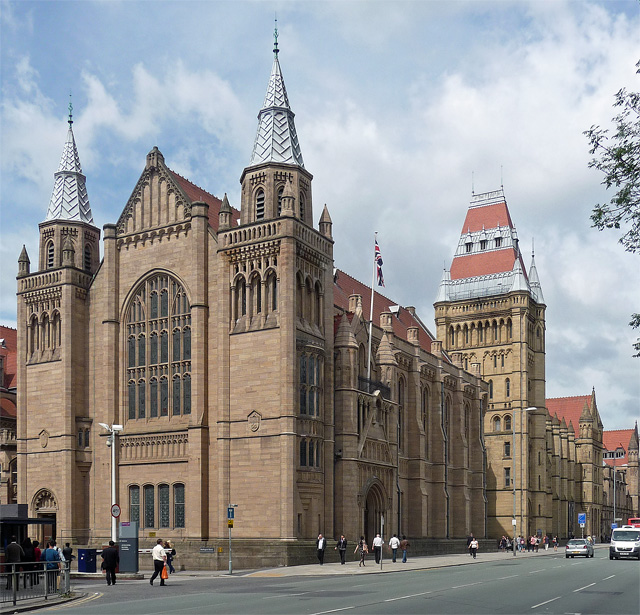
A Grade II* listed structure completed in 1902, the Whitworth Building anchors the University of Manchester’s historic south-east quadrangle on Oxford Road.
At a glance
The Whitworth Building stands as a significant early-twentieth-century addition to Manchester’s institutional architecture. Located in Chorlton-on-Medlock, it forms part of the university’s original campus layout, connected to the Manchester Museum to the north and the former Christie Library to the west.
History
Completed in 1902, the building has served the University of Manchester for over a century. Its Grade II* listing status, granted in 1963, reflects its architectural and historical importance to the institution and the city.
What you see
The building occupies a strategic position within the university’s original quadrangle, positioned at the south-east range. Its Grade II* designation indicates exceptional architectural merit and design quality characteristic of Edwardian institutional buildings.
Cultural significance
The Whitworth Building represents an important phase in Manchester’s development as a center of higher learning. Its integration with neighboring structures—the Manchester Museum and former Christie Library—demonstrates the coherent campus planning of the early university.
Key facts
- Country: United Kingdom
- City: Manchester
- Completed: 1902
- Listed status: Grade II* (since 1963)
- Coordinates: 53.4655, -2.2335
- Location: Oxford Road and Burlington Street, Chorlton-on-Medlock
Practical information & getting there
The building is located on Oxford Road in Manchester’s Chorlton-on-Medlock district, within the University of Manchester campus. It remains an active part of the institution and is best viewed as part of a broader exploration of the university’s historic quadrangle.
Sources & resources
Find it on the map
See this place and what’s around it →📷 Become a Cultural Heritage Online photographer
Share your photos of places: they stay published under your name as the author. The more they're seen, the more you get noticed — and soon a contest will reward the most appreciated photos.
Log in or sign up free to add a photoIs this page about you?
This page is read by travellers and heritage enthusiasts who find it on Google. Tell us how you are connected to this place and we will take it from there.