
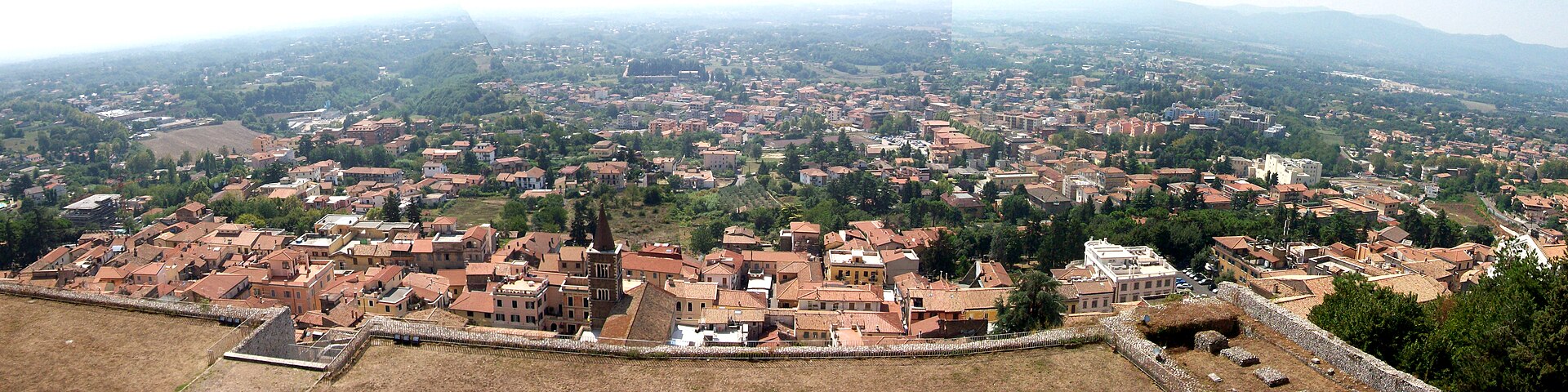
Palestrina is a hilltop town in Lazio, about 35 kilometres east of Rome, built upon the ruins of the ancient Latin city of Praeneste. Famous for the colossal Sanctuary of Fortuna Primigenia — one of the largest sacred complexes of the Roman Republic — and as the birthplace of Renaissance composer Giovanni Pierluigi da Palestrina, the town preserves layers of antiquity, medieval urbanism, and Baroque architecture within its historic centre.
At a glance
- Type
- Historic hilltop town and archaeological site
- Period
- Founded as Praeneste in the pre-Roman era; Roman sanctuary 2nd century BC; medieval and Baroque overlays 11th–17th century
- Style
- Roman Republican monumental architecture; medieval fortifications; Baroque palace
- Location
- Palestrina, Metropolitan City of Rome, Lazio, Italy — 41.8337° N, 12.8877° E
Overview
Palestrina is a modern Italian city of about 22,000 inhabitants, situated on the slopes of the Prenestine Hills and connected to Rome by the ancient Via Prenestina. The town’s urban fabric overlies the terraced substructures of the ancient Sanctuary of Fortuna Primigenia, which dominates the hillside in six ascending terraces culminating in the Palazzo Colonna Barberini. The Museo Nazionale Archeologico di Palestrina, housed within the Baroque palace, is celebrated for the Nile Mosaic — a large Hellenistic floor mosaic depicting Egypt in flood — recovered from the sanctuary.
History
Ancient Praeneste was an independent Latin city that resisted Roman absorption until the 1st century BC, when Sulla razed much of it and founded a colony in its place. The Sanctuary of Fortuna Primigenia, rebuilt on a monumental scale in the late 2nd century BC, was among the grandest architectural achievements of the Roman Republic, drawing pilgrims from across Italy to its oracle and healing cult. In the Middle Ages the town was contested among the Colonna and Barberini families, and in 1630 the Barberini converted the uppermost sanctuary rotunda into their family palace. The town suffered heavy Allied bombing in 1943, which paradoxically revealed large sections of the ancient sanctuary beneath the modern town.
What you see
The Sanctuary of Fortuna Primigenia rises in six terraces linked by ramps and staircases, culminating in a semicircular colonnade and the theatre-like cavea at the summit. The Palazzo Colonna Barberini crowns the complex and contains the archaeological museum, whose centrepiece is the polychrome Nile Mosaic (c. 80 BC), measuring roughly 5.85 × 4.31 metres. In the lower town, the Cathedral of Sant’Agapito preserves Roman columns reused in its nave, and narrow medieval lanes wind between houses built on ancient vaulted substructures. The birthplace of Giovanni Pierluigi da Palestrina is marked in the historic centre.
Cultural significance
Palestrina is one of the foremost examples of Roman Republican religious architecture in Italy and forms part of the broader archaeological and historical landscape of Latium Vetus. The Nile Mosaic is considered one of the most important surviving Hellenistic floor mosaics in the world, offering rare pictorial evidence of the Ptolemaic Nile landscape. The town also holds lasting musical heritage as the birthplace of Giovanni Pierluigi da Palestrina (c. 1525–1594), the defining master of Renaissance polyphony whose music remains central to the Catholic choral tradition.
Practical information
- Address
- Piazza della Cortina, Palestrina, 00036 Roma RM, Italy
- Coordinates
- 41.8337° N, 12.8877° E
Getting there
From Rome Termini take the COTRAL bus to Palestrina (journey approximately 45–60 minutes); buses depart from the Anagnina terminus on Metro Line A. By car, follow the Via Prenestina (SS155) east from Rome — approximately 35 km. There is no direct train connection; the nearest rail station is Zagarolo on the Roma–Cassino line, from which a connecting bus runs to Palestrina.
Sources & resources
Find it on the map
See this place and what’s around it →Historical events at this place (2)
📷 Become a Cultural Heritage Online photographer
Share your photos of places: they stay published under your name as the author. The more they're seen, the more you get noticed — and soon a contest will reward the most appreciated photos.
Log in or sign up free to add a photo