
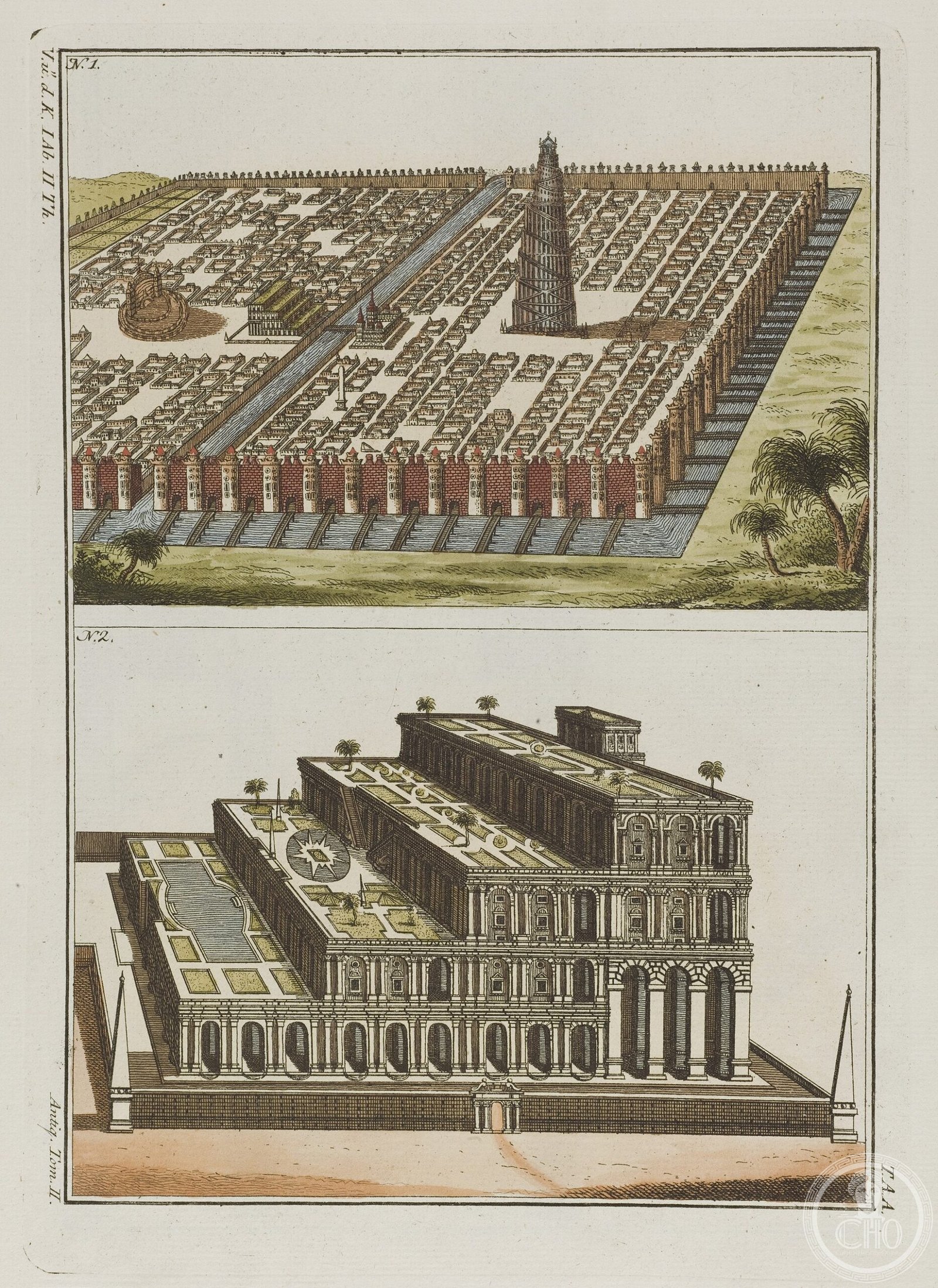
The Hanging Gardens of Babylon are one of the Seven Wonders of the Ancient World, a terraced garden monument of legendary beauty traditionally attributed to the Neo-Babylonian king Nebuchadnezzar II, who is said to have built them around 600 BCE for his Median queen Amytis. Uniquely among the Seven Wonders, no confirmed physical remains have ever been identified, leading some scholars to question whether the gardens existed in Babylon at all or were a literary conflation of other royal gardens elsewhere in Mesopotamia.
At a glance
- Type
- Legendary terraced garden / Wonder of the Ancient World
- Period
- Traditionally c. 600 BCE (Neo-Babylonian Empire)
- Style
- Neo-Babylonian royal architecture (if constructed)
- Location
- Ancient Babylon, Babil Governorate, Iraq (proposed site near modern Hillah)
- Coordinates
- 32.5424 N, 44.4212 E
Overview
The Hanging Gardens were described by several Greek and Roman authors including Diodorus Siculus, Strabo, and Quintus Curtius Rufus as a series of ascending terraces planted with trees and irrigated by an elaborate mechanical system raising water from the Euphrates to the uppermost level. The gardens are said to have risen to a height equivalent to the walls of Babylon, perhaps 23 metres, and to have been visible from a great distance as a mass of green cascading over their stone terraces. No contemporary Babylonian source, however, makes any mention of the gardens, a silence that has fuelled persistent scholarly debate about their historicity.
History
The standard ancient tradition holds that Nebuchadnezzar II (reigned c. 605-562 BCE), greatest king of the Neo-Babylonian Empire, built the gardens to console his queen Amytis of Media, who missed the green hills of her homeland in the arid Mesopotamian plain. The historian Berossus, writing in the 3rd century BCE, attributes the gardens to Nebuchadnezzar, while later Greek writers elaborated the description into one of the canonical marvels of the ancient world. An alternative hypothesis proposed by scholar Stephanie Dalley in 2013 suggests the gardens were actually located at Nineveh, built by the Assyrian king Sennacherib around 700 BCE, and subsequently misattributed to Babylon by classical authors.
What you see
The ruins of ancient Babylon, including the site where the Hanging Gardens may have stood, are partially preserved near the modern city of Hillah in central Iraq. Excavations led by Robert Koldewey from 1899 to 1917 uncovered the Ishtar Gate, the Processional Way, and extensive palace remains, but identified no structure unambiguously corresponding to the gardens. A vaulted subterranean structure excavated near the northern palace has been tentatively proposed as the basement of the gardens’ irrigation system, though this identification remains contested. The ancient city of Babylon was inscribed as a UNESCO World Heritage Site in 2019.
Cultural significance
As one of the Seven Wonders of the Ancient World, the Hanging Gardens occupy a unique position in the collective imagination of world heritage, representing the aspiration of ancient engineers and rulers to transform the natural landscape into an expression of power and beauty. The gardens have inspired artists, writers, and architects across two and a half millennia, from Renaissance paintings to modern landscape design. Whether or not they physically existed, their enduring cultural resonance confirms their status as one of humanity’s most compelling heritage myths.
Practical information
- Physical remains
- No confirmed remains identified; proposed site is within the Babylon archaeological complex near Hillah, Iraq
- Access
- The Babylon archaeological site is open to visitors; consult current travel advisories for Iraq before planning a visit
- UNESCO status
- Ancient city of Babylon inscribed as UNESCO World Heritage Site in 2019
Getting there
The ancient site of Babylon is located approximately 85 kilometres south of Baghdad near the modern city of Hillah in Babil Governorate, Iraq. Access from Baghdad is via the main southern highway (Route 8); organised tours from Baghdad are the standard approach for international visitors. The site is managed by the Iraqi State Board of Antiquities and Heritage. Visitors should consult their national foreign affairs ministry for current travel advisories before visiting Iraq.
Sources & resources
See the place
Find it on the map
See this place and what’s around it →📷 Become a Cultural Heritage Online photographer
Share your photos of places: they stay published under your name as the author. The more they're seen, the more you get noticed — and soon a contest will reward the most appreciated photos.
Log in or sign up free to add a photo