
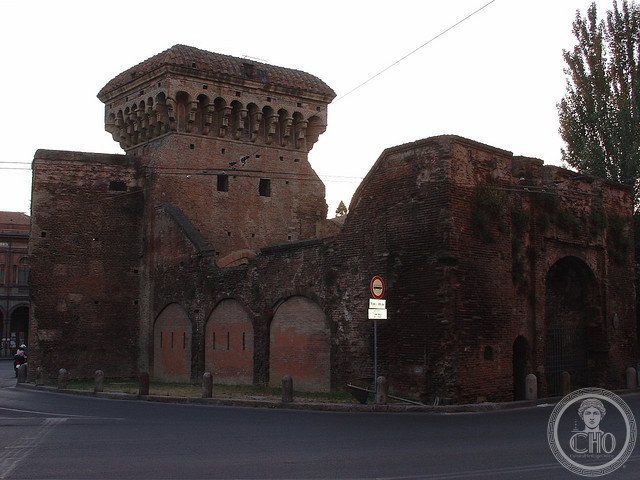
The Cassero of Porta San Donato is a medieval defensive tower that formed part of the outer ring of Bologna’s city walls, standing at the gate once known as Porta Zamboni. Located on the edge of the historic university district, this fortified gatehouse survives as a rare remnant of the communal-era defences that once encircled one of medieval Europe’s most populous cities.
At a glance
- Type
- Fortified gate tower (cassero) of the medieval city walls
- Period
- 13th century; part of Bologna’s second circle of walls
- Style
- Medieval communal military architecture
- Location
- Via Zamboni area, Bologna, Emilia-Romagna, Italy
- Coordinates
- 44.4984° N, 11.3564° E
Overview
Porta San Donato — also known as Porta Zamboni — was one of the principal gates piercing Bologna’s outer medieval walls, providing access to the city’s ancient university quarter. The cassero attached to this gate served as a fortified barbican, adding an extra defensive layer to control passage through the walls. The gate complex stood on the road leading north-east from the city centre, connecting the university area to the surrounding countryside.
History
Bologna’s outer ring of walls was constructed in the thirteenth century as the commune expanded rapidly to become one of the largest cities in medieval Europe. The gate at San Donato was a significant checkpoint on a route used heavily by students and scholars arriving at the world’s oldest university. Like most of Bologna’s historic gates, the structure witnessed centuries of conflict, civic governance, and the steady transformation of the city fabric. Much of the medieval wall circuit was progressively dismantled from the late eighteenth century onward, leaving only scattered towers and gate structures as testament to the original fortifications.
What you see
The surviving cassero presents the characteristic form of a medieval communal tower-gate: thick rusticated masonry, a vaulted passage at ground level, and upper chambers that once housed a garrison. The brickwork, typical of Bologna’s red-brick building tradition, blends with the surrounding streetscape of the university district. The immediate area around the former gate retains much of its historic character, with medieval and Renaissance palaces lining the lanes that once funnelled travellers through the city walls.
Cultural significance
As a gateway to Bologna’s university zone, Porta San Donato carries layers of intellectual and civic history stretching back to the twelfth century. The cassero represents the communal defensive tradition of northern Italian cities, where civic identity was expressed through ambitious public building in stone and brick. Its survival, partial though it may be, anchors a neighbourhood whose medieval street pattern remains largely intact today.
Practical information
The cassero and remnants of the gate can be viewed from the street at any time. There is no formal entrance fee. The surrounding university district is pedestrian-friendly and safe to explore on foot. Check the local heritage office or the Comune di Bologna website for any guided wall walks or occasional access to the tower interior.
Getting there
The site lies a short walk north-east of Piazza Maggiore along Via Zamboni, the main artery of Bologna’s university district. Bus lines serving the Zona Universitaria stop within a few minutes’ walk. Bologna Centrale railway station is approximately 1.5 km west, reachable on foot or by bus. No dedicated car park is available immediately at the gate; visitors arriving by car should use the park-and-ride facilities near the city walls.
Sources & resources
See the place
Find it on the map
See this place and what’s around it →📷 Become a Cultural Heritage Online photographer
Share your photos of places: they stay published under your name as the author. The more they're seen, the more you get noticed — and soon a contest will reward the most appreciated photos.
Log in or sign up free to add a photo