
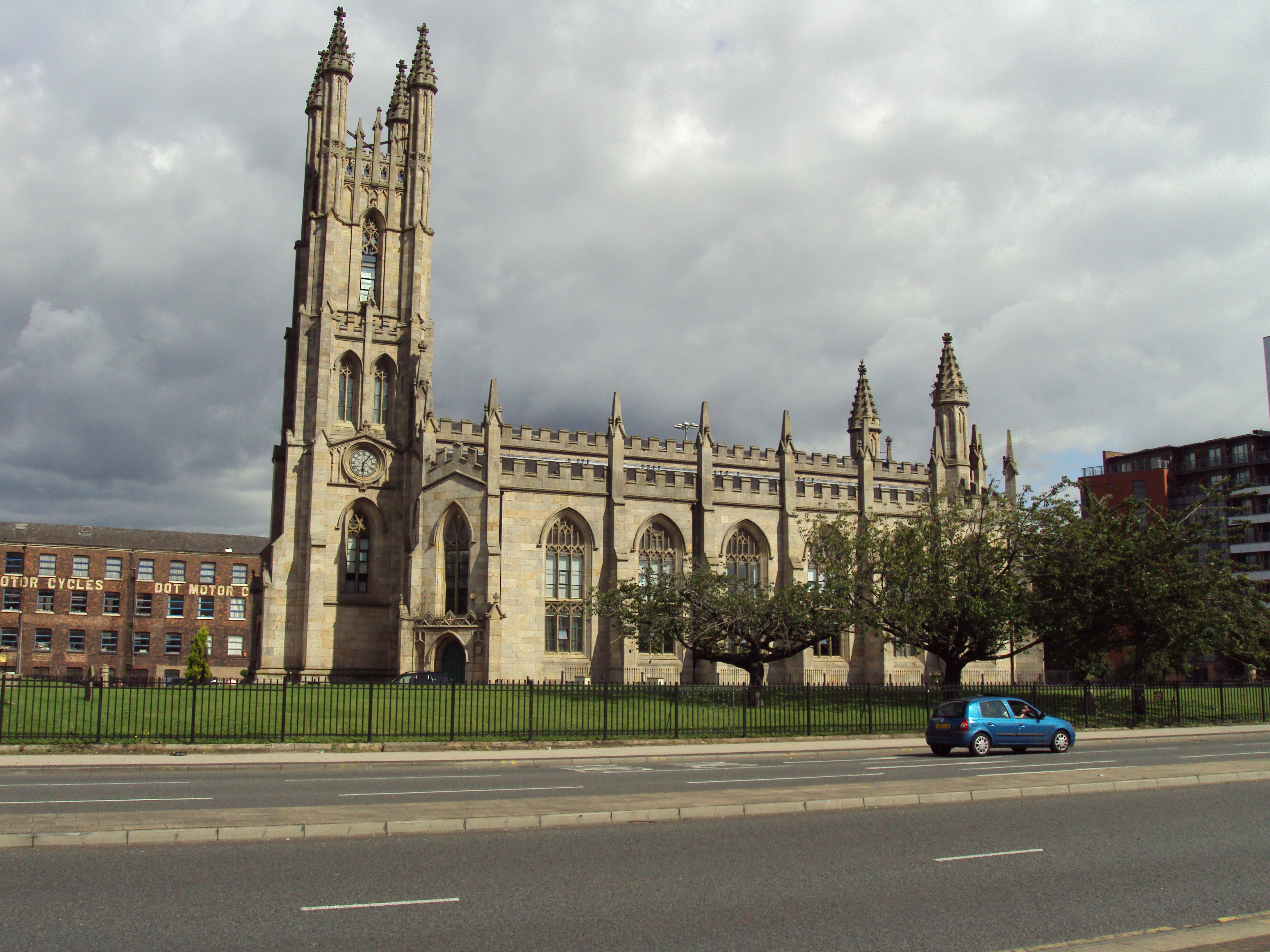
Francis Goodwin’s early Gothic Revival church, built as a Commissioners’ church to commemorate the Battle of Waterloo, stands as a monument to Regency-era ecclesiastical ambition on Chester Road.
At a glance
A Grade II* listed church designed by Francis Goodwin and completed in 1828. Originally conceived as one of the Commissioners’ churches—a nationwide building programme following the Napoleonic Wars—St George represents an important moment in the development of Gothic Revival architecture in northern England. The church was restored in 1884 by J. S. Crowther.
History
St George was built between 1826 and 1828 as part of a coordinated effort to celebrate the victory at Waterloo and expand Anglican worship in growing industrial cities. Parliament allotted £15,000 for its construction, a substantial sum. Goodwin’s selection was natural; he had already designed several churches across the Midlands and North West, and had completed the original Manchester Town Hall.
The church functioned as a parish church through much of the nineteenth and twentieth centuries, though its fortunes declined with the post-war contraction of the inner-city population. Major road construction in its vicinity hastened its isolation. St George closed in 1984, after which it endured a twenty-year search for viable new uses. Conversion to residential flats in 2000–2002 fundamentally altered its character.
What you see
The exterior presents a six-bay nave with high three-light Perpendicular windows, concluding in a tall tower at the west end. Two high pinnacles rise at the east end, creating a memorable silhouette. Porches are positioned at the northwest and southwest corners.
Sir Nikolaus Pevsner identified Nicholas Hawksmoor’s St Michael, Cornhill as Goodwin’s likely inspiration, observing that “the whole makes a lively and memorable picture.” The interior once contained galleries, Perpendicular arcades, and a wall monument to The Hon. George Berkeley Molyneux (d.1841), by sculptor Edward Physick, depicting a soldier mourning beside an urn. Much of this spatial integrity was lost during conversion.
Cultural significance
St George exemplifies the early Gothic Revival movement in the North West and remains a testament to Goodwin’s architectural skill. It belongs to the broader Commissioners’ Church programme, which sought to provide spiritual infrastructure for rapidly urbanising communities. The church’s closure and subsequent conversion represent a wider pattern of post-industrial change in Manchester’s urban landscape.
Key facts
- Country: United Kingdom
- City: Manchester
- Designed by: Francis Goodwin
- Built: 1826–1828
- Restored: 1884 (J. S. Crowther)
- Listed status: Grade II* (3 October 1974)
- Coordinates: 53.4721, -2.2593
Practical information & getting there
St George stands on Chester Road in Hulme, Manchester. The building is now privately owned residential apartments and is not open to the public. Exterior views are accessible from the street.
Sources & resources
Find it on the map
See this place and what’s around it →📷 Become a Cultural Heritage Online photographer
Share your photos of places: they stay published under your name as the author. The more they're seen, the more you get noticed — and soon a contest will reward the most appreciated photos.
Log in or sign up free to add a photoIs this page about you?
This page is read by travellers and heritage enthusiasts who find it on Google. Tell us how you are connected to this place and we will take it from there.