
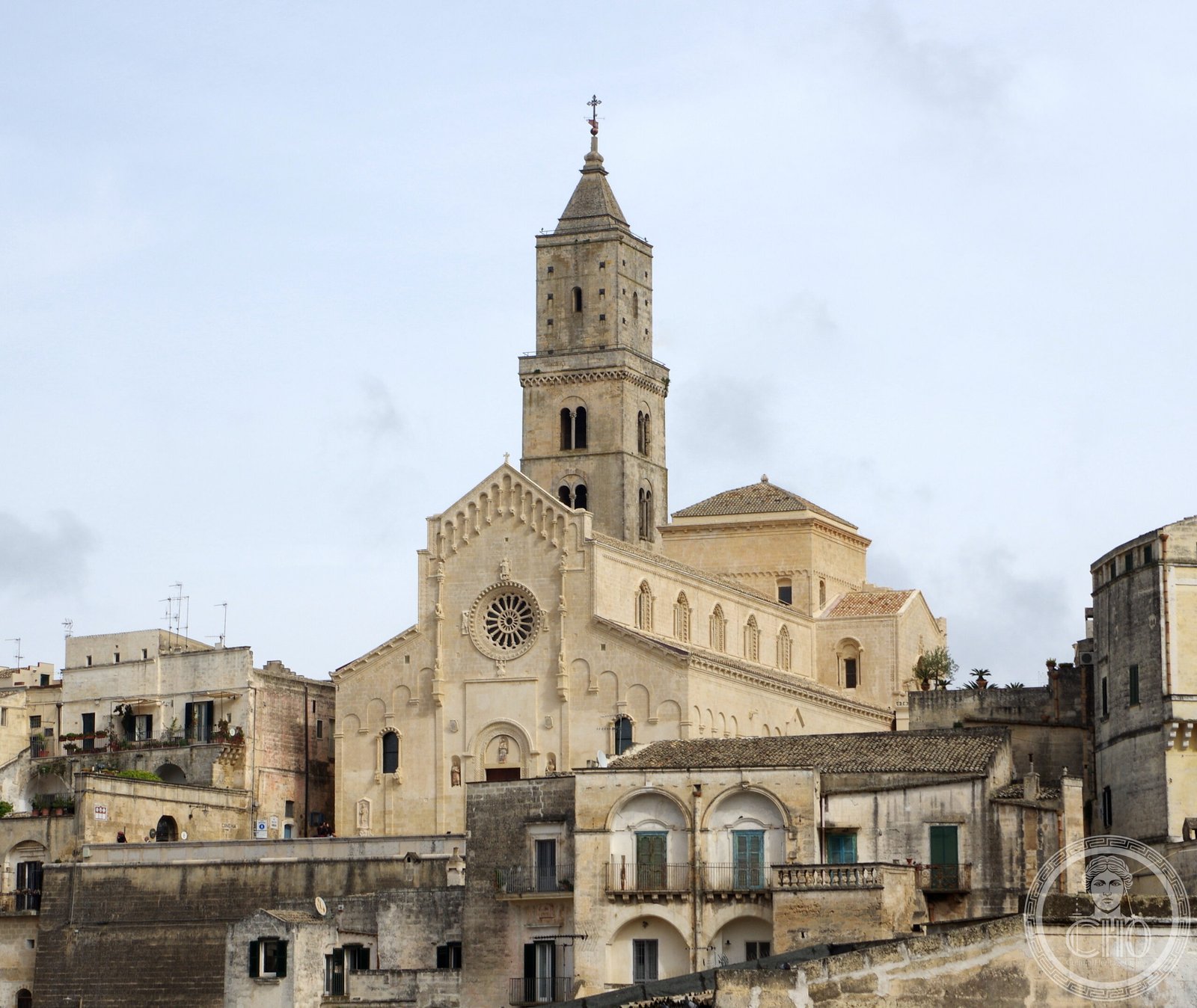
The Cathedral of Matera — formally the Pontifical Basilica Cathedral of Maria Santissima della Bruna and Sant’Eustachio — is a Roman Catholic cathedral overlooking the sassi of Matera, the UNESCO World Heritage Site ancient cave city of Basilicata. Built between 1230 and 1270 in the Apulian Romanesque style, the cathedral is dedicated to the Madonna della Bruna, patron saint of Matera, whose feast on 2 July is celebrated with one of the oldest and most spectacular processions in southern Italy.
At a glance
- Type
- Roman Catholic cathedral / pontifical basilica
- Period
- 1230–1270 (Romanesque); later modifications 15th–18th century
- Style
- Apulian Romanesque
- Location
- Matera, Province of Matera, Basilicata, Italy
- Coordinates
- 40.6668° N, 16.6106° E
- Diocese
- Archdiocese of Matera-Irsina
Overview
Matera Cathedral is a Roman Catholic cathedral in Matera, Basilicata, Italy, dedicated to the Virgin Mary under the title of the Madonna della Bruna and to Saint Eustace. Formerly the seat of the Bishops and later Archbishops of Matera, it is now the cathedral of the Archdiocese of Matera-Irsina. The cathedral stands on the civita — the rocky spur between the two sassi basins of Barisano and Caveoso — at the symbolic and physical heart of the ancient city, visible from virtually every point in the surrounding landscape.
History
The cathedral was built between 1230 and 1270, during the period when Matera flourished as an important centre of the Norman and Swabian Kingdom of Sicily. It was constructed in the Apulian Romanesque style, closely related to the great Romanesque cathedrals of Bari, Trani, and Bitonto. The building was consecrated in 1270 and became the seat of the bishops of Matera. In subsequent centuries the interior received Baroque modifications, including new altars and frescoes, while the Romanesque exterior was largely preserved. The cathedral survived the centuries of abandonment that characterised Matera’s sassi, remaining an active place of worship throughout.
What you see
The cathedral’s facade is articulated in the Apulian Romanesque style, with a central rose window, blind arcading, and sculptural decoration around the portal. The bell tower, rising to 52 metres, is one of the landmarks of the Matera skyline and features an octagonal upper register with double-light windows. The interior is a three-nave basilica with a 16th-century lacunar ceiling and a series of Baroque altars housing notable paintings and sculptures. Among the most celebrated works is the Byzantine-influenced image of the Madonna della Bruna herself, venerated in the apse chapel. The crypt of the Original Sin, with its extraordinary early medieval frescoes, is accessible nearby.
Cultural significance
Matera, designated European Capital of Culture for 2019, is inscribed on the UNESCO World Heritage List as one of the earliest and best-preserved examples of troglodyte settlements in the world. The cathedral is the spiritual and architectural crown of this extraordinary urban landscape, situated at the highest point of the civita with the sassi spreading below it. The feast of the Madonna della Bruna, held on 2 July, culminates in the ritual destruction of the processional float — a tradition dating to 1389 — and is one of the most unusual and vivid expressions of popular religiosity in southern Italy.
Practical information
- Address
- Piazza Duomo, 75100 Matera MT
- Opening hours
- The cathedral is generally open daily for visits and worship; check the diocesan website for current hours
- Admission
- Free entry to the cathedral; guided tours may have a fee
- Feast day
- Madonna della Bruna procession: 2 July
Getting there
Matera is connected by the Ferrovie Appulo-Lucane (FAL) regional railway to Bari (approximately 1.5–2 hours), which is the main Apulian transport hub with an international airport. From Bari, buses also serve Matera directly. The cathedral is in the historic centre, a 15-minute walk uphill from the main bus and train arrival points. A car is convenient for exploring the wider Matera territory.
Sources & resources
See the place
Find it on the map
See this place and what’s around it →📷 Become a Cultural Heritage Online photographer
Share your photos of places: they stay published under your name as the author. The more they're seen, the more you get noticed — and soon a contest will reward the most appreciated photos.
Log in or sign up free to add a photoIs this page about you?
This page is read by travellers and heritage enthusiasts who find it on Google. Tell us how you are connected to this place and we will take it from there.