
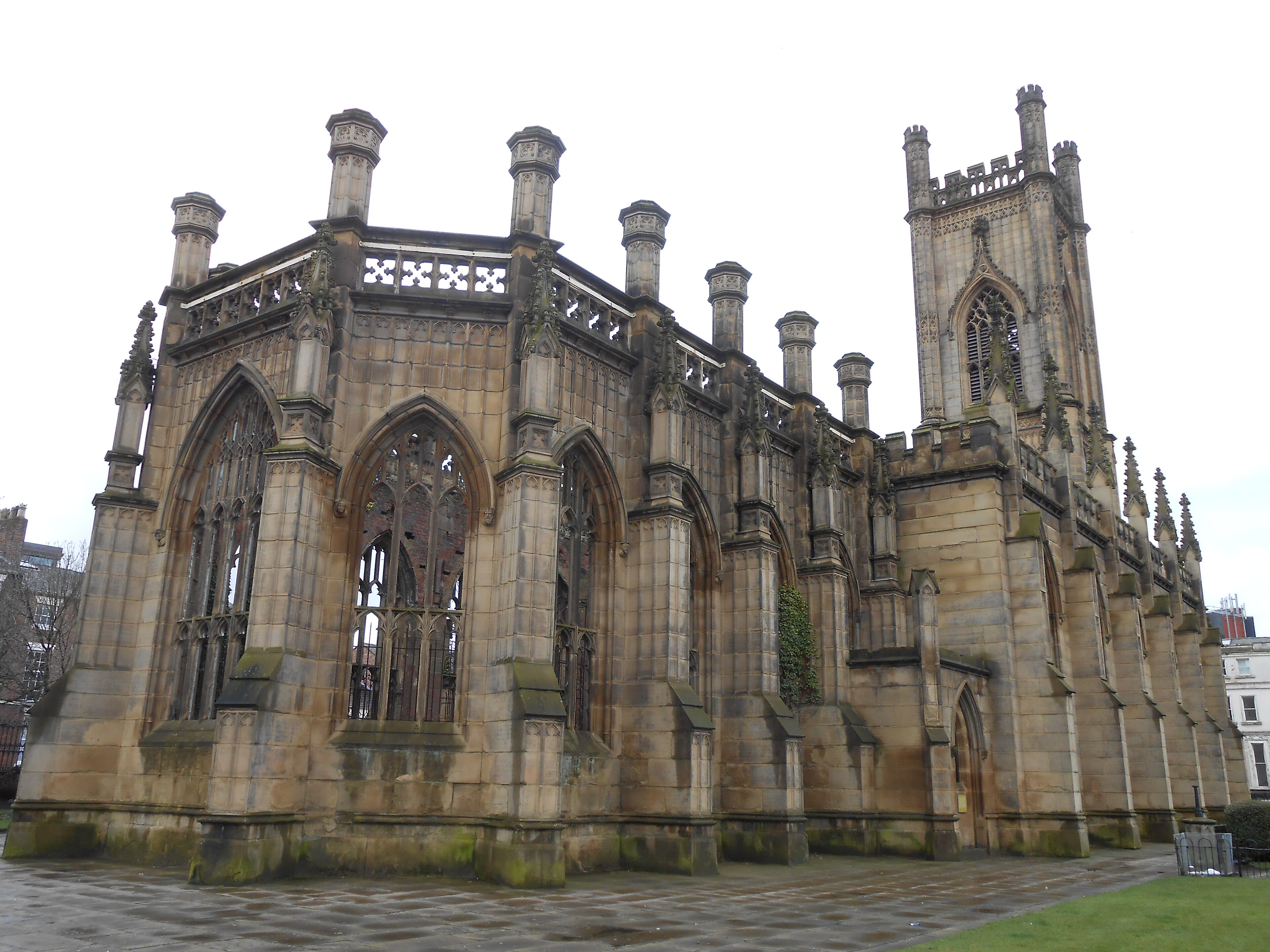
A roofless Anglican church transformed by wartime destruction into a poignant memorial. Once designed as a parish church, concert hall, and ceremonial venue, it now stands as Liverpool’s most eloquent testament to the Blitz.
At a glance
St Luke’s occupies a commanding corner site at the top of Bold Street, where Berry Street and Leece Street meet. Designed by the Fosters, Liverpool’s father-and-son municipal surveyors, the church was conceived as a multi-purpose civic landmark. Bombs in 1941 reduced it to its present skeletal form—a Grade II* listed structure that has endured as one of Liverpool’s most recognizable ruins.
History
Construction began in 1811 and concluded in 1832, a two-decade undertaking by John Foster, Sr. and John Foster, Jr., who served successively as surveyors for Liverpool’s municipal Corporation. The building was designed to serve triple duty: as a parish church, as a ceremonial venue for civic worship, and as a concert hall.
The Liverpool Blitz of 1941 devastated the structure. Bombing stripped the church of its roof and interior, leaving only its outer walls standing. The damage proved permanent. Rather than rebuild, the authorities chose preservation—maintaining the shell as a memorial to those killed in the raids.
What you see
The church’s empty nave and surrounding walls, gates, and railings retain the architectural ambitions of the Foster era—a period when Liverpool’s merchants and civic leaders were reshaping the city’s skyline. The absence of a roof and interior has paradoxically clarified its essential form: a statement of void and remembrance rather than active worship.
Cultural significance
St Luke’s embodies Liverpool’s wartime experience. The church serves as both literal and symbolic ruin—a space where civic aspiration and collective loss intersect. Beyond its memorial function, it has been repurposed for exhibitions and public events, allowing contemporary artists and communities to activate its evocative emptiness.
Key facts
- Country: United Kingdom
- City: Liverpool
- Built: 1811–1832
- Architects: John Foster, Sr. and John Foster, Jr.
- Damaged: 1941 (Liverpool Blitz)
- Listed status: Grade II* (church, walls, gates, railings)
- Coordinates: 53.4017, -2.9752
Practical information & getting there
St Luke’s stands on the corner of Berry Street and Leece Street, at the top of Bold Street in Liverpool city centre. The site is accessible to the public and remains a significant landmark on the pedestrian streetscape. Check locally for information about events and exhibitions held at the venue.
Sources & resources
Find it on the map
See this place and what’s around it →📷 Become a Cultural Heritage Online photographer
Share your photos of places: they stay published under your name as the author. The more they're seen, the more you get noticed — and soon a contest will reward the most appreciated photos.
Log in or sign up free to add a photoIs this page about you?
This page is read by travellers and heritage enthusiasts who find it on Google. Tell us how you are connected to this place and we will take it from there.