
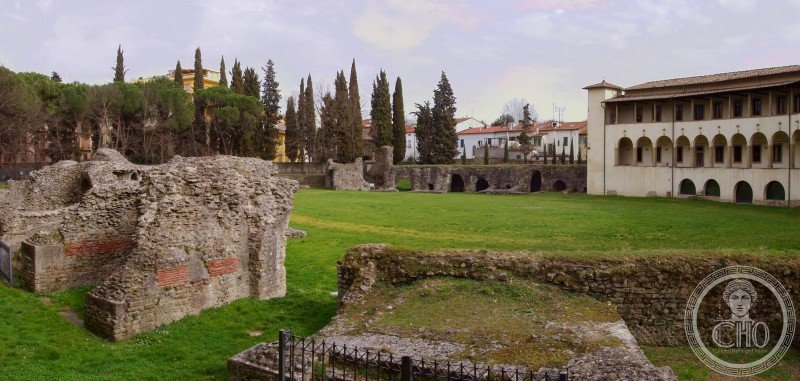
The Roman Amphitheater of Arezzo is a well-preserved ancient monument set within the historic centre of Arezzo, in Tuscany, dating from the 1st to 2nd century AD. Built during the Roman Imperial period to serve the prosperous municipality of Arretium, it is today incorporated into the archaeological museum grounds and offers an evocative open-air setting that includes a virtual tour experience for remote visitors.
At a glance
- Type
- Roman amphitheatre (civic)
- Period
- 1st–2nd century AD, Roman Imperial period
- Style
- Roman imperial architecture
- Location
- Arezzo, Province of Arezzo, Tuscany, Italy
Overview
The amphitheatre of Arezzo survives as one of central Tuscany’s most significant Roman monuments, occupying a site adjacent to the Museo Archeologico Nazionale “Gaio Cilnio Mecenate,” itself partly housed in a former convent built over and incorporating parts of the ancient structure. The monument occupies the south-eastern corner of the Roman city of Arretium, which was among the wealthiest municipia of Augustan Italy and famous for its production of Arretine ware (terra sigillata). Visitors to the archaeological area can walk the perimeter of the elliptical arena and examine the surviving substructures at close range.
History
Arretium was one of the most important cities of Etruria and subsequently a flourishing Roman colony from the late Republic. The amphitheatre was constructed during the Imperial era, probably in the 1st or early 2nd century AD, reflecting the city’s wealth and its adoption of mainstream Roman entertainment culture. In the medieval period the monument fell into disuse and the site was progressively built over; a Benedictine convent was constructed partly on its foundations, a common fate for large Roman public buildings throughout Italy. Systematic archaeological excavation in the 19th and 20th centuries revealed the extent of the surviving substructures and allowed a partial anastylosis of the site.
What you see
The elliptical cavea foundations and lower perimeter walls of the amphitheatre are preserved across most of the circuit, giving a clear impression of the monument’s original oval plan. Arched passageways typical of Roman amphitheatre construction are visible at ground level, constructed in opus reticulatum and brick. The medieval convent building that stands along one flank of the site now houses the archaeological museum, creating an instructive juxtaposition of Roman, medieval and Renaissance building phases. A programme of virtual tour interpretation, accessible online and on-site, enhances the visitor experience with digital reconstructions of the original monument.
Cultural significance
The Arezzo amphitheatre exemplifies the continuity of urban occupation in Italian historic centres, where Roman, medieval and modern layers coexist on the same footprint. Its integration into the national archaeological museum complex makes it an important educational site, linking the monument directly to the rich collection of Arretine pottery and other finds from the ancient city.
Practical information
- Address
- Via Margaritone, 10, 52100 Arezzo AR, Italy
- Coordinates
- 43.4604° N, 11.8804° E
- Museum
- Museo Archeologico Nazionale “Gaio Cilnio Mecenate,” adjacent to the amphitheatre
- Hours
- Check the museum’s official website for current opening hours and admission fees
Getting there
Arezzo is served by frequent trains on the Florence–Rome main line (approximately 45 minutes from Florence, 2 hours from Rome). The archaeological area is a short walk (approximately 600 m) south-east from Arezzo railway station. By car, Arezzo is reached via the A1 Autostrada del Sole (Arezzo exit); paid parking is available in the town centre. City bus routes connect the station with the historic centre.
Sources & resources
See the place
Find it on the map
See this place and what’s around it →📷 Become a Cultural Heritage Online photographer
Share your photos of places: they stay published under your name as the author. The more they're seen, the more you get noticed — and soon a contest will reward the most appreciated photos.
Log in or sign up free to add a photo