
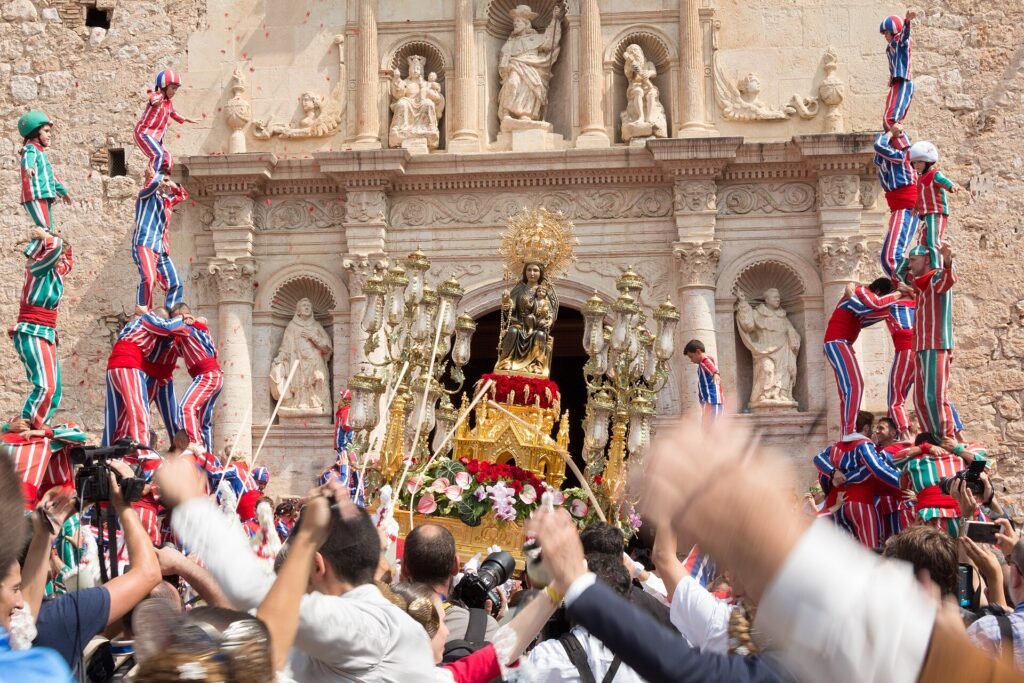
Each late summer, the town of Algemesí honours its patron saint with a ten-day celebration rooted in medieval devotion, blending religious procession, music, and communal ritual into a living festival of faith and identity.
In UNESCO’s words
The Festivity of ‘la Mare de Déu de la Salut’ is celebrated in Algemesí in the Province of Valencia, Spain. Every 7 and 8 September almost 1,400 people participate in theatre, music, dance and performances organized in the historical areas of the city: Valencia, La Muntanya, Santa Barbara and La Capella. Processions run from the Basílica Menor de San Jaime to the Capella de la Troballa. The festivities commence with bell-ringing from the basilica followed by a parade. The Schola Cantorum choir and orchestra perform vespers in the evening at the basilica, followed by bell-ringing and the Procession of the Betrothed, which features ''Els Misteris'' (short, religious theatrical pieces performed by children) human towers with traditional musical accompaniment, and dance performances. The next day, giant puppets representing the King and Queen of Aragon, James I and his wife Violante of Hungary, join the morning procession, while the General Grand Procession features representations of biblical characters and songs of the apostles. The involvement of the town’s inhabitants is the foundation for the continuity of this celebration. All costumes, ornaments and accessories are handcrafted, and the dances and musical scores are passed from generation to generation.
Official description, UNESCO Intangible Cultural Heritage List — Festivity of ‘la Mare de Déu de la Salut’ of Algemesí
At a glance
The Festivity of La Mare de Déu de la Salut is a celebration held every 7 and 8 September in Algemesí, Valencia. Nearly 1,400 people participate in theatre, music, dance and performances across the city's historical areas. Processions move from the Basílica Menor de San Jaime to the Capella de la Troballa, beginning with bell-ringing and a parade. The festival combines religious observance with community performance in a tradition that belongs to the entire town.
Origins & history
The festival is rooted in devotion to La Mare de Déu de la Salut (Our Lady of Health) and has been documented since 1247, making it one of Spain’s oldest continuous celebrations. The practice evolved over seven centuries as a sacred and social anchor for Algemesí’s identity.
The practice
On the first evening, the Schola Cantorum choir and orchestra perform vespers at the basilica, followed by the Procession of the Betrothed. This includes Els Misteris—short religious theatrical pieces performed by children—human towers with traditional musical accompaniment, and dance performances. The following morning, giant puppets representing King James I and Queen Violante of Hungary join the procession, while the General Grand Procession features representations of biblical characters and apostolic songs. All costumes and accessories are handcrafted, with dances and musical scores transmitted across generations.
Cultural significance
The town's inhabitants are the foundation for the festival's continuity. Through their sustained participation and transmission of artistic knowledge across generations, they maintain this expression of collective identity and spiritual devotion. The handcrafted elements and intergenerational passing of performance traditions ensure the celebration endures as a living practice.
Key facts
- Country: Spain
- Inscribed: 2011
- UNESCO list: Representative List of the Intangible Cultural Heritage of Humanity
- UNESCO reference: 00576
- UNESCO vocabulary: Festivals; Performing arts; Procession
- Map: Algemesí — the locality named in UNESCO’s official description of this element
Where to experience it
The Festival of 'la Mare de Déu de la Salut' unfolds in Algemesí, in the Province of Valencia, Spain, on 7 and 8 September. Nearly 1,400 participants bring the celebration to life across the city's historical quarters—Valencia, La Muntanya, Santa Barbara and La Capella—with theatre, music, dance and processions that run from the Basílica Menor de San Jaime to the Capella de la Troballa. Visitors can witness bell-ringing, the Procession of the Betrothed featuring 'Els Misteris' (short religious plays performed by children), human towers, giant puppets of medieval royalty, biblical character representations, and generations-old dances accompanied by traditional music.
Sources & resources
- UNESCO — official element page: Festivity of ‘la Mare de Déu de la Salut’ of Algemesí
- UNESCO — open data record: Intangible Heritage List, reference 00576
- UNESCO — official video: UNESCO film on this element — embedded on this page
- UNESCO — official photograph: Entry of the "Mare de Déu" in the Basilica — Museu Valencià de la Festa — 2010 by Generalitat Valenciana
- Reference — Wikipedia (secondary): La Mare de D%C3%A9u de la Salut Festival — consulted as a secondary reference, not as confirmation
- Cultural Heritage Online: Our archive and city guides

Find it on the map
See this place and what’s around it →📷 Become a Cultural Heritage Online photographer
Share your photos of places: they stay published under your name as the author. The more they're seen, the more you get noticed — and soon a contest will reward the most appreciated photos.
Log in or sign up free to add a photo