
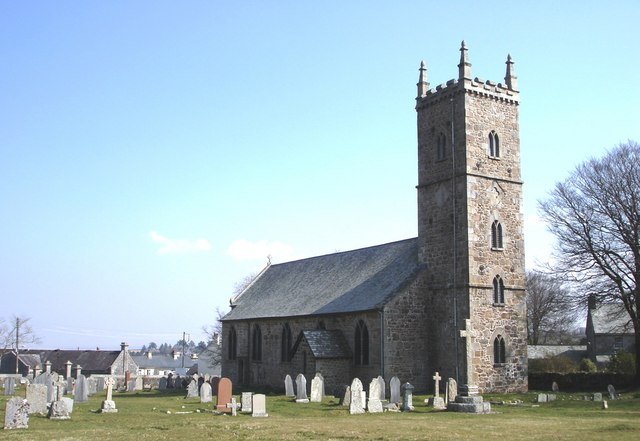
A granite church on Dartmoor built entirely by Napoleonic and American prisoners of war—the only structure of its kind in England, now cared for by the Churches Conservation Trust.
At a glance
St Michael stands 436 metres above sea level near the centre of Dartmoor, a windswept moorland plateau in Devon. The Anglican church is Grade II* listed and redundant, though still consecrated and occasionally used for services. Its three-stage west tower, crowned with pinnacles, rises prominently against the exposed landscape.
History
Construction began in 1810 with permission granted in 1812 by the Lord Commissioners of the Admiralty. Prisoners held at Dartmoor Prison during the Napoleonic Wars built the structure, with American prisoners captured in the War of 1812 completing the work—making it England’s only church constructed by prisoners of war.
The prison closed in 1816 and the church followed, but reopened and was reconsecrated in 1831. Edmund Sedding oversaw significant alterations between 1898 and 1901. The tower underwent restoration in 1915. The church was declared redundant on 1 November 1995 and transferred to the Churches Conservation Trust on 8 January 2001.
What you see
The church is built from local granite, reflecting Dartmoor’s austere landscape. Its defining feature is the three-stage west tower surmounted by pinnacles. The 1868 alteration modified the chancel, while early 20th-century changes enlarged the building.
The east window contains stained glass by Mayer of Munich, installed in 1910. This commemorates the American prisoners who helped construct the church and was partially funded by a £250 donation in 1908 from the National Society United States Daughters of 1812.
Cultural significance
St Michael embodies a rare historical convergence: a monument to wartime imprisonment, Anglo-American reconciliation, and architectural ambition in an inhospitable environment. The graves of many prisoners remain in the churchyard, transforming the site into a memorial to lives lost far from home.
The involvement of prisoners of war in its construction marks it as unique in English ecclesiastical history. The stained glass window funded by American donations illustrates post-war commemoration and the bridge built between former enemies through shared loss.
Key facts
- Location: Dartmoor Forest, Devon, England
- Country: United Kingdom
- Coordinates: 50.5461, -3.9961
- Built: 1810–1814
- Architect: Daniel Alexander
- Listed status: Grade II*
- Current use: Occasional services; redundant but consecrated
- Care: Churches Conservation Trust
Practical information & getting there
The church stands near Dartmoor Prison. Access is via Princetown, a village on the moorland plateau accessible by road from surrounding towns. Opening hours and service times vary; contact the Churches Conservation Trust for current information. The exposed moorland location means weather conditions can be severe year-round.
Sources & resources
Find it on the map
See this place and what’s around it →📷 Become a Cultural Heritage Online photographer
Share your photos of places: they stay published under your name as the author. The more they're seen, the more you get noticed — and soon a contest will reward the most appreciated photos.
Log in or sign up free to add a photoIs this page about you?
This page is read by travellers and heritage enthusiasts who find it on Google. Tell us how you are connected to this place and we will take it from there.