
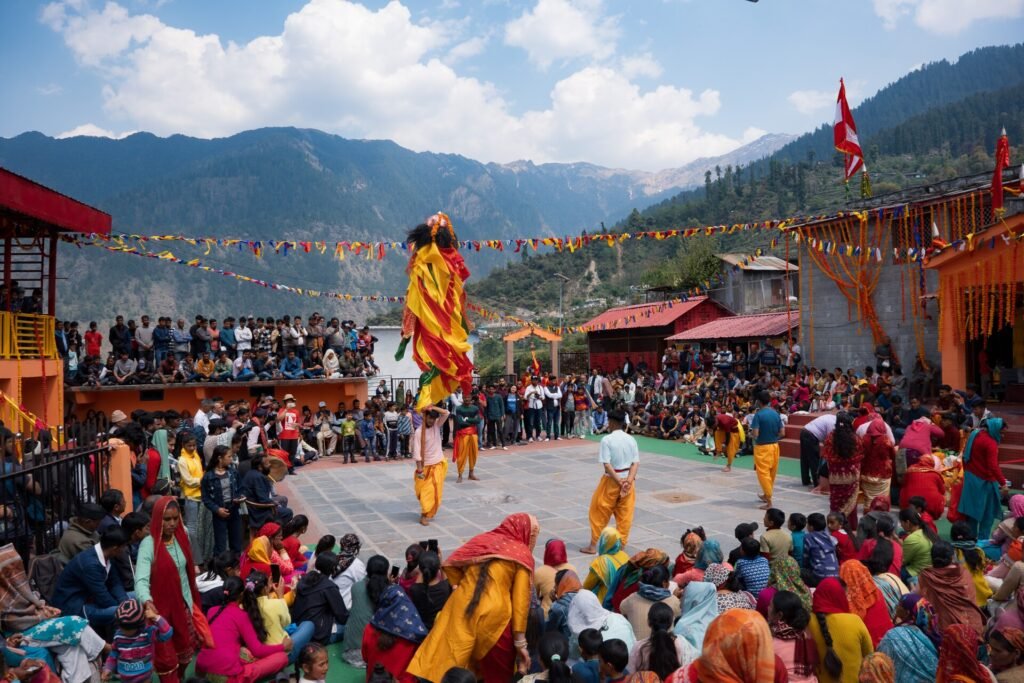
A masked ritual theatre of the Garhwal Himalayas, Ramman is performed as a sacred offering to village deities, transforming courtyard temples into spaces of spiritual communion and ancestral remembrance.
At a glance
Ramman is a religious festival and ritual theatre practised across the Garhwal region of Uttarakhand. Villagers enact masked performances in the courtyards of temple sanctuaries, honouring local deities through movement, song, and ceremonial gesture. The most renowned variant—the masked Ramman of Saloor-Dungra village in the Painkhanda Valley—occurs nowhere else in the Himalayan region.
Origins & history
Ramman belongs to an ancient religious tradition of the Garhwali people, woven into the spiritual life of mountain communities for generations. Multiple versions exist across villages, each tied to local pantheons and seasonal cycles. The masked form in Saloor-Dungra stands singular—a practice preserved and transmitted within that village alone, making it irreplaceable within its cultural geography.
The practice
Masked performers enact sacred narratives in village temple courtyards, their costumes and movements channelling the presence of Bhumiyal Devta and other local deities. Participants wear elaborate masks that transform their identity, allowing them to embody divine and ancestral powers. The performance combines dance, song, and dramatic gesture, creating an immersive ritual space where the boundary between performer and spectator dissolves into shared devotion.
Cultural significance
Ramman is far more than entertainment—it is the primary vehicle through which Garhwali communities maintain dialogue with their sacred landscape and guardian deities. The ritual reinforces social bonds and transmits cosmological knowledge across generations. For the bearers of this practice, the festival embodies continuity, offering a lived connection to ancestral wisdom and village identity that no other cultural form can replace.
Key facts
- Anchor community: Joshimath region, Uttarakhand, India
- UNESCO Intangible Cultural Heritage inscription: 2008 (reference 00281)
- Notable variant: Masked Ramman of Saloor-Dungra village, Painkhanda Valley, Chamoli district
- Primary venue: Village temple courtyards
- Performing tradition: Garhwali people
Where to experience it
The Garhwal region, particularly around Joshimath and the Painkhanda Valley, remains the heartland of Ramman. The masked variant is unique to Saloor-Dungra village, where it continues to be performed as part of village religious observance. Visitors seeking to witness this practice should engage with local communities respectfully, recognising that Ramman is a sacred ritual, not a staged performance.
Sources & resources
Find it on the map
See this place and what’s around it →📷 Become a Cultural Heritage Online photographer
Share your photos of places: they stay published under your name as the author. The more they're seen, the more you get noticed — and soon a contest will reward the most appreciated photos.
Log in or sign up free to add a photo