
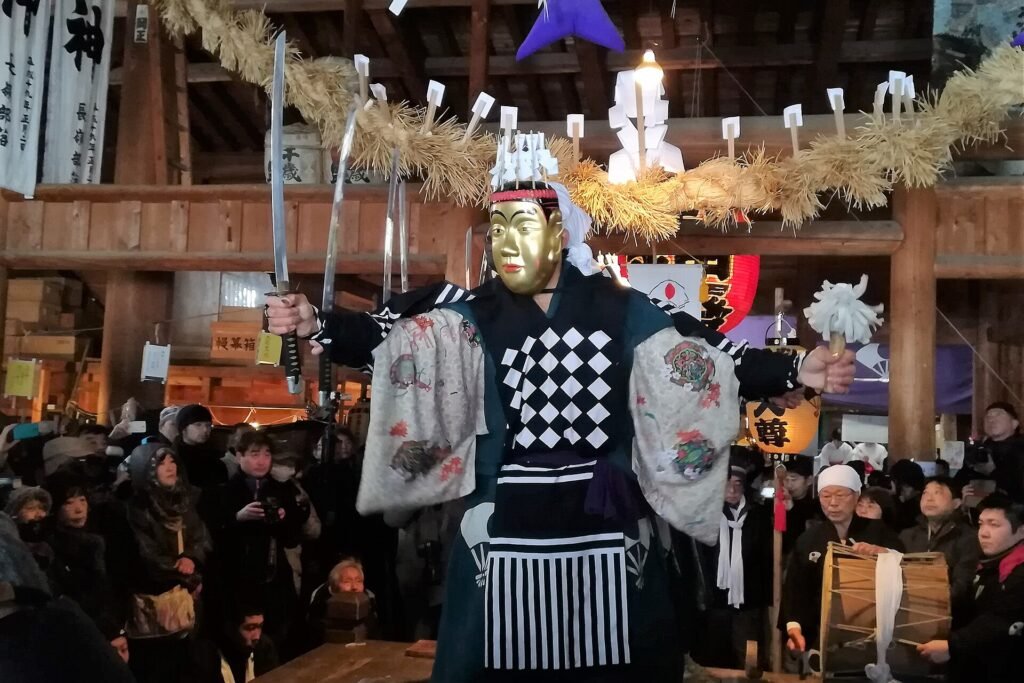
Nine sacred ritual dances and instrumental music performed annually on January second, tracing their lineage back to imperial court performers who settled in rural Akita in the early eighth century.
In UNESCO’s words
According to legend, travelling performers of ''bugaku,'' the ritual dance and music of the imperial palace, visited Hachimantai Town in northern Japan in the early eighth century, during the reconstruction of Dainichido, the shrine pavilion. The ritual performance of Dainichido Bugaku takes its name from this story, but the art evolved considerably since, reflecting local features as elders transmitted it to the young within each of the four local communities of Osato, Azukisawa, Nagamine and Taniuchi. On the second day of each year, the 2 January, the people of these communities proceed from dedicated sites to the shrine, where they perform nine sacred dances from dawn to noon as a prayer for happiness in the New Year. Some of the dances involve masks (including the imaginary lion-like ''shishi'' of myths), others include child dancers, reflecting variations among the four groups. The practice deepens the sense of affiliation with the local community, for both the participants and the many residents who come to observe the tradition each year. Although the Dainichido Bugaku was interrupted for nearly six decades in the late eighteenth century, the people of Hachimantai take great pride in the restored tradition, which is the spiritual core of their solidarity.
Official description, UNESCO Intangible Cultural Heritage List — Dainichido Bugaku
At a glance
Dainichido Bugaku is a sacred dance performance held each year on 2 January at a shrine in northern Japan. According to legend, travelling performers of bugaku—the ritual dance and music of the imperial palace—visited the area in the early eighth century and taught their art to local people. The tradition has evolved over centuries, shaped by four local communities who each bring their own variations to the practice.
Origins & history
The tradition began when imperial palace performers are said to have visited during the reconstruction of Dainichido shrine in the early eighth century. Over time, the four local communities of Osato, Azukisawa, Nagamine and Taniuchi transmitted the dances to each new generation, and the art developed distinct local features. The practice was interrupted for nearly six decades in the late eighteenth century, but the people of Hachimantai restored it and continue it today.
The practice
On 2 January, participants from the four communities process from dedicated sites to the shrine and perform nine sacred dances from dawn until noon. Some dances use masks, including representations of the shishi, the lion-like creature of myth. Others include child dancers. The variations in masks and performers differ among the four groups, reflecting how each community has shaped the tradition over time.
Cultural significance
For participants and residents who gather to watch, Dainichido Bugaku deepens the sense of belonging to their local community. The people of Hachimantai regard the restored tradition with great pride, and it serves as the spiritual core of their solidarity. The performance functions as a prayer for happiness in the coming year and remains central to community life.
Key facts
- Country: Japan
- Inscribed: 2009
- UNESCO list: Representative List of the Intangible Cultural Heritage of Humanity
- UNESCO reference: 00275
- UNESCO vocabulary: Ritual dance; Seasonal ritual
- Map: Hachimantai Town — the locality named in UNESCO’s official description of this element
Where to experience it
Dainichido Bugaku is performed annually on 2 January in Hachimantai Town, where the four local communities of Osato, Azukisawa, Nagamine and Taniuchi maintain this sacred tradition. People from each community proceed to the shrine at dawn to perform nine ritual dances until noon as a prayer for happiness in the New Year. The performances feature variations among the groups, including masked dances and child dancers, drawing both active participants and residents who gather to observe this spiritual core of local solidarity.
Sources & resources
- UNESCO — official element page: Dainichido Bugaku
- UNESCO — open data record: Intangible Heritage List, reference 00275
- UNESCO — official video: UNESCO film on this element — embedded on this page
- UNESCO — official photograph: Photograph of this element — Kazuno City — 2008, by Kazuno City
- Reference — Wikipedia (secondary): Dainichido Bugaku — consulted as a secondary reference, not as confirmation
- Cultural Heritage Online: Our archive and city guides

Find it on the map
See this place and what’s around it →📷 Become a Cultural Heritage Online photographer
Share your photos of places: they stay published under your name as the author. The more they're seen, the more you get noticed — and soon a contest will reward the most appreciated photos.
Log in or sign up free to add a photo