

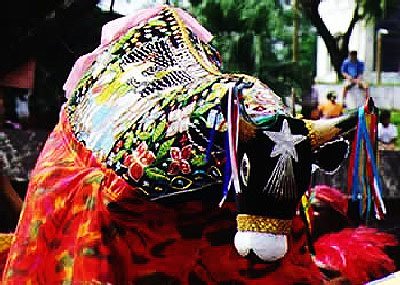
An 18th-century interactive play in which lower-class Brazilians use song, dance, and comedy to critique those of higher social status through the death and resurrection of an ox.
In UNESCO’s words
The Cultural Complex of Bumba-meu-boi from Maranhão is a ritualistic practice involving forms of musical, choreographic, performing and ludic expression, in which the practitioners’ relationship with the sacred is mediated by the figure of the ox. The practice features certain key distinguishing elements: the cycle of life; the mystical-religious universe; and the ox itself. The practice is heavily charged with symbolism: by reproducing the cycle of birth, life and death, it offers a metaphor for human existence itself. There are similar forms of expression in other Brazilian states, but in Maranhão Bumba-meu-boi is distinguished by the various styles and groups it includes, as well as by the intrinsic relationship between faith, festivities and art. Each year, the Bumba groups from Maranhão reinvent this celebration, creating the songs, comedies, the embroideries on the ox leather and the performers’ costumes. Divided into five main ‘accents’ with particular features, the groups, albeit diverse, share a yearly calendar of performances and festivities. The festival cycle – which reaches its peak at the end of June – may last for four to eight months, involving the following stages: rehearsals; the pre-season; baptisms; public performances or ‘brincadas’; and rituals around the ox’s death. The practice is a period of renovation during which energies are reinvigorated, and is transmitted through children’s groups, dance workshops, and spontaneously within the group.
Official description, UNESCO Intangible Cultural Heritage List — Cultural Complex of Bumba-meu-boi from Maranhão
At a glance
Bumba-meu-boi is a ritualistic practice that combines music, choreography, performance, and play. At its centre stands the figure of an ox, through which participants engage with the sacred. The tradition reproduces the cycle of birth, life, and death, using this pattern as a metaphor for human existence itself. Heavily symbolic throughout, the practice weaves together faith, festivities, and art into a unified expression.
Origins & history
While similar forms of expression exist in other Brazilian states, Bumba-meu-boi in Maranhão developed its own distinctive character through numerous styles and groups. Over time, the practice became known for the particular relationship between its religious and artistic dimensions. Each year, the groups reinvent the celebration by creating new songs, comedies, embroideries on ox leather, and performer costumes, allowing the tradition to evolve while maintaining its core elements.
The practice
The practice follows a yearly festival cycle lasting four to eight months, reaching its peak at the end of June. The cycle includes rehearsals, a pre-season, baptisms, public performances called 'brincadas', and rituals around the ox's death. Bumba-meu-boi is organized into five main 'accents', each with particular features. Though diverse, all groups share this yearly calendar of performances and festivities. The tradition is transmitted through children's groups, dance workshops, and spontaneously within the group itself.
Cultural significance
Bumba-meu-boi serves as a period of renewal in which energies are reinvigorated within the community. The practice's deep symbolic charge—drawing on the cycle of life and death—connects participants to their mystical-religious universe and to human existence itself. By sustaining this tradition year after year, the groups preserve a form of cultural expression that carries profound meaning for their communities.
Key facts
- Country: Brazil
- Inscribed: 2019
- UNESCO list: Representative List of the Intangible Cultural Heritage of Humanity
- UNESCO reference: 01510
- UNESCO vocabulary: Religious practice; Religious syncretism
- Map: Maranhão — the locality named in UNESCO’s official description of this element
- Related World Heritage site: Historic Centre of São Luís (a different UNESCO designation, not the place of the tradition)
Where to experience it
Bumba-meu-boi thrives throughout Maranhão in northeast Brazil, where groups perform according to a yearly calendar that spans four to eight months and peaks at the end of June. Visitors can encounter the practice through public performances, known as 'brincadas', as well as through dance workshops and community celebrations where the various regional styles and groups showcase their distinctive interpretations. The tradition is transmitted through children's groups and spontaneous gatherings within communities, making it accessible to those seeking to experience this ritualistic expression of music, choreography, and performance that connects faith, art, and the cycle of life.
Sources & resources
- UNESCO — official element page: Cultural Complex of Bumba-meu-boi from Maranhão
- UNESCO — open data record: Intangible Heritage List, reference 01510
- UNESCO — official photograph: Ox in front of the altar on its baptism day, at the headquarters of the Maracanã group — Márcio Vasconcelos, 2013
- Reference — Wikipedia (secondary): Bumba Meu Boi — consulted as a secondary reference, not as confirmation
- Cultural Heritage Online: Our archive and city guides

Find it on the map
See this place and what’s around it →📷 Become a Cultural Heritage Online photographer
Share your photos of places: they stay published under your name as the author. The more they're seen, the more you get noticed — and soon a contest will reward the most appreciated photos.
Log in or sign up free to add a photo