
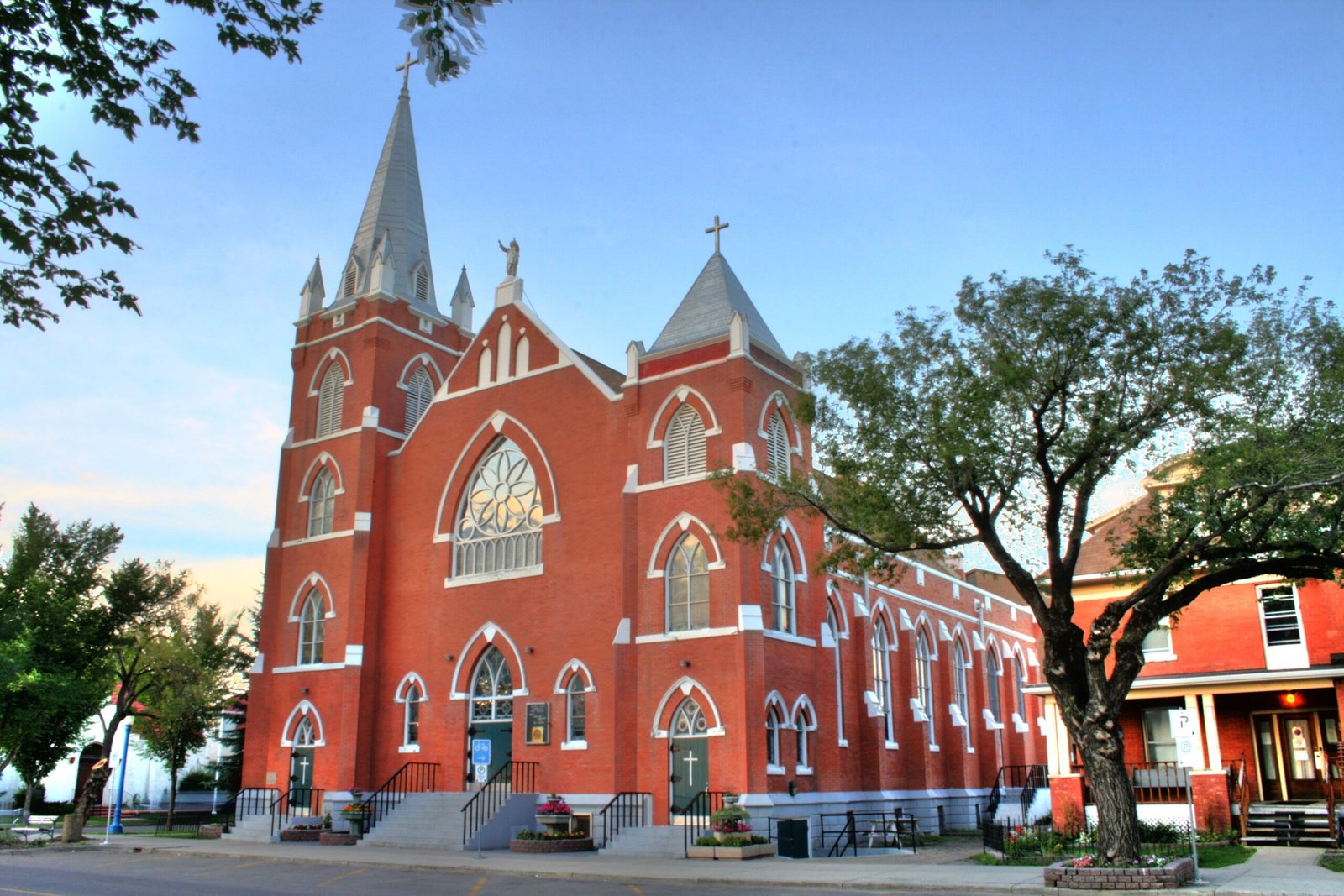
A Roman Catholic church transformed from a parish for European immigrants into Canada’s first national parish serving First Nations, Métis, and Inuit communities.
At a glance
Sacred Heart opened in 1913 as Edmonton’s population surged. By 1991, it had become a beacon for the city’s urban Indigenous communities, redesignated as a First Nations, Métis, and Inuit national parish—a pioneering model in Canadian Catholic practice.
History
The church was established in 1913 to accommodate Edmonton’s expanding population during an era of rapid urban growth. For much of the twentieth century, it served as a spiritual and institutional foundation for the city’s immigrant Catholic parishes. As post-war demographics shifted and the inner-city parish aged, Sacred Heart’s leadership recognized an opportunity to serve a new community. In 1991, Archbishop Joseph MacNeil formally declared the church a First Nations, Métis, and Inuit national parish—the first designation of its kind in Canada. That same year, the Archdiocese of Edmonton’s Native Pastoral Centre relocated into the building, cementing its new mission.
What you see
The church building itself reflects early twentieth-century Roman Catholic architecture, having served continuous worship since its 1913 opening.
Cultural significance
Sacred Heart Church of the First Peoples represents a landmark moment in Canadian religious history. Its 1991 redesignation established a new pastoral model: a Roman Catholic parish explicitly centered on Indigenous spiritual and cultural needs. The church’s evolution from a European immigrant sanctuary to an Indigenous national parish mirrors larger shifts in Canadian urbanism and reconciliation efforts.
Key facts
- Location: Edmonton, Alberta, Canada
- Coordinates: 53.555°N, 113.487°W
- Opened: 1913
- Redesignated: October 27, 1991 (first Indigenous national parish in Canada)
- Archdiocese: Edmonton
Practical information & getting there
Sacred Heart Church of the First Peoples is located in Edmonton’s inner city. For current visiting hours, service times, and accessibility information, consult the Archdiocese of Edmonton directly.
Sources & resources
Find it on the map
See this place and what’s around it →📷 Become a Cultural Heritage Online photographer
Share your photos of places: they stay published under your name as the author. The more they're seen, the more you get noticed — and soon a contest will reward the most appreciated photos.
Log in or sign up free to add a photoDo you manage this place?
This page is read by travellers and heritage enthusiasts who find it on Google. Keep it accurate — and make it work for you. Free for non-profit heritage institutions.