
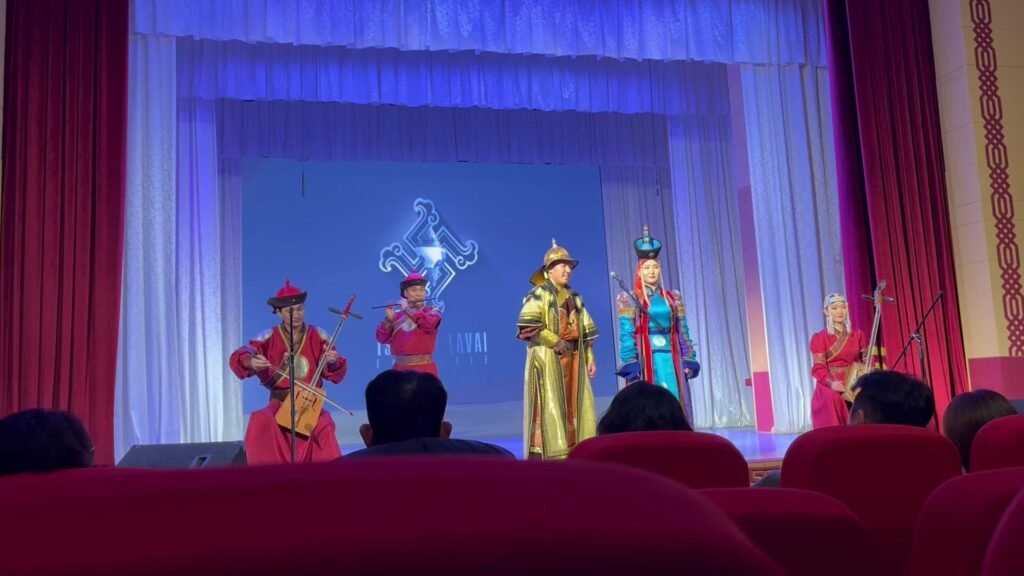
Mongolia’s ancient vocal tradition stretches syllables into pure meditation. A single word can float across minutes; a song of ten words may unfold for hours.
At a glance
Urtiin duu—the long song—stands as a cornerstone of Mongolian music, prized for its extraordinary extension of individual syllables rather than speed or volume. The genre transforms lyric poetry into sustained vocal art, where time itself becomes material. Themes range from philosophy and spirituality to love and celebration, with horses appearing as symbolic and literal subjects woven through the verses.
Origins & history
Long songs belong to the deep musical inheritance of the Mongolian peoples, shaped across centuries of nomadic life and pastoral tradition. The practice remains vital across Mongolia and among Mongolian communities in China, transmitted orally through families and formal apprenticeship.
The practice
A long song reduces language to its essence. Ten words might sustain four minutes of singing; the famous “Uvgin shuvuu khoyor” (also known as “Jargaltain delger,” or “Old Man and the Bird”) unfolds across three hours when performed complete with all thirty-two stanzas. The singer’s voice moves with fluid ornamentation, bending and extending vowels into complex melodic shapes.
Eastern Mongolian singers typically accompany themselves on the morin khuur—the horse-head fiddle—sometimes adding the limbe, a traditional wooden flute. Western Oirat groups traditionally perform unaccompanied or with the igil, allowing the voice to remain the central instrument. Each regional style carries distinct musical characteristics and performance conventions.
Cultural significance
Urtiin duu embodies the Mongolian relationship with landscape, time, and emotional depth. The stretched syllables echo the vast steppes; the patient unfolding mirrors pastoral rhythms. These songs preserve philosophical wisdom, spiritual teachings, and the poetry of daily life—from celebration of horses to expressions of devotion and longing.
The practice binds community memory and identity across generations, sustaining values central to Mongolian culture even as modern life accelerates around it.
Key facts
- Practiced in Mongolia and among Mongolian communities in China
- Anchor community: Ulaanbaatar, Mongolia (47.92187°N, 106.91012°E)
- UNESCO Intangible Cultural Heritage, reference 00115
- Primary instruments: morin khuur (horse-head fiddle), limbe (flute), igil
- Lyrical themes: philosophical, religious, romantic, celebratory; horses as symbol and subject
- Performance scale: from four-minute songs to three-hour complete versions with multiple stanzas
Where to experience it
Ulaanbaatar and the heartland of Mongolia remain the living center of long-song performance and transmission. The practice thrives in concert halls, cultural institutions, and family gatherings where singers continue to apprentice and perform both traditional and newly composed works in this centuries-old style.
Sources & resources
Find it on the map
See this place and what’s around it →📷 Become a Cultural Heritage Online photographer
Share your photos of places: they stay published under your name as the author. The more they're seen, the more you get noticed — and soon a contest will reward the most appreciated photos.
Log in or sign up free to add a photo