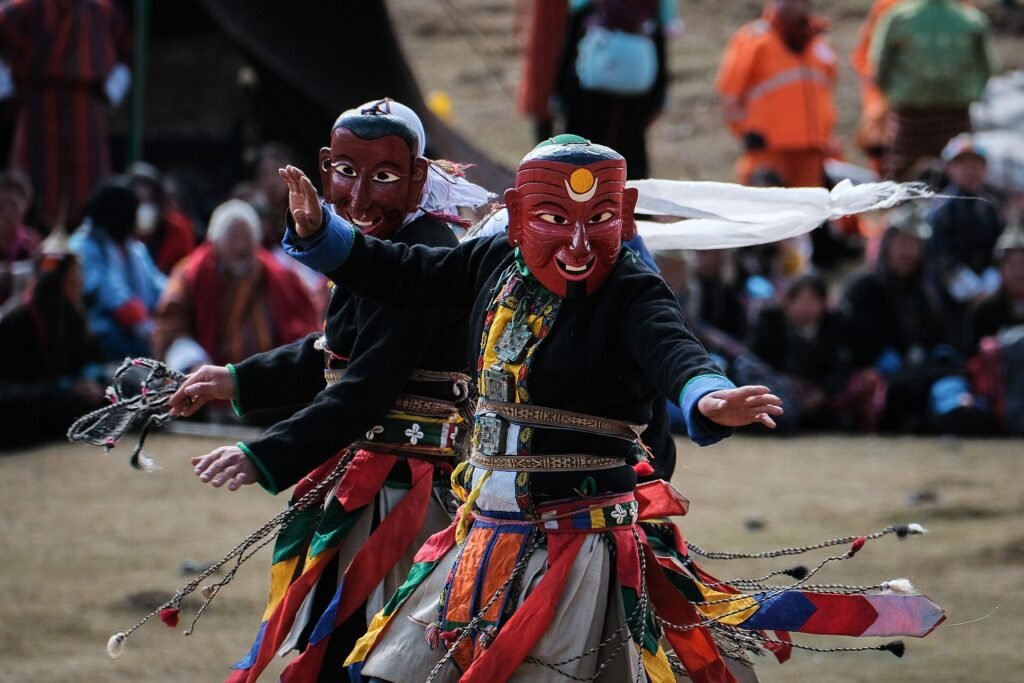
Drametse Ngacham mask dance. Photo: Sabine Blankevoort via Wikimedia Commons, CC BY-SA 4.0.
Drametse, Bhutan · Representative List
Mask dance of the drums from Drametse
A sacred masked dance performed twice yearly in eastern Bhutan, Drametse Ngacham combines prayer, mythology, and monastic ritual in a five-century-old tradition that has become emblematic of Bhutanese cultural identity.
In UNESCO’s words
The mask dance of the Drametse community is a sacred dance performed during the Drametse festival in honour of Padmasambhava, a Buddhist guru. The festival, which takes place in this eastern Bhutanese village twice a year, is organized by the Ogyen Tegchok Namdroel Choeling Monastery.
The dance features sixteen masked male dancers wearing colourful costumes and ten other men making up the orchestra. The dance has a calm and contemplative part that represents the peaceful deities and a rapid and athletic part where the dancers embody wrathful deities. Dancers dressed in monastic robes and wearing wooden masks with features of real and mythical animals perform a prayer dance in the soeldep cham, the main shrine, before appearing one by one in the main courtyard. The orchestra consists of cymbals, trumpets and drums, including the bang nga, a large cylindrical drum, the lag nga, a small hand-held circular flat drum and the nga chen, a drum beaten with a bent drumstick.
The Drametse Ngacham has been performed in the same monastery for centuries. Its form has both religious and cultural significance, because it is believed to have originally been performed by the heroes and heroines of the celestial world. In the nineteenth century, versions of the Drametse Ngacham were introduced in other parts of Bhutan. For the audience, the dance is a source of spiritual empowerment and is attended by people from Drametse as well as neighbouring villages and districts to obtain blessings. Today, the dance has evolved from a local event centred on a particular community into an art form, representing the identity of the Bhutanese nation as a whole.
Although the dance is highly appreciated among all generations, the number of practitioners is dwindling due to lack of rehearsal time, the absence of a system for training and the gradual waning of interest among young people.
Drametse Ngacham is a mask dance performed twice a year during the Drametse festival by sixteen male dancers in honour of Padmasambhava, a Buddhist guru. The performance takes place at Ogyen Tegchok Namdroel Choeling Monastery in an eastern Bhutanese village. Ten musicians accompany the dancers, who wear colourful costumes and wooden masks depicting real and mythical animals. The dance moves from a prayer performance in the main shrine to the courtyard, alternating between calm sequences representing peaceful deities and rapid, athletic movements embodying wrathful deities.
Origins & history
The Drametse Ngacham has been performed at the same monastery for centuries. It is believed to have originated as a prayer dance performed by celestial heroes and heroines. In the nineteenth century, versions of the dance spread to other parts of Bhutan, expanding beyond its local roots. The dance has since evolved into a national art form representing the identity of Bhutanese culture as a whole, while remaining centred on its original monastery home.
The practice
Dancers wear monastic robes and wooden masks carved with animal and mythical features, appearing one by one in the courtyard after performing in the main shrine. The ten-member orchestra uses cymbals, trumpets, and three drums: the bang nga (a large cylindrical drum), the lag nga (a small hand-held circular flat drum), and the nga chen (beaten with a bent drumstick). The performance structure contrasts a calm, contemplative opening with rapid, acrobatic sequences that demand strength and precision from the dancers.
Cultural significance
For audiences from Drametse and neighbouring villages, the dance provides spiritual empowerment and blessings. Its religious and cultural significance stems from the belief that it was originally performed by celestial beings. Today the dance represents Bhutanese national identity. However, the number of practitioners is declining due to limited rehearsal time, the absence of formal training systems, and decreasing interest among young people.
Key facts
Country: Bhutan
Inscribed: 2008
UNESCO list: Representative List of the Intangible Cultural Heritage of Humanity
UNESCO reference: 00161
UNESCO vocabulary: Masks; Percussion instruments; Ritual dance
Map: Drametse — the locality named in UNESCO’s official description of this element
Where to experience it
The Drametse Ngacham is performed twice yearly in Drametse village during the festival held at Ogyen Tegchok Namdroel Choeling Monastery. Visitors and pilgrims from neighbouring villages and districts gather to witness the sixteen masked dancers and orchestra perform in the main courtyard and shrine. The dance, which has been preserved in this eastern Bhutanese monastery for centuries, draws audiences seeking both spiritual empowerment and connection to a tradition now recognized as representing Bhutanese cultural identity.
Share your photos of places: they stay published under your name as the author. The more they're seen, the more you get noticed — and soon a contest will reward the most appreciated photos.
This site uses cookies and similar technologies for statistics and to remember your preferences. You can accept them, or opt out below.
Functional
Always active
The technical storage or access is strictly necessary for the legitimate purpose of enabling the use of a specific service explicitly requested by the subscriber or user, or for the sole purpose of carrying out the transmission of a communication over an electronic communications network.
Preferences
The technical storage or access is necessary for the legitimate purpose of storing preferences that are not requested by the subscriber or user.
Statistics
The technical storage or access that is used exclusively for statistical purposes.The technical storage or access that is used exclusively for anonymous statistical purposes. Without a subpoena, voluntary compliance on the part of your Internet Service Provider, or additional records from a third party, information stored or retrieved for this purpose alone cannot usually be used to identify you.
Marketing
The technical storage or access is required to create user profiles to send advertising, or to track the user on a website or across several websites for similar marketing purposes.
This site uses cookies and similar technologies for statistics and to remember your preferences. You can accept them, or opt out below.
Functional
Always active
The technical storage or access is strictly necessary for the legitimate purpose of enabling the use of a specific service explicitly requested by the subscriber or user, or for the sole purpose of carrying out the transmission of a communication over an electronic communications network.
Preferences
The technical storage or access is necessary for the legitimate purpose of storing preferences that are not requested by the subscriber or user.
Statistics
The technical storage or access that is used exclusively for statistical purposes.The technical storage or access that is used exclusively for anonymous statistical purposes. Without a subpoena, voluntary compliance on the part of your Internet Service Provider, or additional records from a third party, information stored or retrieved for this purpose alone cannot usually be used to identify you.
Marketing
The technical storage or access is required to create user profiles to send advertising, or to track the user on a website or across several websites for similar marketing purposes.