
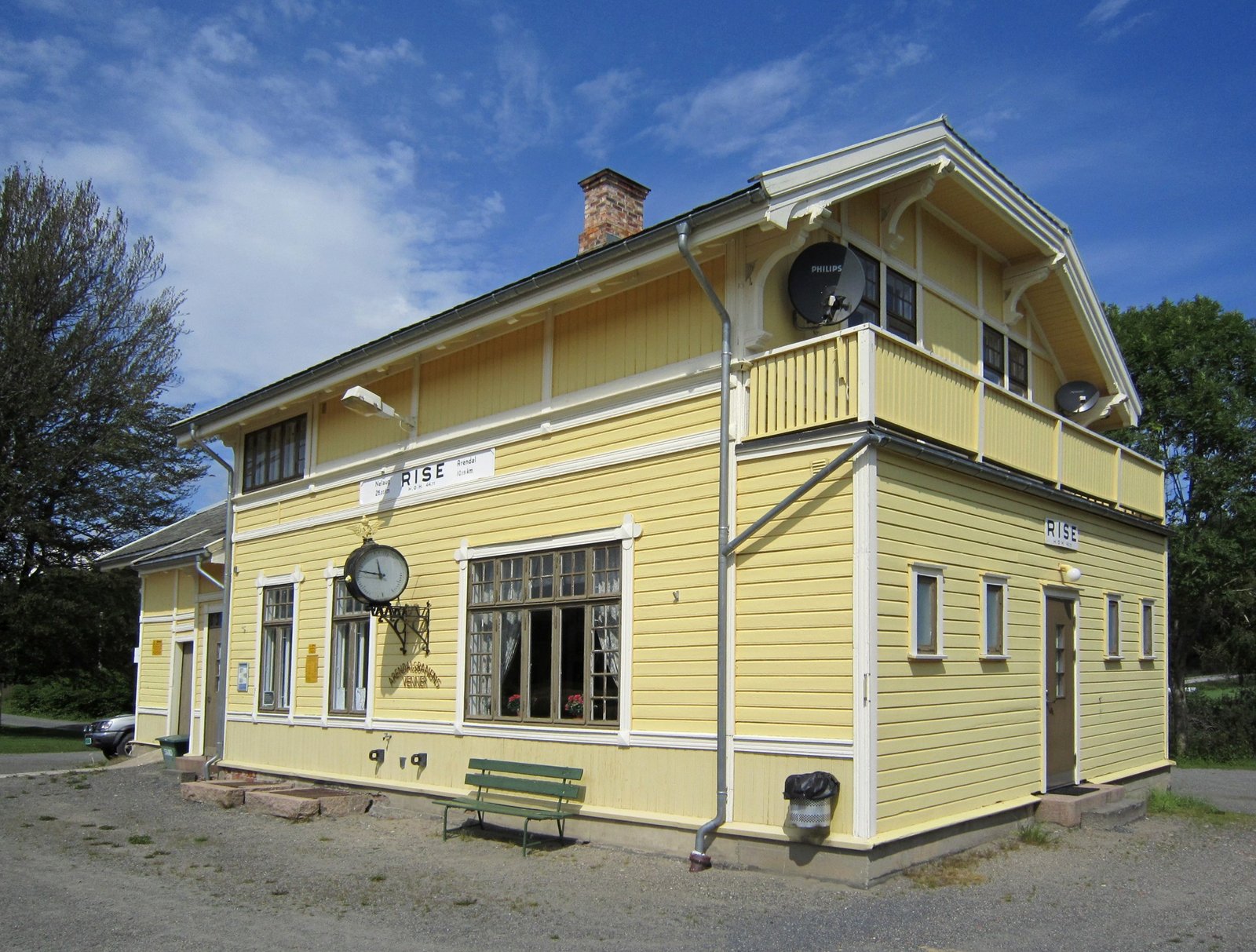
A modest railway junction in southeastern Norway that witnessed the technical transformation of Scandinavian rail infrastructure, from narrow gauge to standard track.
At a glance
Rise Station sits at the convergence of two historic railway lines in Arendal Municipality. Originally built as the terminus of the Grimstad Line, it evolved into a junction point and reflects the practical challenges of railway modernization in early 20th-century Norway.
History
The station opened in 1907 as the terminus of the Grimstad Line. In 1908, a connection to the Arendal Line transformed it into a transfer point between two rail routes. During the 1930s, both lines underwent conversion from narrow to standard gauge; from 1935 to 1936, Rise served as a break-of-gauge station where passengers and goods transferred between different track widths. The Grimstad Line closed in 1961. By 1983, the station had become unstaffed.
What you see
The station building was designed by Paul Armin Due, the prominent Norwegian architect and railway engineer known for his station designs. The structure reflects early 20th-century Scandinavian railway architecture, though practical modernization altered its operational character over time.
Cultural significance
Rise Station documents a crucial period in Norwegian railway history: the standardization of gauge across competing regional networks. The brief years when it served as a break-of-gauge station illustrate the logistical complexity of upgrading rail infrastructure while maintaining service.
Key facts
- Country: Norway
- City: Arendal Municipality
- Opened: 1907
- Architect: Paul Armin Due
- Coordinates: 58.4684, 8.6231
- Current operator: Go-Ahead Norge
Practical information & getting there
Rise Station is located on the Arendal Line in southeastern Norway and remains an active railway station. You can access it via Go-Ahead Norge services. For detailed journey planning and schedules, consult Norwegian Railways’ official transport websites.
Sources & resources
Find it on the map
See this place and what’s around it →📷 Become a Cultural Heritage Online photographer
Share your photos of places: they stay published under your name as the author. The more they're seen, the more you get noticed — and soon a contest will reward the most appreciated photos.
Log in or sign up free to add a photoIs this page about you?
This page is read by travellers and heritage enthusiasts who find it on Google. Tell us how you are connected to this place and we will take it from there.