
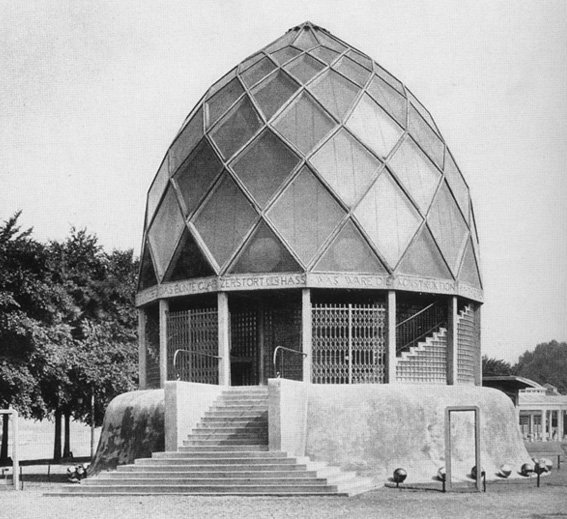
Bruno Taut’s prismatic glass dome—a luminous “temple of beauty” that demonstrated glass as both material and spiritual catalyst—stood for a single season at the 1914 Cologne Deutscher Werkbund Exhibition before vanishing into architectural legend.
At a glance
A fourteen-sided polygonal structure clad in thick glass bricks, the Glass Pavilion rose as a pineapple-shaped cupola from a concrete plinth. Its double-layered dome housed colored glass prisms that fractured sunlight into cascading hues, from deep blue at the base through moss green and golden yellow to pale luminescence at the apex. Inside, glass-treaded staircases descended past a seven-tiered waterfall lit from beneath, creating the sensation of moving through crystalline water.
History
Designed and built by Bruno Taut in 1914 for the German glass industry association, the pavilion served a singular purpose: to demonstrate glass’s architectural potential at the Deutscher Werkbund Exhibition in Cologne. The structure was financed as a “house of art” intended to show how the material could orchestrate human emotion and contribute to what Taut envisioned as a spiritual utopia.
The pavilion was demolished shortly after the exhibition closed. It was always temporary—a vision made manifest for one season only. Only black-and-white photographs from 1914 survive, inadequate documents of a building whose essence was colored light.
What you see
The Glass Pavilion was the first building of architectural importance constructed entirely from glass bricks. Its fourteen-sided base rose without a single rectangle, each facet echoing the complex geometry of the natural world. The facade featured inlaid colored glass plates that functioned as mirrors, fragmenting and reflecting the external environment.
Taut’s interior design created an immersive chromatic experience. Prisms cast colored rays from sunlight across floor-to-ceiling mosaic glass walls. The seven-tiered cascade with underwater lighting dominated the lower chamber, while spiral staircases ascended to an upper projection room—itself a kaleidoscope of refracted color.
Cultural significance
The Glass Pavilion embodied Expressionist ideals at the height of the movement’s influence in Germany. It represented a radical belief: that architecture could transcend utility and function as spiritual instrument. Taut’s companion in this vision was the anarcho-socialist writer Paul Scheerbart, whose aphoristic poems—”Colored glass destroys hatred,” “Without a glass palace, life is a conviction”—were inscribed as a frieze around the structure.
In 1914, Scheerbart published Glasarchitektur (“Architecture in Glass”), dedicated to Taut, while Taut founded the magazine Frühlicht (“Dawn’s Light”) to propagate Expressionist doctrine centered on glass’s spiritual iconography. The pavilion stands as the physical and philosophical apex of this collaboration—a building conceived in the spirit of Gothic cathedrals, rooted in the luminous traditions of Solomon’s Temple.
Key facts
- Location: Deutz, Cologne, Germany (50.9336°N, 6.98601°E)
- Built: 1914
- Architect: Bruno Taut
- Exhibition: Cologne Deutscher Werkbund Exhibition
- Material: Concrete, glass bricks, colored and reflective glass
- Form: Fourteen-sided polygonal dome, pineapple-shaped
- Status: Demolished after 1914 exhibition
Practical information & getting there
The Glass Pavilion no longer exists. It stood in the Deutz district of Cologne during the 1914 Deutscher Werkbund Exhibition and was dismantled afterward. Visitors interested in the work must consult historical photographs and documentary sources. The Cologne region remains rich in early twentieth-century architecture and design heritage.
Sources & resources
Find it on the map
See this place and what’s around it →📷 Become a Cultural Heritage Online photographer
Share your photos of places: they stay published under your name as the author. The more they're seen, the more you get noticed — and soon a contest will reward the most appreciated photos.
Log in or sign up free to add a photoIs this page about you?
This page is read by travellers and heritage enthusiasts who find it on Google. Tell us how you are connected to this place and we will take it from there.