
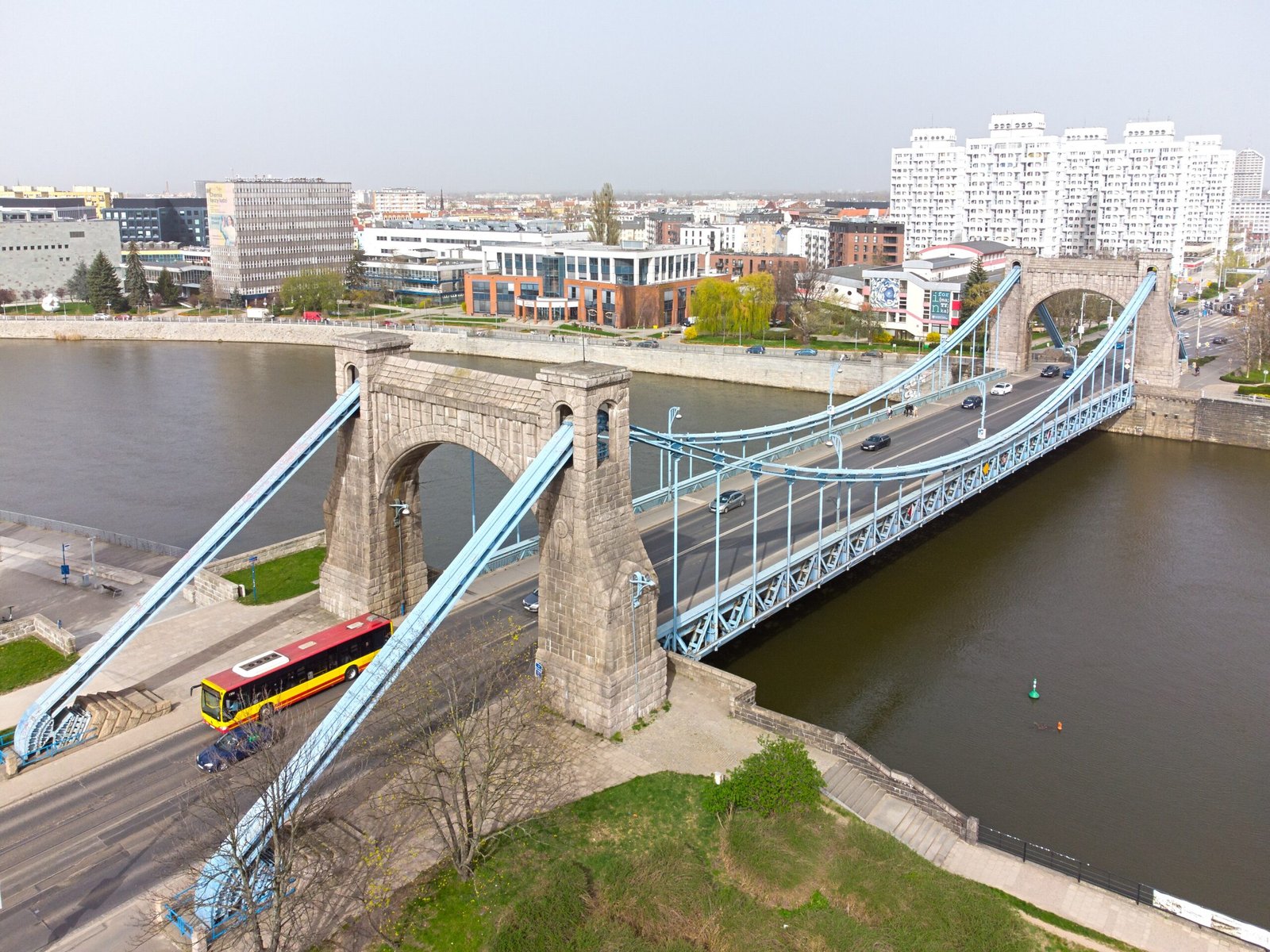
A steel suspension bridge spanning the Oder River, this early-twentieth-century structure exemplifies Prussian engineering and Wrocław’s industrial heritage. Opened by Emperor Wilhelm II in 1910, it remains one of Poland’s longest spans of its kind.
At a glance
The Grunwald Bridge carries pedestrians and a streetcar line across the Oder in central Wrocław. Built as the Imperial Bridge during the German occupation of Silesia, it has survived two centuries of urban change and wartime damage to become a symbol of the city’s layered history.
History
Construction began in 1908 under the direction of city councilor Richard Plüddemann, whose design established the bridge’s distinctive character. The structure opened on 10 October 1910 in a ceremony attended by Emperor Wilhelm II, underscoring its significance to the Prussian state. Originally named the Imperial Bridge (Kaiserbrücke), it was later renamed the Bridge of Freedom (Freiheitsbrücke) before finally adopting its current Polish name after the Second World War. World War II left the bridge severely damaged, but it was repaired and reopened in September 1947, allowing traffic to resume across the Oder.
What you see
The suspension bridge measures 112.5 meters in length and 18 meters in width, carrying its 2,300-ton weight with engineering precision. Built from Silesian granite, the structure displays the robust aesthetic of early-twentieth-century industrial design, blending functional form with the regional stone that grounds it in local geology.
Cultural significance
The bridge exemplifies the architectural ambitions of Wrocław during the Prussian era, a period when the city was expanding and modernizing its infrastructure. Its survival and restoration after 1947 reflect postwar commitment to preserving the built environment despite political and territorial upheaval.
Key facts
- Location: Wrocław, Poland (51.109°N, 17.053°E)
- Type: Suspension bridge
- Length: 112.5 meters
- Width: 18 meters
- Weight: 2,300 tons
- Completed: 1910
- Designer: Richard Plüddemann
- Material: Silesian granite
- Current use: Pedestrian and streetcar traffic
Practical information & getting there
The bridge is accessible on foot and by streetcar in central Wrocław. For current transit schedules and visitor information, consult local Wrocław tourism resources.
Sources & resources
Find it on the map
See this place and what’s around it →📷 Become a Cultural Heritage Online photographer
Share your photos of places: they stay published under your name as the author. The more they're seen, the more you get noticed — and soon a contest will reward the most appreciated photos.
Log in or sign up free to add a photoIs this page about you?
This page is read by travellers and heritage enthusiasts who find it on Google. Tell us how you are connected to this place and we will take it from there.