

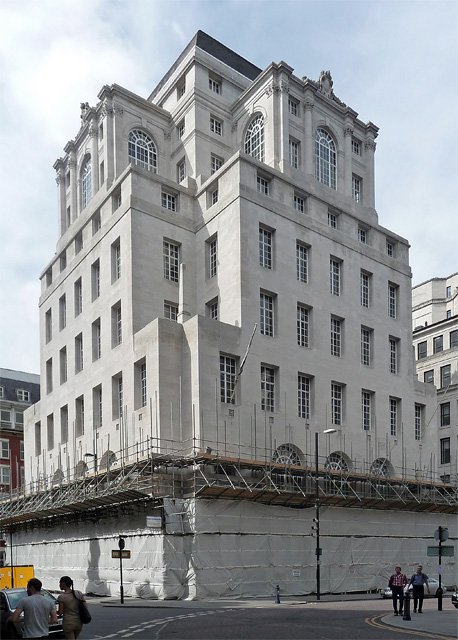
A masterwork of early-twentieth-century banking architecture, this former Midland Bank headquarters exemplifies Sir Edwin Lutyens’ classical restraint and precision applied to commercial design.
At a glance
Originally built as the regional centre of the Midland Bank, 100 King Street stands as Lutyens’ most significant architectural contribution to Manchester. The building was completed between 1933 and 1935, following designs he prepared three years earlier. Its Grade II* listing recognises its exceptional quality within the city’s heritage landscape.
History
Lutyens conceived the design in 1928, during his peak years of practice. Construction took place over two years from 1933 to 1935, a period of economic challenge in Britain. The building served the Midland Bank’s operations for decades, reflecting the institution’s prominence in Manchester’s financial district. In 1974, the structure gained Grade II* listed status, acknowledging its architectural significance.
What you see
The building demonstrates Lutyens’ refined approach to classical design principles adapted for modern commercial purposes. His characteristic attention to proportion and detail is evident throughout the structure. The design balances monumentality with accessible urbanism on a busy city street.
Cultural significance
As Lutyens’ major Manchester work, the building represents a crucial moment when leading British architects engaged with commercial and industrial cities beyond London. It stands among the finest examples of interwar banking architecture in northern England.
Key facts
- Location: Manchester, United Kingdom
- Coordinates: 53.4806, -2.2422
- Designed by: Sir Edwin Lutyens (1928)
- Constructed: 1933–35
- Listed status: Grade II* (1974)
Practical information & getting there
The building is located on King Street in Manchester’s city centre, readily accessible by public transport. As a Grade II* listed structure, it remains visible from the street and forms part of Manchester’s architectural heritage walk.
Sources & resources
Find it on the map
See this place and what’s around it →📷 Become a Cultural Heritage Online photographer
Share your photos of places: they stay published under your name as the author. The more they're seen, the more you get noticed — and soon a contest will reward the most appreciated photos.
Log in or sign up free to add a photoIs this page about you?
This page is read by travellers and heritage enthusiasts who find it on Google. Tell us how you are connected to this place and we will take it from there.