
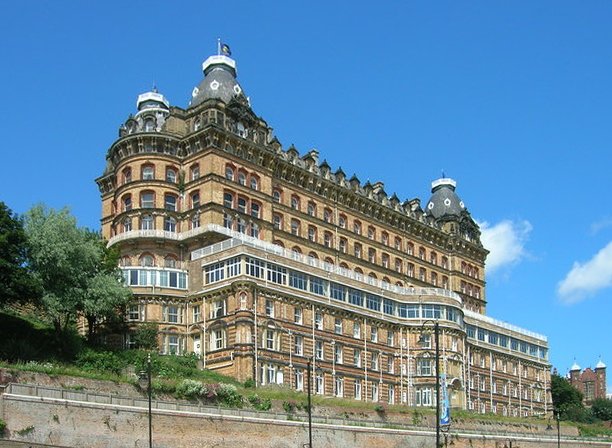
Grand Hotel, Scarborough
When it opened in 1867, this brick-and-terracotta colossus on St Nicholas Cliff was reckoned the largest hotel in Europe: Cuthbert Brodrick’s domed seaside palace, set to survey Scarborough’s South Bay.
At a glance
The Grand Hotel dominates the cliff above Scarborough’s South Bay, a vast wedge of ochre brick and terracotta that has faced the North Sea since 1867. It was designed by Cuthbert Brodrick (1821–1905), the Hull-born architect of Leeds Town Hall, for the Scarborough Cliff Hotel Company. At its opening it was reckoned among the largest hotels — and one of the largest brick buildings — in Europe. Four corner towers carry lead domes. A rusticated base anchors storeys of round-headed windows and continuous iron balconies. It survives today as a Grade II* listed landmark, still trading as a hotel and still, unmistakably, the biggest thing on the seafront.
Key facts
- Opened: 24 July 1867 (built 1863–67, at a cost of around £100,000)
- Architect: Cuthbert Brodrick, 1821–1905
- Developer: the Scarborough Cliff Hotel Company
- Style & materials: a French-influenced grand manner in red and tawny brick with terracotta dressings
- Scale: among the largest hotels in Europe at its opening; roughly 121 ft (37 m) high, said to use some six million bricks
- Protection: Grade II* listed (first listed 8 June 1973; Historic England entry 1243163)
- Now: operated by Britannia Hotels
History
Scarborough was Britain’s original seaside resort, a spa town where visitors had taken the waters since the seventeenth century. The railway reached it in 1845 and the crowds followed. To capture them, the Scarborough Cliff Hotel Company bought the commanding site on St Nicholas Cliff and engaged Cuthbert Brodrick, fresh from the triumph of Leeds Town Hall. Work began in 1863. The build was long and expensive, the company’s money ran short before it was finished, and a Leeds businessman took the project on to see it through. The hotel opened on 24 July 1867.
Brodrick’s brief was scale, and he answered it. The plan is laid out in a broad V, a flourish said to honour Queen Victoria. The design is also said to have been conceived around the theme of time: four domed towers for the seasons, twelve floors for the months, fifty-two chimneys for the weeks, and — when it opened — 365 bedrooms, one for each day of the year. Whether or not every part of that scheme was intended, the ambition is real: contemporaries counted the Grand among the largest and most advanced hotels anywhere in Europe.
The building has outlasted a turbulent century. On 16 December 1914 German warships shelled Scarborough, and the Grand was among the structures struck. It served other purposes in wartime, weathered the long postwar decline of the English seaside holiday, and saw its original 365 rooms reconfigured over successive refurbishments. Britannia Hotels took ownership in 2004. Through every change of fortune the great domed silhouette has stayed put, the fixed point of Scarborough’s skyline.
What you see
From the foreshore the hotel reads as a single enormous mass, its long facade stepping across the cliff. A rusticated basement grounds the composition. Above it run tiers of round-headed windows tied together by a continuous iron-railed balcony, then an ornamental cornice, and finally the tall two-storey domes that rise from a brick-and-terracotta attic at each corner. The tawny terracotta dressings stand out warm against the darker body of the brick. It is Victorian confidence built in millions of bricks.
The siting does half the work. Brodrick set the hotel into the slope of St Nicholas Cliff, so the building climbs from beach level to the town above and looks far taller from the sands than from the street. The four domes form a signature visible right across South Bay. Approach from the Cliff Bridge and the scale sharpens with every step; the Grand does not reveal itself gradually so much as fill the view.
Practical information
- Operating as a hotel under Britannia Hotels; interiors are for guests, but the exterior can be seen at any time from the seafront and St Nicholas Cliff.
- Location: St Nicholas Cliff, above South Bay, in central Scarborough.
- Time needed: 10–15 minutes to walk the exterior and the cliff approach; longer if you are staying.
Getting there
Scarborough railway station is about a ten-minute walk away, with direct services from York and Leeds. By road, the A64 runs from Leeds and York to the coast; the hotel sits above Foreshore Road, reached on foot across the Cliff Bridge from the town centre.
Nearby
- Scarborough Castle — the medieval headland fortress dividing the town’s two bays, a short walk north.
- Rotunda Museum — the 1829 circular museum built for the geologist William Smith, at the foot of the cliff.
- South Bay — the beach and foreshore directly below the hotel, the heart of the Victorian resort.
- Peasholm Park — the Edwardian oriental-themed pleasure park on the North Bay side.
Sources
- Historic England, list entry 1243163 — https://historicengland.org.uk/listing/the-list/list-entry/1243163
- Wikipedia, “Grand Hotel, Scarborough” — https://en.wikipedia.org/wiki/Grand_Hotel,_Scarborough
- Scarborough Civic Society, “The Grand Hotel” — https://scarboroughcivicsociety.org.uk/The-Grand.php
- Yorkshire Bylines, “So palatial a structure: the Grand Hotel Scarborough and Cuthbert Brodrick” — https://yorkshirebylines.co.uk/region/so-palatial-a-structure-the-grand-hotel-scarborough-and-cuthbert-brodrick/
- Wikidata, Q5594626 — https://www.wikidata.org/wiki/Q5594626
Find it on the map
See this place and what’s around it →📷 Diventa un fotografo di Cultural Heritage Online
Condividi le tue foto dei luoghi: restano pubblicate con la tua firma come autore. Più vengono viste, più ti fai conoscere — e presto un concorso premierà le foto più apprezzate.
Accedi o registrati gratis per aggiungere una fotoDo you manage this place?
This page is read by travellers and heritage enthusiasts who find it on Google. Keep it accurate — and make it work for you. Free for non-profit heritage institutions.