
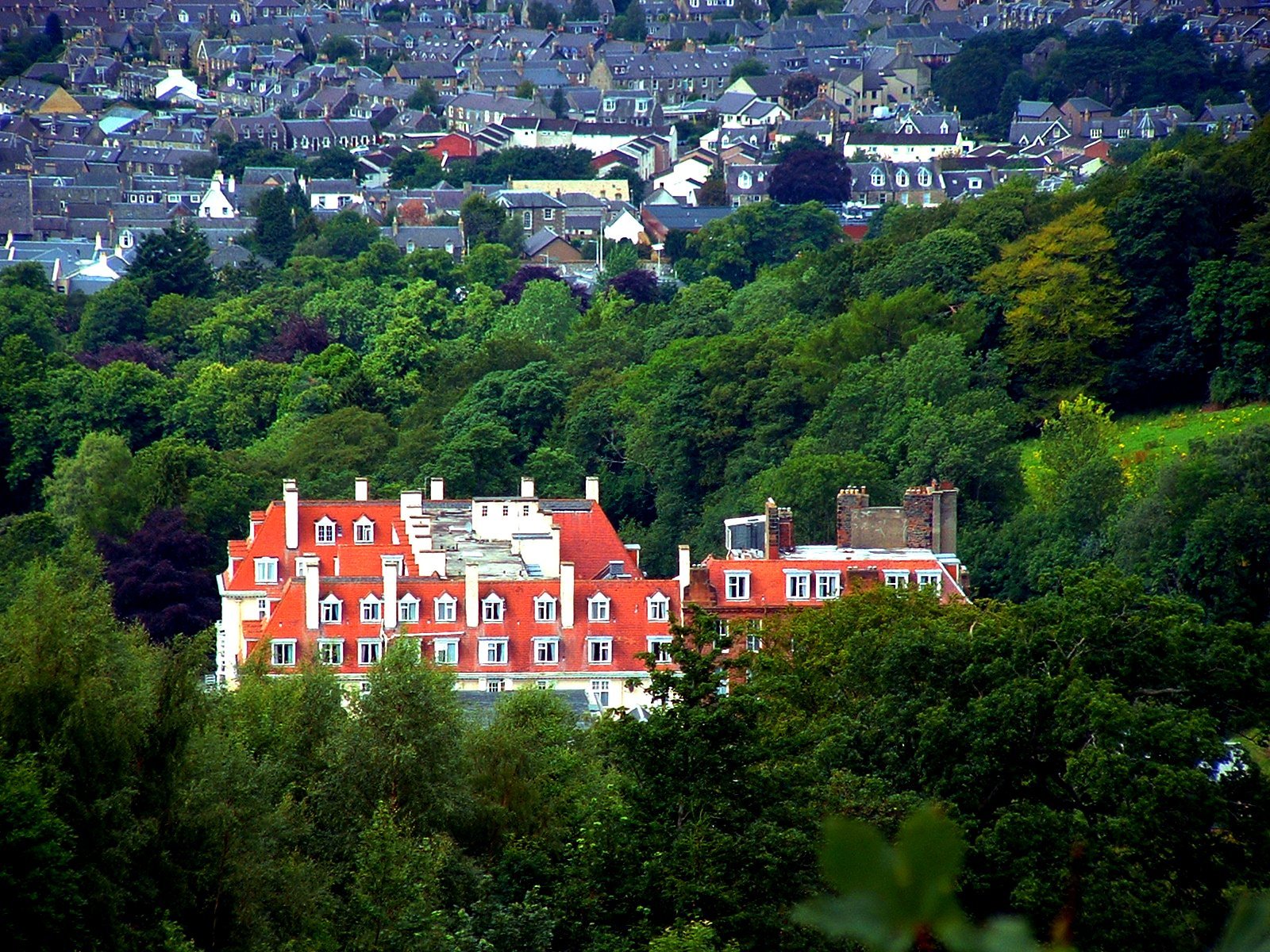
A grand survivor of Scotland’s water-cure age, Peebles Hydro rebuilt itself from ash in two years after fire gutted the original hydropathic in 1905.
At a glance
Peebles Hydro stands on the wooded slopes above the River Tweed, on the north-eastern edge of the Scottish Borders town of Peebles. The present hotel is a category B listed building designed by the Scottish architect James Miller (1860–1947) and completed between 1905 and 1907, replacing an earlier hydropathic destroyed by fire. Its long cream-harled front, red roofs and columned porte-cochere read unmistakably as Edwardian resort architecture. The Hydro is one of the few surviving Victorian hydropathic hotels in Scotland, and is now owned by Crieff Hydro. More than a century after the water cure fell out of fashion, it still trades as a large country-house resort.
Key facts
- Location: Innerleithen Road, Peebles, Scottish Borders, EH45 8LX
- Architect (present building): James Miller (1860–1947)
- Built: 1905–1907, after the 1905 fire
- Original hydropathic: opened 1881, designed by John Starforth (d. 1898)
- Style: Queen Anne; three storeys with double attic; cream harl
- Designation: Category B listed (HES ref LB39220, first listed 1978)
- Rooms: 132; operated today by Crieff Hydro
History
The hydropathic movement carried the Continental water cure into Victorian Britain, and by the 1880s grand “hydros” were rising across Scotland, offering cold baths, douches and temperance regimens in a resort setting. The first Peebles Hydropathic opened in 1881, built for the Hydropathic Company to a design by John Starforth (d. 1898), a pupil of the Edinburgh architect David Bryce. Work had begun in 1878, and the building cost more than £70,000.
In July 1905 fire tore through the hydro, reportedly starting from an electrical fault in the roof space and gutting Starforth’s building. Rebuilding was swift. James Miller — then at the height of a career that produced Wemyss Bay station and the Turnberry and Gleneagles hotels — designed the replacement, which reopened in 1907. Salvaged squared and snecked red sandstone from the 1881 hydro survives in the rear elevation, and the more moderate cost, put at around £37,000, reflected the reuse of stone.
War interrupted the hotel twice. The Hydro served as a naval hospital during the First World War, and in 1939 the Royal Army Medical Corps requisitioned it as a military hospital of some 1,200 beds, with operating theatres and an X-ray department. It returned to hotel use in 1946.
What you see
Miller gave Peebles Hydro the symmetry and confidence of an Edwardian resort palace. An eleven-bay principal front runs along the hillside, its ends breaking forward as projecting pavilions, with a porte-cochere carried on Tuscan columns marking the entrance. Cream harl covers the walls beneath the building’s distinctive red roofs, a combination that has long made the hotel a landmark visible from across the valley. Three storeys rise to a double attic, the scale deliberately generous for a house built to lodge hundreds of cure-seekers at once.
The hillside setting is half the drama. The Hydro sits high on Innerleithen Road amid terraced grounds with steps, a fountain and stone urns, looking out over the Tweed and the surrounding hills. Inside, the listed interiors keep set-pieces from both the resort’s heyday and its rebuilding: the Bannockburn Room retains panelling and a Baronial plaster ceiling beneath a mural of the battle, while a ballroom survives with elaborate plasterwork and Ionic pilasters.
Practical information
- Operating hotel: Peebles Hydro is a working resort; its interiors are open to guests and to visitors using the restaurants, spa and function rooms.
- Grounds: extensive terraced grounds and woodland; the exterior and hillside setting can be appreciated from the public road and nearby paths.
- Time needed: 20–30 minutes for the exterior and grounds; longer for a meal, a spa visit or an overnight stay.
Getting there
Peebles lies about 23 miles (37 km) south of Edinburgh in the valley of the Tweed. The town has no railway station, so access is by road: regular buses run from Edinburgh, and by car the A703 and A701 connect the town to the city and the wider Borders. The Hydro is signposted on Innerleithen Road, on the north-eastern edge of Peebles.
Nearby
- Neidpath Castle — a medieval tower house on a bluff above the Tweed, about a mile west of Peebles.
- Tweed Valley — riverside walks and the Glentress Forest mountain-biking trails on the town’s doorstep.
- Traquair House — near Innerleithen, said to be the oldest continuously inhabited house in Scotland.
Sources
- Historic Environment Scotland, listed building record LB39220 — http://portal.historicenvironment.scot/designation/LB39220
- Wikipedia, “Peebles Hydro” — https://en.wikipedia.org/wiki/Peebles_Hydro
- Wikipedia, “James Miller (architect)” — https://en.wikipedia.org/wiki/James_Miller_(architect)
- Wikidata Q7160140 — https://www.wikidata.org/wiki/Q7160140
- Peeblesshire News, “Checking in for a history of the Peebles Hydro Hotel” — https://www.peeblesshirenews.com/news/15708935.checking-in-for-a-history-of-the-peebles-hydro-hotel/
Find it on the map
See this place and what’s around it →📷 Become a Cultural Heritage Online photographer
Share your photos of places: they stay published under your name as the author. The more they're seen, the more you get noticed — and soon a contest will reward the most appreciated photos.
Log in or sign up free to add a photoIs this page about you?
This page is read by travellers and heritage enthusiasts who find it on Google. Tell us how you are connected to this place and we will take it from there.