
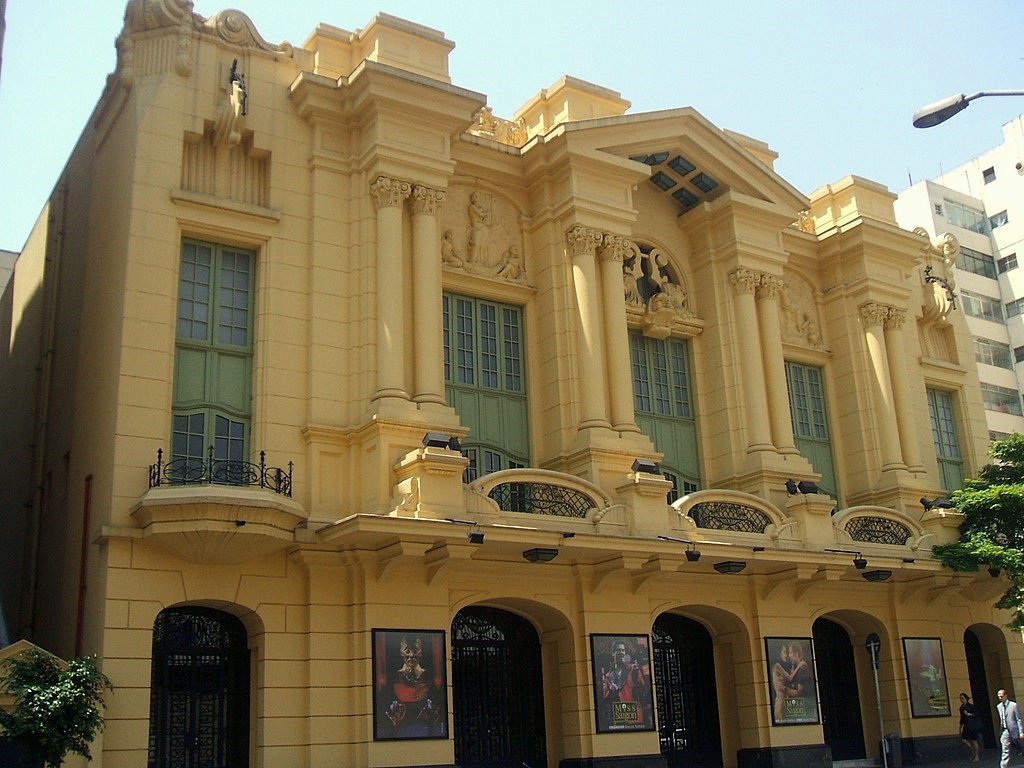
Teatro Renault (Teatro Paramount)
On Avenida Brigadeiro Luís Antônio stands a theater that has changed names as often as it has changed fortunes, surviving fire, decades of neglect and a corporate rebrand to remain one of São Paulo’s working stages.
At a glance
Opened in 1929 as the Paramount Theater, this Art Deco venue in the República district was Latin America’s first sound cinema. It has since operated under three names — Paramount, Abril and, since 2012, Renault — while its original foyer and facade endure beneath later rebuilding.
History
Paramount Pictures commissioned the building in 1927 on the site of the old wooden Palace Theatro. Engineer Arnaldo Maia Lello worked alongside architects Francisco Augusto da Silva Rocha and Francisco de Paula Ramos de Azevedo, blending art deco with eclectic detailing. It opened in April 1929 with a screening of The Patriot before a crowd that included Paramount’s own foreign-department representative. A speech that night, carried by the Movietone system, became the first sound broadcast in Latin America. The hall later hosted symphony concerts, carnival balls, and in the 1960s Rede Record’s O Fino da Bossa and the 1967 Festival de Música Popular Brasileira, drawing Caetano Veloso, Chico Buarque and Gilberto Gil. Fire tore through the building in 1969. Only the foyer and facade survived, and São Paulo’s city hall later protected both as heritage. The theater closed in 1996, unable to compete with mall multiplexes, before a 2001 restoration by CIE Brasil and Grupo Abril rebuilt the stage entirely. A 2012 naming-rights deal with Renault gave the venue its current title.
What you see
The street facade still reads as 1929. Inside, restoration replaced what fire took. The stage now measures 225 square meters and rises 10 meters, with a further 15 meters of clearance above to store scenery canvases flat, unrolled. The orchestra pit spans 86 square meters and seats up to 80 musicians. Total capacity reaches 1,552, split between audience floor, balcony and boxes. An annex added in 2001 holds the box office, a souvenir shop and a café, wrapping practical function around the historic core.
Cultural significance
Few São Paulo venues carry this much layered memory. The theater’s opening night marked a technological milestone for the region’s cinema. Its later decades tracked the city’s own cultural shifts, from bossa nova television to Tropicália-era songwriters performing live. Today it functions as a commercial musical house, staging productions like The Lion King, yet its protected foyer and facade keep one thread of the 1929 building visible to every visitor who walks in.
Key facts
- Opened April 1929 as the Paramount Theater
- Design: engineer Arnaldo Maia Lello with architects Francisco Augusto da Silva Rocha and Francisco de Paula Ramos de Azevedo
- Style: Art Deco with eclectic elements
- First sound cinema in Latin America
- Fire in 1969 destroyed all but the foyer and facade
- Restored and reopened in 2001 as Teatro Abril
- Renamed Teatro Renault in 2012
- Current capacity: 1,552 seats
Practical information & getting there
The theater sits on Avenida Brigadeiro Luís Antônio in the República district, central São Paulo. You’ll find it well served by the city’s metro and bus network, in a neighborhood dense with other historic cinemas and theaters. Programming runs to touring musicals and large-scale productions, so check current listings before planning a visit, as the building operates as a commercial venue rather than a museum with fixed public hours.
Sources & resources
Find it on the map
See this place and what’s around it →📷 Diventa un fotografo di Cultural Heritage Online
Condividi le tue foto dei luoghi: restano pubblicate con la tua firma come autore. Più vengono viste, più ti fai conoscere — e presto un concorso premierà le foto più apprezzate.
Accedi o registrati gratis per aggiungere una fotoDo you manage this place?
This page is read by travellers and heritage enthusiasts who find it on Google. Keep it accurate — and make it work for you. Free for non-profit heritage institutions.