
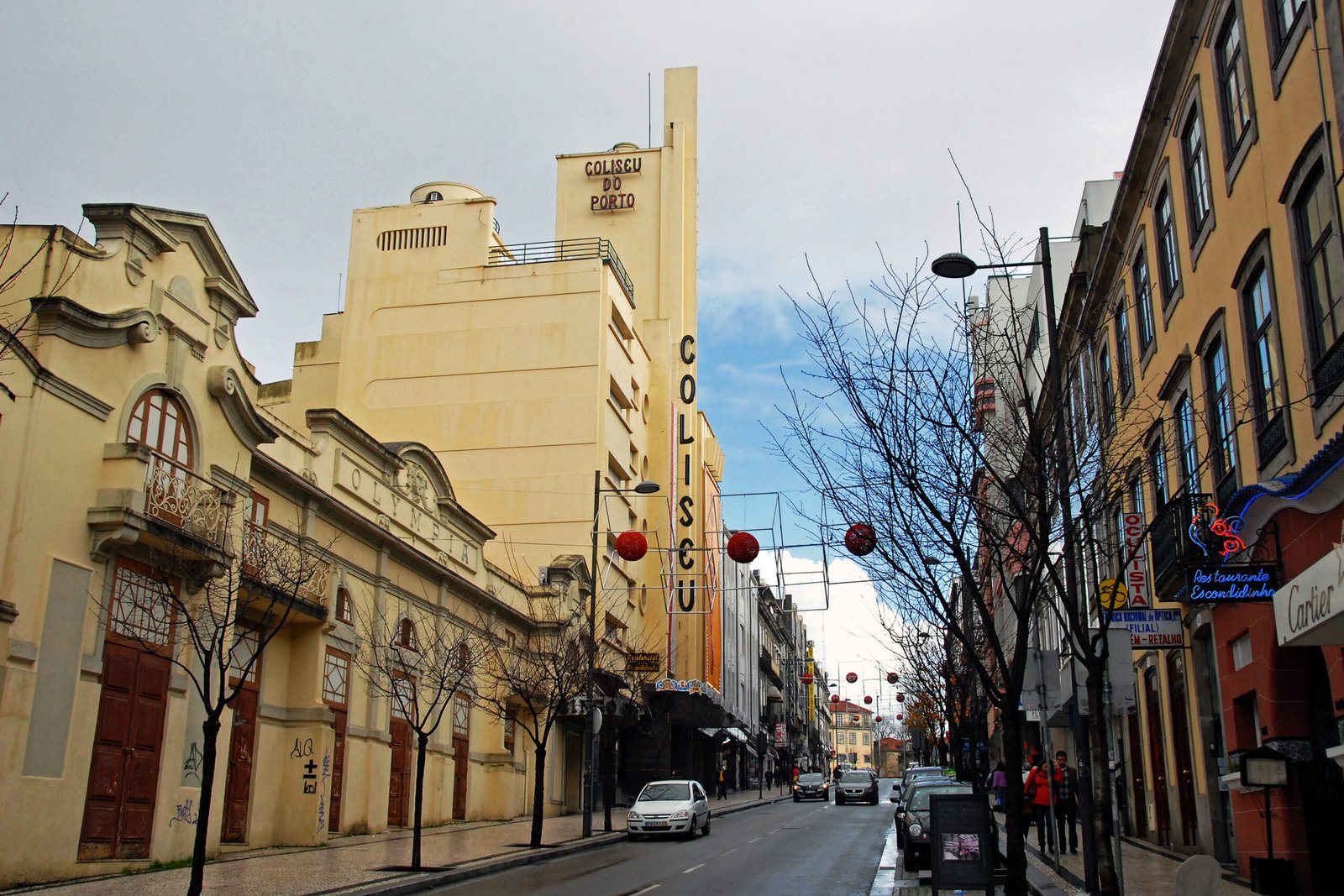
A vast Art Deco auditorium built on the site of a demolished Edwardian pleasure garden, the Coliseu do Porto has hosted the city’s concerts, circuses and civic dramas since 1941.
At a glance
Standing on a steep east-west slope in central Porto, the Coliseu holds up to 4,000 people standing or 3,000 seated across stalls, dress circle, boxes and gallery. A smaller Ático Room seats 300 for conferences and intimate performances. The building is legally protected as a Property of Public Interest and remains the city’s principal venue for large-scale music and theatre.
History
The story begins earlier, in 1908, when the Garden-hall Passos Manuel opened as Porto’s first grand public hall, complete with gardens, luminous fountains and a small theatre. Demand outgrew it. By 1937 plans for a modern replacement were underway, and the old hall was shuttered and demolished the following year. The new project passed through several hands. Architect José Porto abandoned it. Dutch architect Jan Wils produced designs that went unused. Júlio de Brito’s plans were rejected by Porto’s building commission, though he stayed involved through his ties to the site’s insurance-company owner. Cassiano Branco took over as principal architect in 1939, with Brito assisting; Parisian theatre designer Charles Ciclis contributed interior work, though apparently only his candelabras and doors survived into the final building. It opened on 19 December 1941. Tastes shifted again. By 1971 the hall had become a cinema. In 1995 its sale to the Brazilian church IURD provoked public outrage, prompting a citizens’ association and the municipal council to buy the building back the following year. A fire during an event soon after gutted the stage and dressing rooms; the hall reopened within months. Heritage classification, first proposed in 1981, was finally confirmed in 2010. Since 2015 the Balleteatro company has been in residence, and in 2022 the city council approved a private concession for its management.
What you see
The Coliseu sits wedged between neighbours, addorsed to the Olímpia Cinema and flanked by four-storey residential blocks, opposite a modernist garage. Its facade and interior belong firmly to Portuguese Streamline Moderne and Art Deco, all curved lines and disciplined ornament. Inside, tiers of seating rise steeply toward the gallery, a legacy of the acoustic and sightline overhaul carried out between 1997 and 2001. That renovation also added a second orchestra pit and a hydraulic lifting platform, thirteen metres wide, allowing the stage floor to become a circus ring. Little remains visible of the original 1908 garden hall; what survives is the confident, functional geometry of the 1941 rebuild.
Cultural significance
Together with Batalha Cinema, the Coliseu anchors Porto’s modern architectural identity downtown. It is not a museum piece. The building functions as a working venue, its history entangled with the city’s civic pride. The 1995 sale attempt, and the public revolt it triggered, turned the Coliseu into a symbol of collective ownership over shared heritage, uniting artists, officials and residents against its loss.
Key facts
- Location: central Porto, Portugal
- Principal architect: Cassiano Branco, with Júlio de Brito
- Opened: 19 December 1941
- Style: Art Deco / Streamline Moderne
- Capacity: up to 4,000 standing, 3,000 seated; Ático Room seats 300
- Heritage status: classified Property of Public Interest
Practical information & getting there
The Coliseu sits within Porto’s historic centre, reachable on foot from the city’s main squares and metro stations. Check the official website before visiting, since the hall runs a rotating program of concerts, theatre and circus rather than fixed opening hours. Because seating configurations change between events, arrive with your ticket details confirmed.
Sources & resources
Find it on the map
See this place and what’s around it →📷 Become a Cultural Heritage Online photographer
Share your photos of places: they stay published under your name as the author. The more they're seen, the more you get noticed — and soon a contest will reward the most appreciated photos.
Log in or sign up free to add a photoIs this page about you?
This page is read by travellers and heritage enthusiasts who find it on Google. Tell us how you are connected to this place and we will take it from there.