
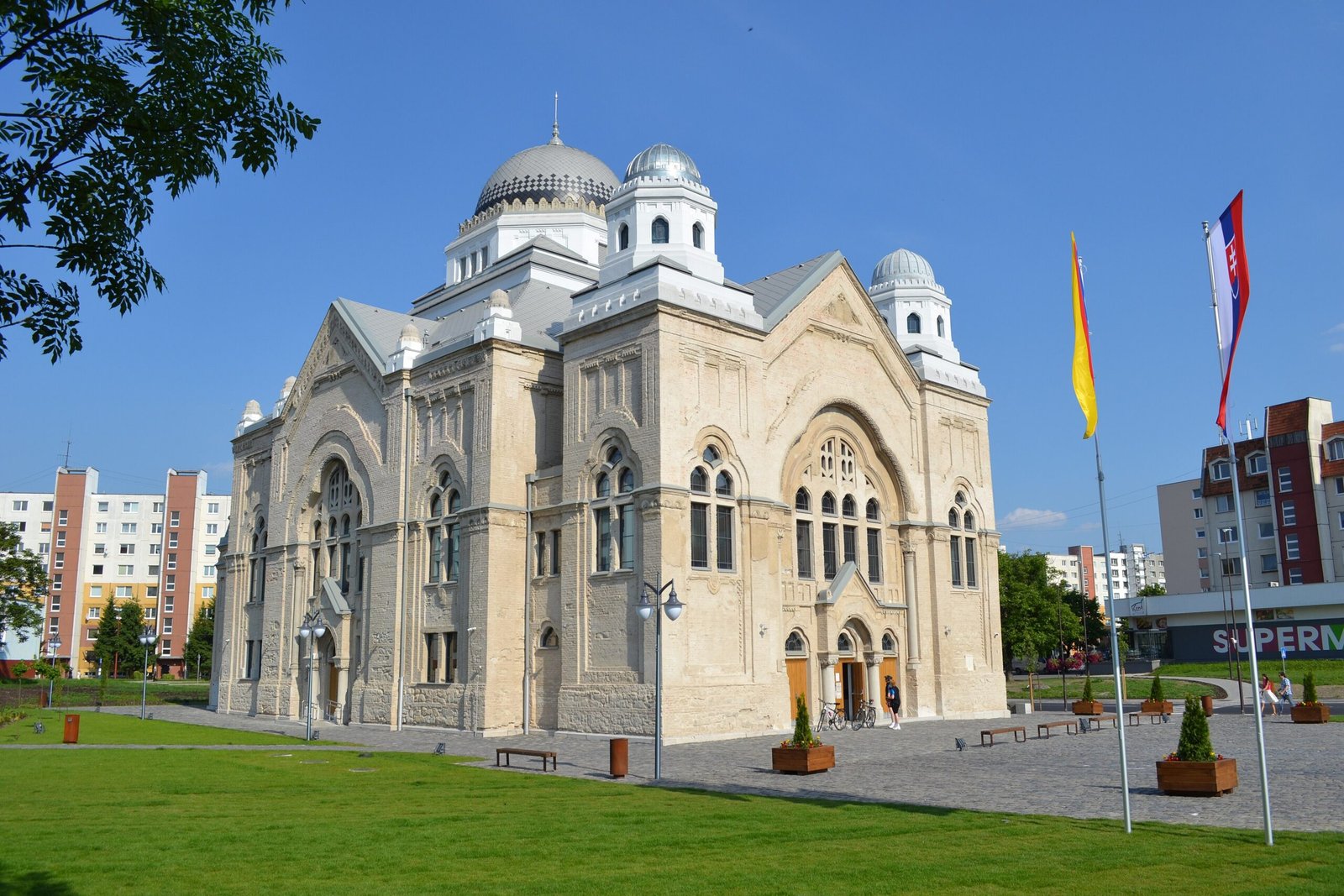
A domed Art Nouveau landmark by Lipót Baumhorn, built for a thriving Neolog Jewish community and reborn, after decades of ruin, as a cultural quarter.
At a glance
The Lučenec Synagogue stands as one of Slovakia’s most striking Secession-style buildings, designed by the Hungarian architect Lipót Baumhorn. Completed in 1925, it once seated up to 1,100 worshippers beneath a lightweight reinforced-concrete dome. Decades of neglect followed the Holocaust and communist-era misuse. Today the restored building operates as the Lučenec Cultural Quarter, hosting concerts, exhibitions and civic events.
History
Baumhorn was commissioned to replace an older synagogue that had stood on the site since 1863 and had fallen into disrepair. Construction cost around 1.5 million Kčs. The building opened on 8 September 1925. It served the Neolog congregation until 1944, when its interior was destroyed. The community’s last rabbi, Arthur Rashovsky, was killed at Auschwitz after Lučenec’s Jews were deported there on 12 June 1944. Partial repairs followed the war, but the building’s fortunes soon worsened. Around the 1960s it became a warehouse for synthetic fertilizers, and the chemicals badly damaged its fabric. By 1980 it stood empty. It gained heritage protection in 1985, yet continued to deteriorate for decades afterward.
What you see
The synagogue’s silhouette is dominated by its dome, an ambitious structural feat for its time. Baumhorn used reinforced concrete to achieve a lightness unusual among synagogues of the era. Ornamental Secession detailing wraps the exterior, blending Jewish liturgical form with the sinuous lines fashionable across early twentieth-century Central Europe. Inside, the vast open hall once designed to hold over a thousand worshippers now serves theater performances, concerts and exhibitions. Little historic decoration survives inside. What remains is largely the architectural envelope itself, carefully stabilized and reopened for public use.
Cultural significance
The synagogue is a physical trace of a Jewish community erased by deportation. Its reconstruction, completed between 2014 and 2015, transformed a derelict monument into a living civic space without erasing that history. The €2.5 million project, largely funded by a €2.4 million EU grant, reopened the building on 13 May 2016. In 2019 it even hosted a touring exhibition of Chinese terracotta soldiers, a striking sign of its new international role. For Slovakia, the building now bridges memory and contemporary cultural life.
Key facts
- Architect: Lipót Baumhorn
- Style: Art Nouveau (Secession)
- Completed: 1925 (opened 8 September 1925)
- Original capacity: up to 1,100 worshippers
- Heritage status: National Cultural Monument, listed 1985
- Reconstruction: 2014–2015, reopened 13 May 2016 as Lučenec Cultural Quarter
Practical information & getting there
The synagogue stands in Lučenec, in the Banská Bystrica region of southern Slovakia. You can reach the town by regional train or bus from Banská Bystrica or Zvolen. The building now functions as a cultural center, hosting rotating exhibitions and performances rather than fixed religious services. Check local listings before visiting, since opening hours depend on scheduled events.
Sources & resources
Find it on the map
See this place and what’s around it →📷 Become a Cultural Heritage Online photographer
Share your photos of places: they stay published under your name as the author. The more they're seen, the more you get noticed — and soon a contest will reward the most appreciated photos.
Log in or sign up free to add a photoIs this page about you?
This page is read by travellers and heritage enthusiasts who find it on Google. Tell us how you are connected to this place and we will take it from there.