
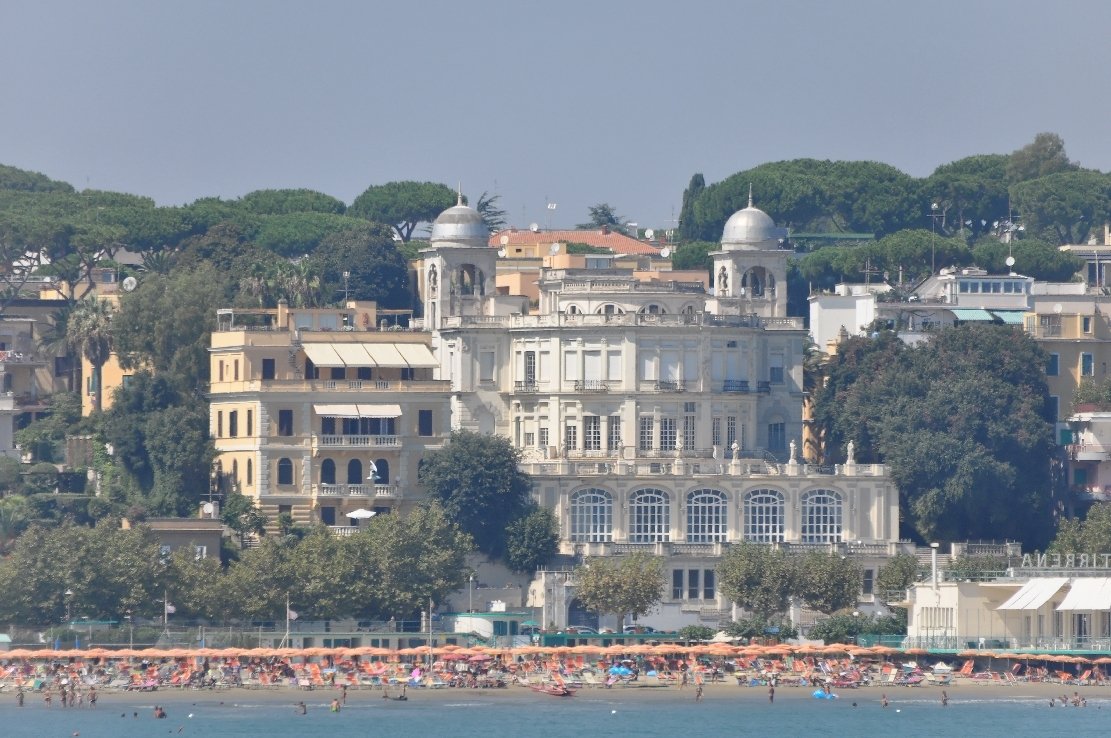
A five-story Art Nouveau palace on the Anzio shoreline, built for a casino that never opened, and later famous as a film set for Fellini and Minghella.
At a glance
Paradiso sul mare sits directly on Anzio’s promenade, its facade facing the sea. Designed by Cesare Bazzani and completed in 1924, it was conceived as a grand seaside casino. That plan collapsed. Today the municipality owns the building, which now hosts a hospitality school, exhibitions and film shoots.
History
The palace rose in the early 1920s, a period when Italian resort towns were racing to build casinos and grand hotels along the coast. Bazzani’s design gave Anzio an elaborate five-story landmark meant to anchor its seafront identity. The casino, however, was never opened. Ownership passed to the municipality, which repurposed the ornate interiors for civic and educational use rather than gaming.
What you see
The building rises five stories above the promenade, its Art Nouveau detailing visible in the facade’s curves and ornament. Rooms once intended for gamblers now serve students and exhibition visitors. The scale is generous. Light off the sea fills the interior spaces that later stood in for a grand hotel ballroom on screen.
Cultural significance
Paradiso sul mare’s afterlife in cinema has outstripped its original purpose. It appears in Alberto Sordi’s 1973 Polvere di stelle. Federico Fellini cast it as the Grand Hotel of Rimini in Amarcord, and John Alcorn’s poster for that film carries its image into wider circulation. Anthony Minghella later used it as the Sanremo Jazz Festival setting in The Talented Mr. Ripley. Local exhibitions, from photography shows to displays on the Battle of Anzio’s anniversary, have kept the palace active in civic memory. In 2013 the city marked Roger Waters’ honorary citizenship here as well.
Key facts
- Architect: Cesare Bazzani
- Completed: 1924
- Style: Art Nouveau
- Original purpose: casino (never opened)
- Current use: hospitality school, event space, exhibitions, film location
Practical information & getting there
The palace stands on Anzio’s seafront promenade, an easy walk from the town’s rail station and port. You can view the exterior freely along the shoreline path. Interior access depends on scheduled exhibitions or school events, so check local listings before visiting. Anzio itself is reachable by regional train from Rome, making the palace a feasible day trip from the capital.
Sources & resources
Find it on the map
See this place and what’s around it →📷 Become a Cultural Heritage Online photographer
Share your photos of places: they stay published under your name as the author. The more they're seen, the more you get noticed — and soon a contest will reward the most appreciated photos.
Log in or sign up free to add a photoIs this page about you?
This page is read by travellers and heritage enthusiasts who find it on Google. Tell us how you are connected to this place and we will take it from there.